
XXX
| I Ching |
|
TAB0_Magnis_augue_pellentesque_amet
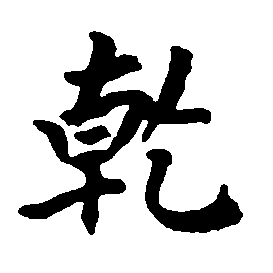 |
1. Ch’ien / The Creative
|
 |
The first hexagram is made up of six unbroken lines. These unbroken lines stand for the primal power, which is light-giving, active, strong, and of the spirit.
- The hexagram is consistently strong in character, and since it is without weakness, its essence is power or energy. Its image is heaven.
- Its energy is represented as unrestricted by any fixed conditions in space and is therefore conceived of as motion. Time is regarded as the basis of this motion.
- Thus the hexagram includes also the power of time and the power of persisting in time, that is, duration.
The power represented by the hexagram is to be interpreted in a dual sense in terms of its action on the universe and of its action on the world of men.
- In relation to the universe, the hexagram expresses the strong, creative action of the Deity.
1
1 The hexagram is assigned to the fourth month, May-June, when the light-giving power is at its zenith, i.e., before the summer solstice has marked the beginning of the year’s decline.
- The German text reads “April-May”; this is obviously a slip, for the first month of the Chinese lunar year extends approximately from the beginning of February to the beginning of March.
- New Year is a variable date, falling around February 5. Two or three other slips of this sort occurring later in the book have been similarly corrected, but without special mention.
- In relation to the human world, it denotes the creative action of the holy man or sage, of the ruler or leader of men, who through his power awakens and develops their higher nature.1
- THE CREATIVE works sublime success,
2
2 The German word used here is fördernd, literally rendered by “furthering.”
- It occurs again and again as a key word in Wilhelm’s rendering of the Chinese text.
- To avoid extreme awkwardness, the phrase “is favorable” is occasionally used as an alternative.
- Furthering2 through perseverance.
According to the original meaning, the attributes [sublimity, potentiality of success, power to further, perseverance] are paired.
- When an individual draws this oracle, it means that success will come to him from the primal depths of the universe and that everything depends upon his seeking his happiness and that of others in one way only, that is, by perseverance in what is right.
The specific meanings of the four attributes became the subject of speculation at an early date.
- The Chinese word here rendered by “sublime” means literally “head,” “origin,” “great.”
- This is why Confucius says in explaining it:
3
3 This quotation and those following are from commentary material on this hexagram appearing in bk. III.
- It will be noted here, as well as in a number of other instances, that the wording of the passages is not identical in the two books.
“Great indeed is the generating power of the Creative; all beings owe their beginning to it. This power permeates all heaven.3 For this attribute inheres in the other three as well.”
The beginning of all things lies still in the beyond in the form of ideas that have yet to become real.
- But the Creative furthermore has power to lend form to these archetypes of ideas.
- This is indicated in the word success, and the process is represented by an image from nature:
4
4 Cf. Gen. 2:1 ff., where the development of the different creatures is also attributed to the fall of rain.
“The clouds pass and the rain does its work, and all individual beings flow into their forms.” 4
Applied to the human world, these attributes show the great man the way to notable success:
“Because he sees with great clarity and cause and effects, he completes the six steps at the right time and mounts toward heaven on them at the right time, as though on six dragons.”
- The six steps are the six different positions given in the hexagram, which are represented later by the dragon symbol.
- Here it is shown that the way to success lies in apprehending and giving actuality to the way of the universe [Tao], which, as a law running through end and beginning, brings about all phenomena in time.
- Thus each step attained forthwith becomes a preparation for the next. Time is no longer a hindrance but the means of making actual what is potential.
The act of creation having found expression in the two attributes sublimity and success, the work of conservation is shown to be a continuous actualization and differentiation of form. This is expressed in the two terms:
- "Furthering” (literally, “creating that which accords with the nature of a given being”) and
- “Persevering” (literally, “correct and firm”).
“The course of the Creative alters and shapes beings until each attains its true, specific nature, then it keeps them in conformity with the Great Harmony. Thus does it show itself to further through perseverance.”
In relation to the human sphere, this shows how the great man brings peace and security to the world through his activity in creating order:
“He towers high above the multitude of beings, and all lands are united in peace.”
Another line of speculation goes still further in separating the words “sublime,” “success,” “furthering,” “perseverance,” and parallels them with the four cardinal virtues in humanity.
- To sublimity, which, as the fundamental principle, embraces all the other attributes, it links love.
5
5 “Mores” is the word chosen to render the German word Sitte, when the latter refers, as in the present instance, to what the Chinese know as li.
- However, neither “mores” nor any other available English word, such as “manners” or “customs,” conveys an adequate idea of what li stood for in ancient China, because none of them necessarily denotes anything more than behavior growing out of and regulated by tradition.
- The ideas for which li stands seem to have had their origin in a religious attitude to life and in ethical principles developing out of that attitude.
- On the religious side li meant the observance with true piety of the ritual through which the “will of heaven" was interpreted and made to prevail on earth.
On the moral side it meant the sense of propriety — understood to be innate in man — that, through training, makes possible right relationships in personal life and in society.
- Li was the cornerstone upon which Confucius built in his effort to bring order out of chaos in his era (see The Sacred Books of the East, XXVII: The Li Ki.
- Obedience to the code of li was entirely self-imposed as regards the “superior man,” who in feudal times was always a man of rank.
- The conduct of the inferior man — the lower-class individual — was governed by law
- To the attribute success are linked the mores,5 which regulate and organize expressions of love and thereby make them successful.
- The attribute furthering is correlated with justice, which creates the conditions in which each receives that which accords with his being, that which is due him and which constitutes his happiness.
- The attribute perseverance is correlated with wisdom, which discerns the immutable laws of all that happens and can therefore bring about enduring conditions.
6
6 See Book II, page 259. The text of the Wên Yen (Commentary on the Words of the Text) appears in Book. III.
These speculations, already broached in the commentary called Wên Yen,6 later formed the bridge connecting the philosophy of the “five stages (elements) of change,” as laid down in the Book of History (Shu Ching) with the philosophy of the Book of Changes, which is based solely on the polarity of positive and negative principles.
7
7 The Creative causes the beginning and begetting of all beings, and can therefore be designated as heaven, radiant energy, father, ruler.
- It is a question whether the Chinese personified the Creative, as the Greeks conceived it in Zeus.
- The answer is that this problem is not the main one for the Chinese.
- The divine-creative principle is suprapersonal and makes itself perceptible only through its all-powerful activity.
- It has, to be sure, an external aspect, which is heaven, and heaven, like all that lives, has a spiritual consciousness, God, the Supreme Ruler.
- But all this is summed up as the Creative.
- In the course of time this combination of the two systems of thought opened the way for an increasingly intricate number symbolism.7
- The movement of heaven is full of power.
- Thus the superior man makes himself strong and untiring.
Since there is only one heaven, the doubling of the trigram Ch’ien, of which heaven is the image, indicates the movement of heaven.
- One complete revolution of heaven makes a day, and the repetition of the trigram means that each day is followed by another. This creates the idea of time.
- Since it is the same heaven moving with untiring power, there is also created the idea of duration both in and beyond time, a movement that never stops nor slackens, just as one day follows another in an unending course.
- This duration in time is the image of the power inherent in the Creative.
With this image as a model, the sage learns how best to develop himself so that his influence may endure.
- He must make himself strong in every way, by consciously casting out all that is inferior and degrading.
- Thus he attains that tirelessness which depends upon consciously limiting the fields of his activity.
Nine at the beginning8 means:
8
8 The lines are counted from the bottom up, i.e., the lowest is taken as the first.
- If the person consulting the oracle draws a seven, this is important in relation to the structure of the hexagram as a whole, because it is a strong line, but inasmuch as it does not move [change] it has no meaning as an individual line.
- On the other hand, if the questioner draws a nine, the line is a moving one, and a special meaning is attached to it; this must be considered separately.
- The same principle applies in respect to all the other strong lines [and also as regards moving and nonmoving weak lines, i.e., sixes and eights].
- The two lowest lines in each hexagram stand for the earth, the two in the middle for the world of man, and the upper two for heaven.
- Further details as to the meaning of the nines and sixes are given in Appendix on p. XXX.
(I. On Consulting the Oracle – 1. THE YARROW-STALK ORACLE)
- Hidden dragon. Do not act.
In China the dragon has a meaning altogether different from that given it in the Western world.
- The dragon is a symbol of the electrically charged, dynamic, arousing force that manifests itself in the thunderstorm.
- In winter this energy withdraws into the earth; in the early summer it becomes active again, appearing in the sky as thunder and lightning.
- As a result the creative forces on earth begin to stir again.
Here this creative force is still hidden beneath the earth and therefore has no effect.
- In terms of human affairs, this symbolizes a great man who is still unrecognized.
- Nonetheless he remains true to himself. He does not allow himself to be influenced by outward success or failure, but confident in his strength, he bides his time.
- Hence it is wise for the man who consults the oracle and draws this line to wait in the calm strength of patience. The time will fulfill itself.
- One need not fear lest strong will should not prevail; the main thing is not to expend one’s powers prematurely in an attempt to obtain by force something for which the time is not yet ripe.
Nine in the second place means:
- Dragon appearing in the field.
- It furthers one to see the great man.
Here the effects of the light-giving power begin to manifest themselves.
- In terms of human affairs, this means that the great man makes his appearance in his chosen field of activity.
- As yet he has no commanding position but is still with his peers.
However, what distinguishes him from the others is his seriousness of purpose, his unqualified reliability, and the influence he exerts on his environment without conscious effort.
- Such a man is destined to gain great influence and to set the world in order. Therefore it is favorable to see him.
Nine in the third place means:
- All day long the superior man is creatively active.
- At nightfall his mind is still beset with cares.
- Danger. No blame.
9
9 The upper trigram is considered to be “outside,” the lower “inside” (see Appenxix page 357).
- This distinction underlies the constant juxtaposition, to be observed throughout bks. I and III, of inner mental states and external actions or events, of subjective and objective experiences.
- From this also arise the frequent comparisons between ability and position, form and content, outer adornment and inner worth.
A sphere of influence opens up for the great man. His fame begins to spread. The masses flock to him. His inner power is adequate to the increased outer activity.9
- There are all sorts of things to be done, and when others are at rest in the evening, plans and anxieties press in upon him.
- But danger lurks here at the place of transition from lowliness to the heights.
- Many a great man has been ruined because the masses flocked to him and swept him into their course. Ambition has destroyed his integrity.
However, true greatness is not impaired by temptations. He who remains in touch with the time that is dawning, and with its demands, is prudent enough to avoid all pitfalls, and remains blameless.
Nine in the fourth place means:
- Wavering flight over the depths.
- No blame.
A place of transition has been reached, and free choice can enter in. A twofold possibility is presented to the great man:
- He can soar to the heights and play an important part in the world, or
- He can withdraw into solitude and develop himself.
- He can go the way of the hero or that of the holy sage who seeks seclusion.
There is no general law to say which of the two is the right way.
- Each one in this situation must make a free choice according to the inner law of his being.
- If the individual acts consistently and is true to himself, he will find the way that is appropriate for him.
- This way is right for him and without blame.
Nine in the fifth place10 means:
10
10 The circle [ – positioned to the left] indicates that this line is a governing ruler of the hexagram.
- Constituting rulers are marked by a square .
- For explanation of governing and constituting rulers, see Book II, page 364.
- Flying dragon in the heavens.
- It furthers one to see the great man.
Here the great man has attained the sphere of the heavenly beings.
- His influence spreads and becomes visible throughout the whole world.
- Everyone who sees him may count himself blessed.
Confucius says about this line:
“Things that accord in tone vibrate together. Things that have affinity in their inmost natures seek one another. Water flows to what is wet, fire turns to what is dry. Clouds (the breath of heaven) follow the dragon, wind (the breath of earth) follows the tiger. Thus the sage arises, and all creatures follow him with their eyes. What is born of heaven feels related to what is above. What is born of earth feels related to what is below. Each follows its kind.”
Nine at the top means:
- Arrogant dragon will have cause to repent.
When a man seeks to climb so high that he loses touch with the rest of mankind, he becomes isolated, and this necessarily leads to failure.
- This line warns against titanic aspirations that exceed one’s power. A precipitous fall would follow.
When all the lines are nines, it means:
- There appears a flight of dragons without heads.
- Good fortune.
When all the lines are nines, it means that the whole hexagram is in motion and changes into the hexagram K’un, THE RECEPTIVE, whose character is devotion.
- The strength of the Creative and the mildness of the Receptive unite.
- Strength is indicated by the flight of dragons, mildness by the fact that their heads are hidden.
- This means that mildness in action joined to strength of decision brings good fortune.
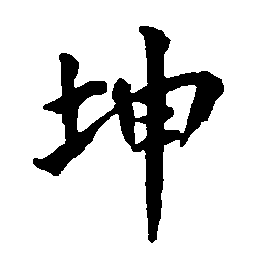 |
2. K'un / The Receptive
|
 |
This hexagram is made up of broken lines only. The broken line represents the dark, yielding, receptive primal power of yin.
- The attribute of the hexagram is devotion; its image is the earth.
1
1 [Hexagrams that are opposites in structure are not necessarily opposites in meaning.]
- It is the perfect complement of THE CREATIVE – the complement, not the opposite,1 for the Receptive does not combat the Creative but completes it.
- It represents nature in contrast to spirit, earth in contrast to heaven, space as against time, the female-maternal as against the male-paternal.
- However, as applied to human affairs, the principle of this complementary relationship is found not only in the relation between man and woman, but also in that between prince and minister and between father and son.
- Indeed, even in the individual this duality appears in the coexistence of the spiritual world and the world of the senses.
But strictly speaking there is no real dualism here, because there is a clearly defined hierarchic relationship between the two principles.
- In itself of course the Receptive is just as important as the Creative, but the attribute of devotion defines the place occupied by this primal power in relation to the Creative.
- For the Receptive must be activated and led by the Creative; then it is productive of good.
- Only when it abandons this position and tries to stand as an equal side by side with the Creative, does it become evil. The result then is opposition to and struggle against the Creative, which is productive of evil to both.
- THE RECEPTIVE brings about sublime success,
- Furthering through the perseverance of a mare.
- If the superior man undertakes something and tries to lead,
- He goes astray;
- But if he follows, he finds guidance.
- It is favorable to find friends in the west and south,
- To forego friends in the east and north.
- Quiet perseverance brings good fortune.
The four fundamental aspects of the Creative — “sublime success, furthering through perseverance” — are also attributed to the Receptive.
- Here, however, the perseverance is more closely defined: it is that of a mare.
- The Receptive connotes spatial reality in contrast to the spiritual potentiality of the Creative.
- The potential becomes real and the spiritual becomes spatial through a specifically qualifying definition.
Thus the qualification, “of a mare,” is here added to the idea of perseverance.
- The horse belongs to earth just as the dragon belongs to heaven.
- Its tireless roaming over the plains is taken as a symbol of the vast expanse of the earth.
- This is the symbol chosen because the mare combines the strength and swiftness of the horse with the gentleness and devotion of the cow.
Only because nature in its myriad forms corresponds with the myriad impulses of the Creative can it make these impulses real.
- Nature’s richness lies in its power to nourish all living things;
- Its greatness lies in its power to give them beauty and splendor.
- Thus it prospers all that lives.
- It is the Creative that begets things, but they are brought to birth by the Receptive.
Applied to human affairs, therefore, what the hexagram indicates is action in conformity with the situation.
- The person in question is not in an independent position, but is acting as an assistant.
- This means that he must achieve something. It is not his task to try to lead — that would only make him lose the way — but to let himself be led.
- If he knows how to meet fate with an attitude of acceptance, he is sure to find the right guidance.
- The superior man lets himself be guided; he does not go ahead blindly, but learns from the situation what is demanded of him and then follows this intimation from fate.
Since there is something to be accomplished, we need friends and helpers in the hour of toil and effort, once the ideas to be realized are firmly set.
- The time of toil and effort is indicated by the west and the south, for west and south symbolize the place where the Receptive works for the Creative, as nature does in summer and autumn.
- If in that situation one does not mobilize all one’s powers, the work to be accomplished will not be done.
- Hence to find friends there means to find guidance.
But in addition to the time of toil and effort, there is also a time of planning, and for this we need solitude.
- The east symbolizes the place where a man receives orders from his master, and the north the place where he reports on what he has done.
- At that time he must be alone and objective.
- In this sacred hour he must do without companions, so that the purity of the moment may not be spoiled by factional hates and favoritism.
- The earth’s condition is receptive devotion.
- Thus the superior man who has breadth of character
- Carries the outer world.
Just as there is only one heaven, so too there is only one earth.
- In the hexagram of heaven the doubling of the trigram implies duration in time,
- But in the hexagram of earth the doubling connotes the solidity and extension in space by virtue of which the earth is able to carry and preserve all things that live and move upon it.
The earth in its devotion carries all things, good and evil, without exception.
- In the same way the superior man gives to his character breadth, purity, and sustaining power, so that he is able both to support and to bear with people and things.
Six at the beginning means:
- When there is hoarfrost underfoot,
- Solid ice is not far off.
Just as the light-giving power represents life, so the dark power, the shadowy, represents death.
- When the first hoarfrost comes in the autumn, the power of darkness and cold is just at its beginning.
- After these first warnings, signs of death will gradually multiply, until, in obedience to immutable laws, stark winter with its ice is here.
In life it is the same. After certain scarcely noticeable signs of decay have appeared, they go on increasing until final dissolution comes.
- But in life precautions can be taken by heeding the first signs of decay and checking them in time.
Six in the second place means:
- Straight, square, great.
- Without purpose,
- Yet nothing remains unfurthered.
The symbol of heaven is the circle, and that of earth is the square.
- Thus squareness is a primary quality of the earth.
- On the other hand, movement in a straight line, as well as magnitude, is a primary quality of the Creative.
- But all square things have their origin in a straight line and in turn form solid bodies.
In mathematics, when we discriminate between lines, planes, and solids, we find that rectangular planes result from straight lines, and cubic magnitudes from rectangular planes.
- The Receptive accommodates itself to the qualities of the Creative and makes them its own.
Thus a square develops out of a straight line and a cube out of a square. - This is compliance with the laws of the Creative; nothing is taken away, nothing added.
- Therefore the Receptive has no need of a special purpose of its own, nor of any effort; yet everything turns out as it should.
Nature creates all beings without erring: this is its straightness.
- It is calm and still: this is its foursquareness.
- It tolerates all creatures equally: this is its greatness.
- Therefore it attains what is right for all without artifice or special intentions.
- Man achieves the height of wisdom when all that he does is as self-evident as what nature does.
Six in the third place means:
- Hidden lines.
- One is able to remain persevering.
- If by chance you are in the service of a king,
- Seek not works, but bring to completion.
If a man is free of vanity he is able to conceal his abilities and keep them from attracting attention too soon; thus he can mature undisturbed.
- If conditions demand it, he can also enter public life, but that too he does with restraint.
- The wise man gladly leaves fame to others.
- He does not seek to have credited to himself things that stand accomplished, but hopes to release active forces;
- That is, he completes his works in such a manner that they may bear fruit for the future.
Six in the fourth place means:
- A tied-up sack. No blame, no praise.
2
2 See Book II, page 301, sec. 2.
The dark element opens when it moves and closes when at rest.2
- The strictest reticence is indicated here.
- The time is dangerous, because any degree of prominence leads either to the enmity of irresistible antagonists if one challenges them or to misconceived recognition if one is complaisant.
- Therefore a man ought to maintain reserve, be it in solitude or in the turmoil of the world, for there too he can hide himself so well that no one knows him.
Six in the fifth place means:
- A yellow lower garment brings supreme good fortune.
Yellow is the color of the earth and of the middle; it is the symbol of that which is reliable and genuine.
- The lower garment is inconspicuously decorated — the symbol of aristocratic reserve.
- When anyone is called upon to work in a prominent but not independent position, true success depends on the utmost discretion.
- A man’s genuineness and refinement should not reveal themselves directly; they should express themselves only indirectly as an effect from within.
Six at the top means:
- Dragons fight in the meadow.
- Their blood is black and yellow.
In the top place the dark element should yield to the light.
- If it attempts to maintain a position to which it is not entitled and to rule instead of serving, it draws down upon itself the anger of the strong.
- A struggle ensues in which it is overthrown, with injury, however, to both sides.
- The dragon, symbol of heaven, comes to fight the false dragon that symbolizes the inflation of the earth principle.
- Midnight blue is the color of heaven; yellow is the color of the earth.
3
3 While the top line of THE CREATIVE indicates titanic pride and forms a parallel to the Greek legend of Icarus, the top line of THE RECEPTIVE presents a parallel to the myth of Lucifer’s rebellion against God, or to the battle between the powers of darkness and the gods of Valhalla, which ended with the Twilight of the Gods.
- Therefore, when black and yellow blood flow, it is a sign that in this unnatural contest both primal powers suffer injury.3
When all lines are sixes, it means:
- When all the lines are sixes, it means
- Lasting perseverance furthers.
When nothing but sixes appears, the hexagram of THE RECEPTIVE changes into the hexagram of THE CREATIVE.
- By holding fast to what is right, it gains the power of enduring.
- There is indeed no advance, but neither is there retrogression.
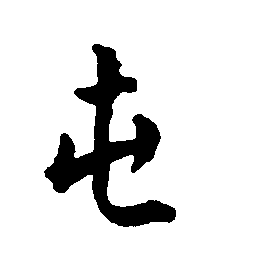 |
3. Chun / Difficulty at the Beginning
|
 |
The name of the hexagram, Chun, really connotes a blade of grass pushing against an obstacle as it sprouts out of the earth—hence the meaning, “difficulty at the beginning.”
- The hexagram indicates the way in which heaven and earth bring forth individual beings.
- It is their first meeting, which is beset with difficulties.
The lower trigram Chên is the Arousing; its motion is upward and its image is thunder.
The upper trigram K’an stands for the Abysmal, the dangerous. Its motion is downward and its image is rain.
The situation points to teeming, chaotic profusion; thunder and rain fill the air. But the chaos clears up.
- While the Abysmal sinks, the upward movement eventually passes beyond the danger.
- A thunderstorm brings release from tension, and all things breathe freely again.
- Difficulty at the Beginning works supreme success,
- Furthering through perseverance.
- Nothing should be undertaken.
- It furthers one to appoint helpers.
Times of growth are beset with difficulties. They resemble a first birth.
- But these difficulties arise from the very profusion of all that is struggling to attain form.
- Everything is in motion: therefore if one perseveres there is a prospect of great success, in spite of the existing danger.
When it is a man’s fate to undertake such new beginnings, everything is still unformed, dark.
- Hence he must hold back, because any premature move might bring disaster.
- Likewise, it is very important not to remain alone; in order to overcome the chaos he needs helpers.
- This is not to say, however, that he himself should look on passively at what is happening. He must lend his hand and participate with inspiration and guidance.
- Clouds and thunder:
- The image of DIFFICULTY AT THE BEGINNING.
- Thus the superior man
- Brings order out of confusion.
Clouds and thunder are represented by definite decorative lines; this means that in the chaos of difficulty at the beginning, order is already implicit.
- So too the superior man has to arrange and organize the inchoate profusion of such times of beginning, just as one sorts out silk threads from a knotted tangle and binds them into skeins.
- In order to find one’s place in the infinity of being, one must be able both to separate and to unite.
Nine at the beginning means:
- Hesitation and hindrance.
- It furthers one to remain persevering.
- It furthers one to appoint helpers.
If a person encounters a hindrance at the beginning of an enterprise, he must not try to force advance but must pause and take thought.
- However, nothing should put him off his course; he must persevere and constantly keep the goal in sight.
- It is important to seek out the right assistants, but he can find them only if he avoids arrogance and associates with his fellows in a spirit of humility.
- Only then will he attract those with whose help he can combat the difficulties.
Six in the second place means:
- Difficulties pile up.
- Horse and wagon part.
- He is not a robber;
- He wants to woo when the time comes.
- The maiden is chaste,
- She does not pledge herself.
- Ten years–then she pledges herself.
We find ourselves beset by difficulties and hindrances.
- Suddenly there is a turn of affairs, as if someone were coming up with a horse and wagon and unhitching them.
- This event comes so unexpectedly that we assume the newcomer to be a robber.
- Gradually it becomes clear that he has no evil intentions but seeks to be friendly and to offer help.
- But this offer is not to be accepted, because it does not come from the right quarter.
- We must wait until the time is fulfilled; ten years is a fulfilled cycle of time. Then normal conditions return of themselves, and we can join forces with the friend intended for us.
Using the image of a betrothed girl who remains true to her lover in face of grave conflicts, the hexagram gives counsel for a special situation.
- When in times of difficulty a hindrance is encountered and unexpected relief is offered from a source unrelated to us, we must be careful and not take upon ourselves any obligations entailed by such help; otherwise our freedom of decision is impaired.
1
1 A different translation is possible here, which would result in a different interpretation:
- Difficulties pile up.
- Horse and wagon turn about.
- If the robber were not there,
- The wooer would come.
- The maiden is faithful, she does not pledge herself.
- Ten years–then she pledges herself.
- If we bide our time, things will quiet down again, and we shall attain what we have hoped for.1
Six in the third place means:
- Whoever hunts deer without the forester
- Only loses his way in the forest.
- The superior man understands the signs of the time
- And prefers to desist.
- To go on brings humiliation.
If a man tries to hunt in a strange forest and has no guide, he loses his way. When he finds himself in difficulties he must not try to steal out of them unthinkingly and without guidance.
- Fate cannot be duped; premature effort, without the necessary guidance, ends in failure and disgrace.
- Therefore the superior man, discerning the seeds of coming events, prefers to renounce a wish rather than to provoke failure and humiliation by trying to force its fulfillment.
Six in the fourth place means:
- Horse and wagon part.
- Strive for union.
- To go brings good fortune.
- Everything acts to further.
We are in a situation in which it is our duty to act, but we lack sufficient power. However, an opportunity to make connections offers itself.
- It must be seized. Neither false pride nor false reserve should deter us.
- Bringing oneself to take the first step, even when it involves a certain degree of self-abnegation, is a sign of inner clarity.
- To accept help in a difficult situation is not a disgrace. If the right helper is found, all goes well.
Nine in the fifth place means:
- Difficulties in blessing.
- A little perseverance brings good fortune.
- Great perseverance brings misfortune.
An individual is in a position in which he cannot so express his good intentions that they will actually take shape and be understood.
- Other people interpose and distort everything he does.
- He should then be cautious and proceed step by step.
- He must not try to force the consummation of a great undertaking, because success is possible only when general confidence already prevails.
- It is only through faithful and conscientious work, unobtrusively carried on, that the situation gradually clears up and the hindrance disappears.
Six at the top means:
- Horse and wagon part.
- Bloody tears flow.
The difficulties at the beginning are too great for some persons.
- They get stuck and never find their way out; they fold their hands and give up the struggle.
- Such resignation is the saddest of all things.
Therefore Confucius says of this line:
“Bloody tears flow: one should not persist in this.”
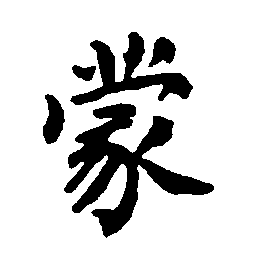 |
4. Mêng / Youthful Folly
|
 |
1
1 “Fool” and “folly” as used in this hexagram should be understood to mean the immaturity of youth and its consequent lack of wisdom, rather than mere stupidity.
Parsifal is known as the “pure fool” not because he was dull-witted but because he was inexperienced.
In this hexagram we are reminded of youth and folly1 in two different ways.
- The image of the upper trigram, Kên, is the mountain,
- That of the lower, K’an, is water;
The spring rising at the foot of the mountain is the image of inexperienced youth.
- Keeping still is the attribute of the upper trigram; that of the lower is the abyss, danger.
- Stopping in perplexity on the brink of a dangerous abyss is a symbol of the folly of youth.
However, the two trigrams also show the way of overcoming the follies of youth.
- Water is something that of necessity flows on.
- When the spring gushes forth, it does not know at first where it will go.
- But its steady flow fills up the deep place blocking its progress, and success is attained.
- YOUTHFUL FOLLY has success.
- It is not I who seek the young fool;
- The young fool seeks me.
- At the first oracle I inform him.
- If he asks two or three times, it is importunity.
- If he importunes, I give him no information.
- Perseverance furthers.
In the time of youth, folly is not an evil. One may succeed in spite of it, provided one finds an experienced teacher and has the right attitude toward him.
- This means, first of all, that the youth himself must be conscious of his lack of experience and must seek out the teacher.
- Without this modesty and this interest there is no guarantee that he has the necessary receptivity, which should express itself in respectful acceptance of the teacher.
- This is the reason why the teacher must wait to be sought out instead of offering himself.
- Only thus can the instruction take place at the right time and in the right way.
A teacher’s answer to the question of a pupil ought to be clear and definite like that expected from an oracle; thereupon it ought to be accepted as a key for resolution of doubts and a basis for decision.
- If mistrustful or unintelligent questioning is kept up, it serves only to annoy the teacher.
- He does well to ignore it in silence, just as the oracle gives one answer only and refuses to be tempted by questions implying doubt.
Given in addition a perseverance that never slackens until the points are mastered one by one, real success is sure to follow. Thus the hexagram counsels the teacher as well as the pupil.
- A spring wells up at the foot of the mountain:
- The image Of YOUTH.
- Thus the superior man fosters his character
- By thoroughness in all that he does
A spring succeeds in flowing on and escapes stagnation by filling up all the hollow places in its path.
- In the same way character is developed by thoroughness that skips nothing but, like water, gradually and steadily fills up all gaps and so flows onward.
Six at the beginning means:
- To make a fool develop
- It furthers one to apply discipline.
- The fetters should be removed.
- To go on in this way brings humiliation.
Law is the beginning of education. Youth in its inexperience is inclined at first to take everything carelessly and playfully.
- It must be shown the seriousness of life.
- A certain measure of taking oneself in hand, brought about by strict discipline, is a good thing.
- He who plays with life never amounts to anything.
- However, discipline should not degenerate into drill. Continuous drill has a humiliating effect and cripples a man’s powers.
Nine in the second place means:
- To bear with fools in kindliness brings good fortune.
- To know how to take women
- Brings good fortune.
- The son is capable of taking charge of the household.
These lines picture a man who has no external power, but who has enough strength of mind to bear his burden of responsibility.
- He has the inner superiority and strength that enable him to tolerate with kindliness the shortcomings of human folly.
- The same attitude is owed to women as the weaker sex. One must understand them and give them recognition in a spirit of chivalrous consideration.
- Only this combination of inner strength with outer reserve enables one to take on the responsibility of directing a larger social body with real success.
Six in the third place means:
- Take not a maiden who, when she sees a man of bronze,
- Loses possession of herself.
- Nothing furthers.
A weak, inexperienced man, struggling to rise, easily loses his own individuality when he slavishly imitates a strong personality of higher station.
- He is like a girl throwing herself away when she meets a strong man.
- Such a servile approach should not be encouraged, because it is bad both for the youth and the teacher.
- A girl owes it to her dignity to wait until she is wooed.
- In both cases it is undignified to offer oneself, and no good comes of accepting such an offer.
Six in the fourth place means:
- Entangled folly brings humiliation.
For youthful folly it is the most hopeless thing to entangle itself in empty imaginings.
- The more obstinately it clings to such unreal fantasies, the more certainly will humiliation overtake it.
- Often the teacher, when confronted with such entangled folly, has no other course but to leave the fool to himself for a time, not sparing him the humiliation that results.
- This is frequently the only means of rescue.
Six in the fifth place means:
- Childlike folly brings good fortune.
An inexperienced person who seeks instruction in a childlike and unassuming way is on the right path, for the man devoid of arrogance who subordinates himself to his teacher will certainly be helped.
Nine at the top means:
- In punishing folly
- It does not further one
- To commit transgressions.
- The only thing that furthers
- Is to prevent transgressions.
Sometimes an incorrigible fool must be punished. He who will not heed will be made to feel.
- This punishment is quite different from a preliminary shaking up.
- But the penalty should not be imposed in anger; it must be restricted to an objective guarding against unjustified excesses.
- Punishment is never an end in itself but serves merely to restore order.
This applies not only in regard to education but also in regard to the measures taken by a government against a populace guilty of transgressions.
- Governmental interference should always be merely preventive and should have as its sole aim the establishment of public security and peace.
 |
1
In the German translation, this secondary name does not appear in Book I. See Book III, 5. Hsü / Waiting (Nourishment).
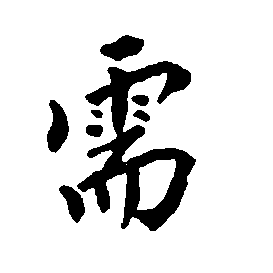
5. Hsü / Waiting (Nourishment1)
|
 |
All beings have need of nourishment from above. But the gift of food comes in its own time, and for this one must wait.
- This hexagram shows the clouds in the heavens, giving rain to refresh all that grows and to provide mankind with food and drink.
- The rain will come in its own time. We cannot make it come; we have to wait for it.
2
2 The upper trigram is considered to be in front of the lower. See Book II, page 357.
- The idea of waiting is further suggested by the attributes of the two trigrams — strength within, danger in front.2
Strength in the face of danger does not plunge ahead but bides its time,
- Whereas weakness in the face of danger grows agitated and has not the patience to wait.
- THE_JUDGMENT1
- WAITING. If you are sincere,
- You have light and success.
- Perseverance brings good fortune.
- It furthers one to cross the great water.
Waiting is not mere empty hoping. It has the inner certainty of reaching the goal.
- Such certainty alone gives that light which leads to success.
- This leads to the perseverance that brings good fortune and bestows power to cross the great water.
One is faced with a danger that has to be overcome. Weakness and impatience can do nothing.
- Only a strong man can stand up to his fate, for his inner security enables him to endure to the end. This strength shows itself in uncompromising truthfulness [with himself].
- It is only when we have the courage to face things exactly as they are, without any sort of self-deception or illusion, that a light will develop out of events, by which the path to success may be recognized.
This recognition must be followed by resolute and persevering action.
- For only the man who goes to meet his fate resolutely is equipped to deal with it adequately.
- Then he will be able to cross the great water — that is to say, he will be capable of making the necessary decision and of surmounting the danger.
- Clouds rise up to heaven:
- The image of WAITING.
- Thus the superior man eats and drinks,
- Is joyous and of good cheer.
When clouds rise in the sky, it is a sign that it will rain. There is nothing to do but to wait until the rain falls.
- It is the same in life when destiny is at work. We should not worry and seek to shape the future by interfering in things before the time is ripe.
- We should quietly fortify the body with food and drink and the mind with gladness and good cheer.
- Fate comes when it will, and thus we are ready.
Nine at the beginning means:
- Waiting in the meadow.
- It furthers one to abide in what endures.
- No blame.
The danger is not yet close. One is still waiting on the open plain.
- Conditions are still simple, yet there is a feeling of something impending.
- One must continue to lead a regular life as long as possible.
- Only in this way does one guard against a premature waste of strength, keep free of blame and error that would become a source of weakness later on.
Nine in the second place means:
- Waiting on the sand.
- There is some gossip.
- The end brings good fortune.
The danger gradually comes closer. Sand is near the bank of the river, and the water means danger. Disagreements crop up.
- General unrest can easily develop in such times, and we lay the blame on one another.
- He who stays calm will succeed in making things go well in the end.
- Slander will be silenced if we do not gratify it with injured retorts.
Nine in the third place means:
- Waiting in the mud
- Brings about the arrival of the enemy.
Mud is no place for waiting, since it is already being washed by the water of the stream.
- Instead of having gathered strength to cross the stream at one try, one has made a premature start that has got him no farther than the muddy bank.
Such an unfavorable position invites enemies from without, who naturally take advantage of it.
- Caution and a sense of the seriousness of the situation are all that can keep one from injury.
Six in the fourth place means:
- Waiting in blood.
- Get out of the pit.
The situation is extremely dangerous. It is of utmost gravity now — a matter of life and death. Bloodshed seems imminent.
- There is no going forward or backward; we are cut off as if in a pit.
- Now we must simply stand fast and let fate take its course.
- This composure, which keeps us from aggravating the trouble by anything we might do, is the only way of getting out of the dangerous pit.
Nine in the fifth place means:
- Waiting at meat and drink.
- Perseverance brings good fortune.
Even in the midst of danger there come intervals of peace when things go relatively well.
- If we possess enough inner strength, we shall take advantage of these intervals to fortify ourselves for renewed struggle.
- We must know how to enjoy the moment without being deflected from the goal, for perseverance is needed to remain victorious.
This is true in public life as well; it is not possible to achieve everything all at once.
- The height of wisdom is to allow people enough recreation to quicken pleasure in their work until the task is completed. Herein lies the secret of the whole hexagram.
- It differs from Chien, OBSTRUCfION (39), in the fact that in this instance, while waiting, we are sure of our cause and therefore do not lose the serenity born of inner cheerfulness.
Six at the top means:
- One falls into the pit.
- Three uninvited guests arrive.
- Honor them, and in the end there will be good fortune.
The waiting is over; the danger can no longer be averted. One falls into the pit and must yield to the inevitable. Everything seems to have been in vain.
- But precisely in this extremity things take an unforeseen turn.
- Without a move on one’s own part, there is outside intervention.
At first one cannot be sure of its meaning: is it rescue or is it destruction?
- A person in this situation must keep his mind alert and not withdraw into himself with a sulky gesture of refusal, but must greet the new turn with respect.
- Thus he ultimately escapes the danger, and all goes well. Even happy turns of fortune often come in a form that at first seems strange to us.
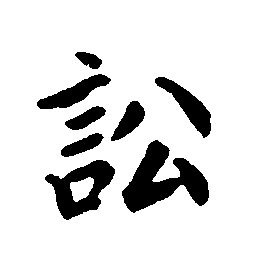 |
6. Sung / Conflict
|
 |
The upper trigram, whose image is heaven, has an upward movement;
The lower trigram, water, in accordance with its nature, tends downward.
The lower trigram, water, in accordance with its nature, tends downward.
- Thus the two halves move away from each other, giving rise to the idea of conflict.
The attribute of the Creative is strength, that of the Abysmal is danger, guile.
- Where cunning has force before it, there is conflict.
A third indication of conflict, in terms of character, is presented by the combination of deep cunning within and fixed determination outwardly.
- A person of this character will certainly be quarrelsome.
- CONFLICT. You are sincere
- And are being obstructed.
- A cautious halt halfway brings good fortune.
- Going through to the end brings misfortune.
- It furthers one to see the great man.
- It does not further one to cross the great water.
Conflict develops when one feels himself to be in the right and runs into opposition.
- If one is not convinced of being in the right, opposition leads to craftiness or high-handed encroachment but not to open conflict.
If a man is entangled in a conflict, his only salvation lies in being so clear-headed and inwardly strong that he is always ready to come to terms by meeting the opponent halfway.
- To carry on the conflict to the bitter end has evil effects even when one is in the right, because the enmity is then perpetuated.
- It is important to see the great man, that is, an impartial man whose authority is great enough to terminate the conflict amicably or assure a just decision.
- In times of strife, crossing the great water is to be avoided, that is, dangerous enterprises are not to be begun, because in order to be successful they require concerted unity of forces.
- Conflict within weakens the power to conquer danger without.
- Heaven and water go their opposite ways:
- The image of CONFLICT.
- Thus in all his transactions the superior man
- Carefully considers the beginning.
The image indicates that the causes of conflict are latent in the opposing tendencies of the two trigrams. Once these opposing tendencies appear, conflict is inevitable.
- To avoid it, therefore, everything must be taken carefully into consideration in the very beginning.
- If rights and duties are exactly defined, or if, in a group, the spiritual trends of the individuals harmonize, the cause of conflict is removed in advance.
Six at the beginning means:
- If one does not perpetuate the affair,
- There is a little gossip.
- In the end, good fortune comes.
While a conflict is in the incipient stage, the best thing to do is to drop the issue.
- Especially when the adversary is stronger, it is not advisable to risk pushing the conflict to a decision.
- It may come to a slight dispute, but in the end all goes well.
Nine in the second place means:
- One cannot engage in conflict;
- One returns home, gives way.
- The people of his town,
- Three hundred households,
- Remain free of guilt.
In a struggle with an enemy of superior strength, retreat is no disgrace. Timely withdrawal prevents bad consequences.
- If, out of a false sense of honor, a man allowed himself to be tempted into an unequal conflict, he would be drawing down disaster upon himself.
- In such a case a wise and conciliatory attitude benefits the whole community, which will then not be drawn into the conflict.
Six in the third place means:
- To nourish oneself on ancient virtue induces perseverance.
- Danger. In the end, good fortune comes.
- If by chance you are in the service of a king,
- Seek not works.
This is a warning of the danger that goes with an expansive disposition.
- Only that which has been honestly acquired through merit remains a permanent possession.
- It can happen that such a possession may be contested, but since it is really one’s own, one cannot be robbed of it.
- Whatever a man possesses through the strength of his own nature cannot be lost.
If one enters the service of a superior, one can avoid conflict only by not seeking works for the sake of prestige.
- It is enough if the work is done: let the honor go to the other.
Nine in the fourth place means:
- One cannot engage in conflict.
- One turns back and submits to fate,
- Changes one’s attitude,
- And finds peace in perseverance.
- Good fortune.
This refers to a person whose inner attitude at first lacks peace. He does not feel content with his situation and would like to improve it through conflict.
- In contrast to the situation of the nine in the second place, he is dealing with a weaker opponent and might therefore succeed.
- But he cannot carry on the fight, because, since right is not on his side, he cannot justify the conflict to his conscience.
- Therefore he turns back and accepts his fate.
- He changes his mind and finds lasting peace in being at one with eternal law. This brings good fortune.
Nine in the fifth place means:
- To contend before him
- Brings supreme good fortune.
This refers to an arbiter in a conflict who is powerful and just, and strong enough to lend weight to the right side.
- A dispute can be turned over to him with confidence. If one is in the right, one attains great good fortune.
Nine at the top means:
- Even if by chance a leather belt is bestowed on one,
- By the end of a morning
- It will have been snatched away three times.
Here we have someone who has carried a conflict to the bitter end and has triumphed.
- He is granted a decoration, but his happiness does not last.
- He is attacked again and again, and the result is conflict without end.
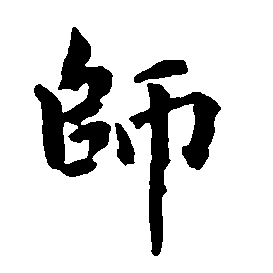 |
7. Shih / The Army
|
 |
This hexagram is made up of the trigrams K’an, water, and K’un, earth, and thus it symbolizes the ground water stored up in the earth.
- In the same way military strength is stored up in the mass of the people — invisible in times of peace but always ready for use as a source of power.
The attributes of the two trigrams are danger inside and obedience outside.
- This points to the nature of an army, which at the core is dangerous, while discipline and obedience must prevail outside.
Of the individual lines, the one that controls the hexagram is the strong nine in the second place, to which the other lines, all yielding, are subordinate.
- This line indicates a commander, because it stands in the middle of one of the two trigrams.
- But since it is in the lower rather than the upper trigram, it represents not the ruler but the efficient general, who maintains obedience in the army by his authority.
- THE ARMY. The army needs perseverance
- And a strong man.
- Good fortune without blame.
An army is a mass that needs organization in order to become a fighting force.
- Without strict discipline nothing can be accomplished, but this discipline must not be achieved by force.
It requires a strong man who captures the hearts of the people and awakens their enthusiasm.
- In order that he may develop his abilities he needs the complete confidence of his ruler, who must entrust him with full responsibility as long as the war lasts.
But war is always a dangerous thing and brings with it destruction and devastation.
- Therefore it should not be resorted to rashly but, like a poisonous drug, should be used as a last recourse.
The justifying cause of a war, and clear and intelligible war aims, ought to be explained to the people by an experienced leader.
- Unless there is a quite definite war aim to which the people can consciously pledge themselves, the unity and strength of conviction that lead to victory will not be forthcoming.
- But the leader must also look to it that the passion of war and the delirium of victory do not give rise to unjust acts that will not meet with general approval.
- If justice and perseverance are the basis of action, all goes well.
- In the middle of the earth is water:
- The image of THE ARMY.
- Thus the superior man increases his masses
- By generosity toward the people.
Ground water is invisibly present within the earth. In the same way the military power of a people is invisibly present in the masses.
- When danger threatens, every peasant becomes a soldier; when the war ends, he goes back to his plow.
He who is generous toward the people wins their love, and a people living under a mild rule becomes strong and powerful. Only a people economically strong can be important in military power.
- Such power must therefore be cultivated by improving the economic condition of the people and by humane government.
- Only when there is this invisible bond between government and people, so that the people are sheltered by their government as ground water is sheltered by the earth, is it possible to wage a victorious war.
Six at the beginning means:
- An army must set forth in proper order.
- If the order is not good, misfortune threatens.
At the beginning of a military enterprise, order is imperative.
- A just and valid cause must exist, and the obedience and coordination of the troops must be well organized, otherwise the result is inevitably failure.
Nine in the second place means:
- In the midst of the army.
- Good fortune. No blame.
- The king bestows a triple decoration.
The leader should be in the midst of his army, in touch with it, sharing good and bad with the masses he leads.
- This alone makes him equal to the heavy demands made upon him.
He needs also the recognition of the ruler.
- The decorations he receives are justified, because there is no question of personal preferment here: the whole army, whose center he is, is honored in his person.
Six in the third place means:
- Perchance the army carries corpses in the wagon.
- Misfortune.
Here we have a choice of two explanations.
- One points to defeat because someone other than the chosen leader interferes with the command;
- The other is similar in its general meaning, but the expression, “carries corpses in the wagon,” is interpreted differently.
At burials and at sacrifices to the dead it was customary in China for the deceased to whom the sacrifice was made to be represented by a boy of the family, who sat in the dead man’s place and was honored as his representative.
- On the basis of this custom the text is interpreted as meaning that a “corpse boy” is sitting in the wagon,
- Or, in other words, that authority is not being exercised by the proper leaders but has been usurped by others.
Perhaps the whole difficulty clears up if it is inferred that there has been an error in copying.
- The character fan, meaning “all,” may have been misread as shih, which means “corpse.”
- Allowing for this error, the meaning would be that if the multitude assumes leadership of the army (rides in the wagon), misfortune will ensue.
Six in the fourth place means:
- The army retreats. No blame.
In face of a superior enemy, with whom it would be hopeless to engage in battle, an orderly retreat is the only correct procedure, because it will save the army from defeat and disintegration.
- It is by no means a sign of courage or strength to insist upon engaging in a hopeless struggle regardless of circumstances.
Six in the fifth place means:
- There is game in the field.
- It furthers one to catch it.
- Without blame.
- Let the eldest lead the army.
- The younger transports corpses;
- Then perseverance brings misfortune.
Game is in the field — it has left its usual haunts in the forest and is devastating the fields. This points to an enemy invasion.
- Energetic combat and punishment are here thoroughly justified, but they must not degenerate into a wild melee in which everyone fends for himself.
- Despite the greatest degree of perseverance and bravery, this would lead to misfortune.
The army must be directed by an experienced leader.
- It is a matter of waging war, not of permitting the mob to slaughter all who fall into their hands;
- If they do, defeat will be the result, and despite all perseverance there is danger of misfortune.
Six at the top means:
- The great prince issues commands,
- Founds states, vests families with fiefs.
- Inferior people should not be employed.
The war has ended successfully, victory is won, and the king divides estates and fiefs among his faithful vassals.
- But it is important that inferior people should not come into power.
- If they have helped, let them be paid off with money, but they should not be awarded lands or the privileges of rulers, lest power be abused.
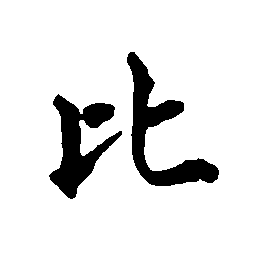 |
8. Pi / Holding Together [Union]
|
 |
The waters on the surface of the earth flow together wherever they can, as for example in the ocean, where all the rivers come together.
- Symbolically this connotes holding together and the laws that regulate it.
The same idea is suggested by the fact that all the lines of the hexagram except the fifth, the place of the ruler, are yielding.
- The yielding lines hold together because they are influenced by a man of strong will in the leading position, a man who is their center of union.
- Moreover, this strong and guiding personality in turn holds together with the others, finding in them the complement of his own nature.
- HOLDING TOGETHER brings good fortune.
- Inquire of the oracle once again
- Whether you possess sublimity, constancy, and perseverance;
- Then there is no blame.
- Those who are uncertain gradually join.
- Whoever comes too late
- Meets with misfortune.
What is required is that we unite with others, in order that all may complement and aid one another through holding together.
- But such holding together calls for a central figure around whom other persons may unite.
To become a center of influence holding people together is a grave matter and fraught with great responsibility.
- It requires greatness of spirit, consistency, and strength.
- Therefore let him who wishes to gather others about him ask himself whether he is equal to the undertaking, for anyone attempting the task without a real calling for it only makes confusion worse than if no union at all had taken place.
But when there is a real rallying point, those who at first are hesitant or uncertain gradually come in of their own accord.
- Late-comers must suffer the consequences, for in holding together the question of the right time is also important.
- Relationships are formed and firmly established according to definite inner laws.
- Common experiences strengthen these ties, and he who comes too late to share in these basic experiences must suffer for it if, as a straggler, he finds the door locked.
If a man has recognized the necessity for union and does not feel strong enough to function as the center, it is his duty to become a member of some other organic fellowship.
- On the earth is water:
- The image of HOLDING TOGETHER.
- Thus the kings of antiquity
- Bestowed the different states as fiefs
- And cultivated friendly relations
- With the feudal lords.
Water fills up all the empty places on the earth and clings fast to it.
- The social organization of ancient China was based on this principle of the holding together of dependents and rulers.
Water flows to unite with water, because all parts of it are subject to the same laws.
- So too should human society hold together through a community of interests that allows each individual to feel himself a member of a whole.
- The central power of a social organization must see to it that every member finds that his true interest lies in holding together with it, as was the case in the paternal relationship between king and vassals in ancient China.
Six at the beginning means:
- Hold to him in truth and loyalty;
- This is without blame.
- Truth, like a full earthen bowl:
- Thus in the end
- Good fortune comes from without.
Fundamental sincerity is the only proper basis for forming relationships.
- This attitude, symbolized by a full earthen bowl, in which the content is everything and the empty form nothing, shows itself not in clever words but through the strength of what lies within the speaker.
- This strength is so great that it has power to attract good fortune to itself from without.
Six in the second place means:
- Hold to him inwardly.
- Perseverance brings good fortune.
If a person responds perseveringly and in the right way to the behests from above that summon him to action, his relations with others are intrinsic and he does not lose himself.
- But if a man seeks association with others as if he were an obsequious office hunter, he throws himself away.
- He does not follow the path of the superior man, who never loses his dignity.
Six in the third place means:
- You hold together with the wrong people.
We are often among people who do not belong to our own sphere.
- In that case we must beware of being drawn into false intimacy through force of habit.
Needless to say, this would have evil consequences.
- Maintaining sociability without intimacy is the only right attitude toward such people, because otherwise we should not be free to enter into relationship with people of our own kind later on.
Six in the fourth place means:
- Hold to him outwardly also.
- Perseverance brings good fortune.
Here the relations with a man who is the center of union are well established.
- Then we may, and indeed we should, show our attachment openly.
- But we must remain constant and not allow ourselves to be led astray.
Nine in the fifth place means:
- Manifestation of holding together.
- In the hunt the king uses beaters on three sides only
- And foregoes game that runs off in front.
- The citizens need no warning.
- Good fortune.
In the royal hunts of ancient China it was customary to drive up the game from three sides, but on the fourth the animals had a chance to run off.
- If they failed to do this they had to pass through a gate behind which the king stood ready to shoot.
- Only animals that entered here were shot; those that ran off in front were permitted to escape.
- This custom accorded with a kingly attitude; the royal hunter did not wish to turn the chase into a slaughter, but held that the kill should consist only of those animals which had so to speak voluntarily exposed themselves.
There is depicted here a ruler, or influential man, to whom people are attracted.
- Those who come to him he accepts, those who do not come are allowed to go their own way.
- He invites none, flatters none — all come of their own free will.
In this way there develops a voluntary dependence among those who hold to him.
- They do not have to be constantly on their guard but may express their opinions openly.
- Police measures are not necessary, and they cleave to their ruler of their own volition.
The same principle of freedom is valid for life in general.
- We should not woo favor from people.
- If a man cultivates within himself the purity and the strength that are necessary for one who is the center of a fellowship, those who are meant for him come of their own accord.
Six at the top means:
- He finds no head for holding together.
- Misfortune.
The head is the beginning. If the beginning is not right, there is no hope of a right ending.
- If we have missed the right moment for union and go on hesitating to give complete and full devotion, we shall regret the error when it is too late.
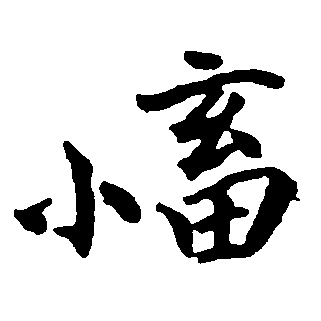 |
9. Hsiao Ch'u / The Taming Power of the Small
|
 |
This hexagram means the force of the small — the power of the shadowy — that restrains, tames, impedes.
1
1 See Book II, page 360.
- A weak line in the fourth place, that of the minister,1 holds the five strong lines in check.
In the Image it is the wind blowing across the sky.
- The wind restrains the clouds, the rising breath of the Creative, and makes them grow dense, but as yet is not strong enough to turn them to rain.
The hexagram presents a configuration of circumstances in which a strong element is temporarily held in leash by a weak element.
- It is only through gentleness that this can have a successful outcome.
- THE TAMING POWER OF THE SMALL
- Has success.
- Dense clouds, no rain from our western region.
This image refers to the state of affairs in China at the time when King Wên, who came originally from the west, was in the east at the court of the reigning tyrant Chou Hsin.
- The moment for action on a large scale had not yet arrived.
- King Wên could only keep the tyrant somewhat in check by friendly persuasion.
- Hence the image of many clouds, promising moisture and blessing to the land, although as yet no rain falls.
The situation is not unfavorable; there is a prospect of ultimate success, but there are still obstacles in the way, and we can merely take preparatory measures.
- Only through the small means of friendly persuasion can we exert any influence.
- The time has not yet come for sweeping measures.
- However, we may be able, to a limited extent, to act as a restraining and subduing influence.
To carry out our purpose we need firm determination within and gentleness and adaptability in external relations.
- The wind drives across heaven:
- The image of THE TAMING POWER OF THE SMALL.
- Thus the superior man
- Refines the outward aspect of his nature.
The wind can indeed drive the clouds together in the sky; yet, being nothing but air, without solid body, it does not produce great or lasting effects.
- So also an individual, in times when he can produce no great effect in the outer world, can do nothing except refine the expression of his nature in small ways.
Nine at the beginning means:
- Return to the way.
- How could there be blame in this?
- Good fortune.
It lies in the nature of a strong man to press forward. In so doing he encounters obstructions.
- Therefore he returns to the way suited to his situation, where he is free to advance or to retreat.
- In the nature of things this will bring good fortune, for it is wise and reasonable not to try to obtain anything by force.
Nine in the second place means:
- He allows himself to be drawn into returning.
- Good fortune.
One would like to press forward, but before going farther one sees from the example of others like oneself that this way is blocked.
2
2 See Book II, page 359 for an explanation of what is meant by the “time.”
- In such a case, if the effort to push forward is not in harmony with the time,2 a reasonable and resolute man will not expose himself to a personal rebuff, but will retreat with others of like mind.
- This brings good fortune, because he does not needlessly jeopardize himself.
Nine in the third place means:
- The spokes burst out of the wagon wheels.
- Man and wife roll their eyes.
Here an attempt is made to press forward forcibly, in the consciousness that the obstructing power is slight.
- But since, under the circumstances, power actually lies with the weak, this sudden offensive is doomed to failure.
- External conditions hinder the advance, just as loss of the wheel spokes stops the progress of a wagon.
- We do not yet heed this hint from fate, hence there are annoying arguments like those of a married couple.
Naturally this is not a favorable state of things, for though the situation may enable the weaker side to hold its ground, the difficulties are too numerous to permit of a happy result.
- In consequence even the strong man cannot so use his power as to exert the right influence on those around him.
- He experiences a rebuff where he expected an easy victory, and he thus compromises his dignity.
Six in the fourth place means:
- If you are sincere, blood vanishes and fear gives way.
- No blame.
If one is in the difficult and responsible position of counselor to a powerful man, one should restrain him in such a way that right may prevail.
- Therein lies a danger so great that the threat of actual bloodshed may arise.
- Nonetheless, the power of disinterested truth is greater than all these obstacles.
- It carries such weight that the end is achieved, and all danger of bloodshed and all fear disappear.
Nine in the fifth place means:
- If you are sincere and loyally attached,
- You are rich in your neighbor.
Loyalty leads to firm ties because it means that each partner complements the other.
- In the weaker person loyalty consists in devotion, in the stronger it consists in trustworthiness.
This relation of mutual reinforcement leads to a true wealth that is all the more apparent because it is not selfishly hoarded but is shared with friends.
- Pleasure shared is pleasure doubled.
Nine at the top means:
- The rain comes, there is rest.
- This is due to the lasting effect of character.
- Perseverance brings the woman into danger.
- The moon is nearly full.
- If the superior man persists,
- Misfortune comes.
Success is at hand. The wind has driven up the rain. A fixed standpoint has been reached.
- This has come about through the accumulation of small effects produced by reverence for a superior character.
But a success thus secured bit by bit calls for great caution. It would be a dangerous illusion for anyone to think he could presume upon it.
- The female principle, the weak element that has won the victory, should never persist in vaunting it — that would lead to danger.
- The dark power in the moon is strongest when the moon is almost full. When it is full and directly opposite the sun, its waning is inevitable.
Under such circumstances one must be content with what has been achieved.
- To advance any further, before the appropriate time has come, would lead to misfortune.
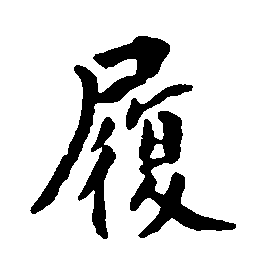 |
10. Lü / Treading [Conduct]
|
 |
The name of the hexagram means on the one hand the right way of conducting oneself.
- Heaven, the father, is above, and the lake, the youngest daughter, is below.
- This shows the difference between high and low, upon which composure, correct social conduct, depends.
1
1 Auftreten, the German word used for the name of the hexagram, means both “treading” and “conduct.”
On the other hand, the word for the name of the hexagram, TREADING,1 means literally treading upon something.
- The small and cheerful [Tui] treads upon the large and strong [Ch’ien].
- The direction of movement of the two primary trigrams is upward.
The fact that the strong treads on the weak is not mentioned in the Book of Changes, because it is taken for granted.
- For the weak to take a stand against the strong is not dangerous here, because it happens in good humor [Tui] and without presumption, so that the strong man is not irritated but takes it all in good part.
- TREADING. Treading upon the tail of the tiger.
- It does not bite the man. Success.
The situation is really difficult. That which is strongest and that which is weakest are close together.
- The weak follows behind the strong and worries it.
- The strong, however, acquiesces and does not hurt the weak, because the contact is in good humor and harmless.
In terms of a human situation, one is handling wild, intractable people.
- In such a case one’s purpose will be achieved if one behaves with decorum.
- Pleasant manners succeed even with irritable people.
- Heaven above, the lake below:
- The image of TREADING.
- Thus the superior man discriminates between high and low,
- And thereby fortifies the thinking of the people.
Heaven and the lake show a difference of elevation that inheres in the natures of the two, hence no envy arises.
- Among mankind also there are necessarily differences of elevation; it is impossible to bring about universal equality.
But it is important that differences in social rank should not be arbitrary and unjust, for if this occurs, envy and class struggle are the inevitable consequences.
- If, on the other band, external differences in rank correspond with differences in inner worth, and if inner worth forms the criterion of external rank, people acquiesce and order reigns in society.
Nine at the beginning means:
- Simple conduct. Progress without blame.
The situation is one in which we are still not bound by any obligations of social intercourse.
- If our conduct is simple, we remain free of them.
- We can quietly follow our predilections as long as we are content and make no demands on people.
The meaning of the hexagram is not standstill but progress.
- A man finds himself in an altogether inferior position at the start.
- However, he has the inner strength that guarantees progress.
- If he can be content with simplicity, he can make progress without blame.
When a man is dissatisfied with modest circumstances, he is restless and ambitious and tries to advance, not for the sake of accomplishing anything worth while, but merely in order to escape from lowliness and poverty by dint of his conduct.
- Once his purpose is achieved, he is certain to become arrogant and luxury-loving.
- Therefore blame attaches to his progress.
On the other hand, a man who is good at his work is content to behave simply.
- He wishes to make progress in order to accomplish something.
- When he attains his goal, he does something worthwhile, and all is well.
Nine in the second place means:
- Treading a smooth, level course.
2
2 See explanation of this line in Book. III, #10 Lü / Treading. Nine in the second place.
- The perseverance of a dark man.2
- Brings good fortune.
The situation of a lonely sage is indicated here.
- He remains withdrawn from the bustle of life, seeks nothing, asks nothing of anyone, and is not dazzled by enticing goals.
- He is true to himself and travels through life unassailed, on a level road.
- Since he is content and does not challenge fate, he remains free of entanglements.
Six in the third place means:
- A one-eyed man is able to see,
- A lame man is able to tread.
- He treads on the tail of the tiger.
- The tiger bites the man.
- Misfortune.
- Thus does a warrior act on behalf of his great prince.
A one-eyed man can indeed see, but not enough for clear vision. A lame man can indeed tread, but not enough to make progress.
- If in spite of such defects a man considers himself strong and consequently exposes himself to danger, he is inviting disaster, for he is undertaking something beyond his strength.
- This reckless way of plunging ahead, regardless of the adequacy of one’s powers, can be justified only in the case of a warrior battling for his prince.
Nine in the fourth place means:
- He treads on the tail of the tiger.
- Caution and circumspection
- Lead ultimately to good fortune.
This text refers to a dangerous enterprise.
- The inner power to carry it through is there, but this inner power is combined with hesitating caution in one’s external attitude.
This line contrasts with the preceding line, which is weak within but outwardly presses forward.
- Here one is sure of ultimate success, which consists in achieving one’s purpose, that is, in overcoming danger by going forward.
Nine in the fifth place means:
- Resolute conduct.
- Perseverance with awareness of danger.
This refers to the ruler of the hexagram as a whole. One sees that one has to be resolute in conduct.
- But at the same time one must remain conscious of the danger connected with such resoluteness, especially if it is to be persevered in.
- Only awareness of the danger makes success possible.
Nine at the top means:
- Look to your conduct and weigh the favorable signs.
- When everything is fulfilled, supreme good fortune comes.
The work is ended. If we want to know whether good fortune will follow, we must look back upon our conduct and its consequences.
- If the effects are good, then good fortune is certain. No one knows himself.
- It is only by the consequences of his actions, by the fruit of his labors, that a man can judge what he is to expect.
 |
11. T'ai / Peace
|
 |
The Receptive, which moves downward, stands above; the Creative, which moves upward, is below.
- Hence their influences meet and are in harmony, so that all living things bloom and prosper.
This hexagram belongs to the first month (February-March), at which time the forces of nature prepare the new spring.
- PEACE. The small departs,
- The great approaches.
- Good fortune. Success.
This hexagram denotes a time in nature when heaven seems to be on earth.
- Heaven has placed itself beneath the earth, and so their powers unite in deep harmony.
- Then peace and blessing descend upon all living things.
In the world of man it is a time of social harmony;
- Those in high places show favor to the lowly,
- And the lowly and inferior in their turn are well disposed toward the highly placed.
- There is an end to all feuds.
Inside, at the center, in the key position, is the light principle; the dark principle is outside.
- Thus the light has a powerful influence, while the dark is submissive. In this way each receives its due.
- When the good elements of society occupy a central position and are in control, the evil elements come under their influence and change for the better.
- When the spirit of heaven rules in man, his animal nature also comes under its influence and takes its appropriate place.
The individual lines enter the hexagram from below and leave it again at the top.
- Here the small, weak, and evil elements are about to take their departure, while the great, strong, and good elements are moving up.
- This brings good fortune and success.
- Heaven and earth unite: the image of PEACE.
- Thus the ruler
- Divides and completes the course of heaven and earth;
- He furthers and regulates the gifts of heaven and earth,
- And so aids the people.
Heaven and earth are in contact and combine their influences, producing a time of universal flowering and prosperity.
- This stream of energy must be regulated by the ruler of men.
It is done by a process of division.
- Thus men divide the uniform flow of time into the seasons, according to the succession of natural phenomena, and mark off infinite space by the points of the compass.
- In this way nature in its overwhelming profusion of phenomena is bounded and controlled.
On the other hand, nature must be furthered in her productiveness.
- This is done by adjusting the products to the right time and the right place, which increases the natural yield.
- This controlling and furthering activity of man in his relation to nature is the work on nature that rewards him.
Nine at the beginning means:
- When ribbon grass is pulled up, the sod comes with it.
- Each according to his kind.
- Undertakings bring good fortune.
In times of prosperity every able man called to fill an office draws like-minded people along with him, just as in pulling up ribbon grass one always pulls up a bunch of it, because the stalks are connected by their roots.
- In such times, when it is possible to extend influence widely, the mind of an able man is set upon going out into life and accomplishing something.
Nine in the second place means:
- Bearing with the uncultured in gentleness,
- Fording the river with resolution,
- Not neglecting what is distant,
- Not regarding one’s companions:
- Thus one may manage to walk in the middle.
In times of prosperity it is important above all to possess enough greatness of soul to bear with imperfect people.
- For in the hands of a great master no material is unproductive; he can find use for everything.
- But this generosity is by no means laxity or weakness.
It is during times of prosperity especially that we must always be ready to risk even dangerous undertakings, such as the crossing of a river, if they are necessary.
- So too we must not neglect what is distant but must attend scrupulously to everything.
- Factionalism and the dominance of cliques are especially to be avoided.
- Even if people of like mind come forward together, they ought not to form a faction by holding together for mutual advantage; instead, each man should do his duty.
These are four ways in which one can overcome the hidden danger of a gradual slackening that always lurks in any time of peace.
- And that is how one finds the middle way for action.
Nine in the third place means:
- No plain not followed by a slope.
- No going not followed by a return.
- He who remains persevering in danger
- Is without blame.
- Do not complain about this truth;
- Enjoy the good fortune you still possess.
Everything on earth is subject to change. Prosperity is followed by decline: this is the eternal law on earth.
- Evil can indeed be held in check but not permanently abolished. It always returns.
This conviction might induce melancholy, but it should not; it ought only to keep us from falling into illusion when good fortune comes to us.
- If we continue mindful of the danger, we remain persevering and make no mistakes.
- As long as a man’s inner nature remains stronger and richer than anything offered by external fortune, as long as he remains inwardly superior to fate, fortune will not desert him.
Six in the fourth place means:
- He flutters down, not boasting of his wealth,
- Together with his neighbor,
- Guileless and sincere.
In times of mutual confidence, people of high rank come in close contact with the lowly quite simply and without boasting of their wealth.
- This is not due to the force of circumstances but corresponds with their inmost sentiment.
- The approach is made quite spontaneously, because it is based on inner conviction.
Six in the fifth place means:
- The sovereign I
- Gives his daughter in marriage.
- This brings blessing
- And supreme good fortune.
1
1 This refers to Ch’êng T’ang, the first of the Shang rulers, whose reign is thought to have begun in 1766 B.C.
However, modern Chinese scholarship no longer accepts the identification of the Emperor I (1191-1155 B.C., according to tradition) with T’ang, and holds that the daughter mentioned was given to King Wên’s father, or perhaps to King Wên himself.
The sovereign I is Tang the Completer.1
- By his decree the imperial princesses, although higher in rank than their husbands, had to obey them like all other wives.
- Here too we are shown a truly modest union of high and low that brings happiness and blessings.
Six at the top means:
- The wall falls back into the moat.
- Use no army now.
- Make your commands known within your own town.
- Perseverance brings humiliation.
The change alluded to in the middle of the hexagram has begun to take place.
- The wall of the town sinks back into the moat from which it was dug. The hour of doom is at hand.
- When matters have come to this pass, we should submit to fate and not try to stave it off by violent resistance.
The one recourse left us is to hold our own within our intimate circle.
- Should we persevere in trying to resist the evil in the usual way, our collapse would only be more complete, and humiliation would be the result.
 |
12. P'i / Standstill [Stagnation]
|
 |
This hexagram is the opposite of the preceding one.
- Heaven is above, drawing farther and farther away, while the earth below sinks farther into the depths.
The creative powers are not in relation. It is a time of standstill and decline.
- This hexagram is linked with the seventh month (August-September), when the year has passed its zenith and autumnal decay is setting in.
- STANDSTILL. Evil people do not further
- The perseverance of the superior man.
- The great departs; the small approaches.
Heaven and earth are out of communion and all things are benumbed. What is above has no relation to what is below, and on earth confusion and disorder prevail.
- The dark power is within, the light power is without.
- Weakness is within, harshness without.
- Within are the inferior, and without are the superior.
- The way of inferior people is in ascent; the way of superior people is on the decline.
But the superior people do not allow themselves to be turned from their principles.
- If the possibility of exerting influence is closed to them, they nevertheless remain faithful to their principles and withdraw into seclusion.
- Heaven and earth do not unite:
- The image of STANDSTILL.
- Thus the superior man falls back upon his inner worth
- In order to escape the difficulties.
- He does not permit himself to be honored with revenue.
When, owing to the influence of inferior men, mutual mistrust prevails in public life, fruitful activity is rendered impossible, because the fundamentals are wrong.
- Therefore the superior man knows what he must do under such circumstances; he does not allow himself to be tempted by dazzling offers to take part in public activities.
- This would only expose him to danger, since he cannot assent to the meanness of the others.
- He therefore hides his worth and withdraws into seclusion.
Six at the beginning means:
- When ribbon grass is pulled up, the sod comes with it.
- Each according to his kind.
- Perseverance brings good fortune and success.
The text is almost the same as that of the first line of the preceding hexagram, but with a contrary meaning.
- In the latter a man is drawing another along with him on the road to an official career;
- Here a man is drawing another with him into retirement from public life.
- This is why the text says here, “Perseverance brings good fortune and success,” and not “Undertakings bring good fortune.”
If it becomes impossible to make our influence count, it is only by retirement that we spare ourselves humiliation.
- Success in a higher sense can be ours, because we know how to safeguard the value of our personalities.
Six in the second place means:
- They bear and endure;
- This means good fortune for inferior people.
- The standstill serves to help the great man to attain success.
Inferior people are ready to flatter their superiors in a servile way.
- They would also endure the superior man if he would put an end to their confusion.
- This is fortunate for them. But the great man calmly bears the consequences of the standstill.
- He does not mingle with the crowd of the inferior; that is not his place.
- By his willingness to suffer personally he insures the success of his fundamental principles.
Six in the third place means:
- They bear shame.
Inferior people who have risen to power illegitimately do not feel equal to the responsibility they have taken upon themselves.
- In their hearts they begin to be ashamed, although at first they do not show it outwardly.
- This marks a turn for the better.
Nine in the fourth place means:
- He who acts at the command of the highest
- Remains without blame.
- Those of like mind partake of the blessing.
The time of standstill is nearing the point of change into its opposite.
- Whoever wishes to restore order must feel himself called to the task and have the necessary authority.
A man who sets himself up as capable of creating order according to his own judgment could make mistakes and end in failure.
- But the man who is truly called to the task is favored by the conditions of the time, and all those of like mind will share in his blessing.
Nine in the fifth place means:
- Standstill is giving way.
- Good fortune for the great man.
- “What if it should fail, what if it should fail?”
- In this way he ties it to a cluster of mulberry shoots.
The time undergoes a change. The right man, able to restore order, has arrived. Hence “Good fortune.”
- But such periods of transition are the very times in which we must fear and tremble.
Success is assured only through greatest caution, which asks always, “What if it should fail?”
- When a mulberry bush is cut down, a number of unusually strong shoots sprout from the roots.
- Hence the image of tying something to a cluster of mulberry shoots is used to symbolize the way of making success certain.
Confucius says about this line:
“Danger arises when a man feels secure in his position. Destruction threatens when a man seeks to preserve his worldly estate. Confusion develops when a man has put everything in order. Therefore the superior man does not forget danger in his security, nor ruin when he is well established, nor confusion when his affairs are in order. In this way he gains personal safety and is able to protect the empire.”
Nine at the top means:
- The standstill comes to an end.
- First standstill, then good fortune.
The standstill does not last forever. However, it does not cease of its own accord; the right man is needed to end it.
- This is the difference between a state of peace and a state of stagnation.
- Continuous effort is necessary to maintain peace: left to itself it would change into stagnation and disintegration.
The time of disintegration, however, does not change back automatically to a condition of peace and prosperity; effort must be put forth in order to end it.
- This shows the creative attitude that man must take if the world is to be put in order.
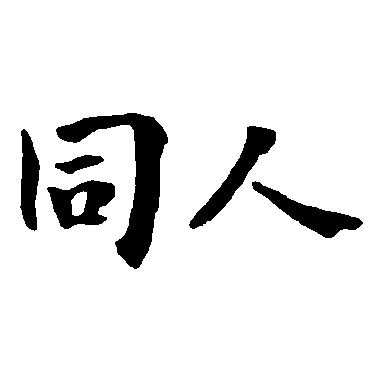 |
13. Tung Jên / Fellowship with Men
|
 |
The image of the upper trigram Ch’ien is heaven, and that of the lower, Li, is flame.
- It is the nature of fire to flame up to heaven. This gives the idea of fellowship.
- It is the second line that, by virtue of its central character, unites the five strong lines around it.
This hexagram forms a complement to Shih, THE ARMY (7).
- In the latter, danger is within and obedience without — the character of a warlike army, which, in order to hold together, needs one strong man among the many who are weak.
- Here, clarity is within and strength without — the character of a peaceful union of men, which, in order to hold together, needs one yielding nature among many firm persons.
- FELLOWSHIP WITH MEN in the open.
- Success.
- It furthers one to cross the great water.
- The perseverance of the superior man furthers.
True fellowship among men must be based upon a concern that is universal.
- It is not the private interests of the individual that create lasting fellowship among men, but rather the goals of humanity.
- That is why it is said that fellowship with men in the open succeeds.
If unity of this kind prevails, even difficult and dangerous tasks, such as crossing the great water, can be accomplished.
- But in order to bring about this sort of fellowship, a persevering and enlightened leader is needed — a man with clear, convincing, and inspiring aims and the strength to carry them out. (The inner trigram means clarity; the outer, strength.)
- Heaven together with fire:
- The image of FELLOWSHIP WITH MEN.
- Thus the superior man organizes the clans
- And makes distinctions between things.
Heaven has the same direction of movement as fire, yet it is different from fire.
- Just as the luminaries in the sky serve for the systematic division and arrangement of time, so human society and all things that really belong together must be organically arranged.
Fellowship should not be a mere mingling of individuals or of things — that would be chaos, not fellowship.
- If fellowship is to lead to order, there must be organization within diversity.
Nine at the beginning means:
- Fellowship with men at the gate.
- No blame.
The beginning of union among people should take place before the door.
- All are equally close to one another. No divergent aims have yet arisen, and one makes no mistakes.
- The basic principles of any kind of union must be equally accessible to all concerned.
- Secret agreements bring misfortune.
Six in the second place means:
- Fellowship with men in the clan.
- Humiliation.
There is danger here of formation of a separate faction on the basis of personal and egotistic interests.
- Such factions, which are exclusive and, instead of welcoming all men, must condemn one group in order to unite the others, originate from low motives and therefore lead in the course of time to humiliation.
Nine in the third place means:
- He hides weapons in the thicket;
- He climbs the high hill in front of it.
- For three years he does not rise up.
Here fellowship has changed about to mistrust.
- Each man distrusts the other, plans a secret ambush, and seeks to spy on his fellow from afar.
- We are dealing with an obstinate opponent whom we cannot come at by this method.
Obstacles standing in the way of fellowship with others are shown here.
- One has mental reservations for one’s own part and seeks to take his opponent by surprise.
- This very fact makes one mistrustful, suspecting the same wiles in his opponent and trying to ferret them out.
- The result is that one departs further and further from true fellowship.
- The longer this goes on, the more alienated one becomes.
Nine in the fourth place means:
- He climbs up on his wall; he cannot attack.
- Good fortune.
Here the reconciliation that follows quarrel moves nearer.
- It is true that there are still dividing walls on which we stand confronting one another.
- But the difficulties are too great.
- We get into straits, and this brings us to our senses.
- We cannot fight, and therein lies our good fortune.
Nine in the fifth place means:
- Men bound in fellowship first weep and lament,
- But afterward they laugh.
- After great struggles they succeed in meeting.
Two people are outwardly separated, but in their hearts they are united. They are kept apart by their positions in life.
- Many difficulties and obstructions arise between them and cause them grief.
- But, remaining true to each other, they allow nothing to separate them, and although it costs them a severe struggle to overcome the obstacles, they will succeed.
- When they come together their sadness will change to joy.
Confucius says of this:
- Life leads the thoughtful man on a path of many windings.
- Now the course is checked, now it runs straight again.
- Here winged thoughts may pour freely forth in words,
- There the heavy burden of knowledge must be shut away in silence.
- But when two people are at one in their inmost hearts,
- They shatter even the strength of iron or of bronze.
- And when two people understand each other in their inmost hearts,
- Their words are sweet and strong, like the fragrance of orchids.
Nine at the top means:
- Fellowship with men in the meadow.
- No remorse.
The warm attachment that springs from the heart is lacking here.
- We are by this time actually outside of fellowship with others. However, we ally ourselves with them.
- The fellowship does not include all, but only those who happen to dwell near one another.
The meadow is the pasture at the entrance to the town.
- At this stage, the ultimate goal of the union of mankind has not yet been attained, but we need not reproach ourselves.
- We join the community without separate aims of our own.
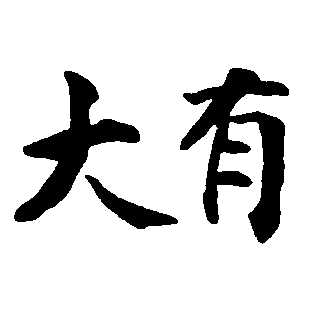 |
14. Ta Yu / Posession in Great Measure
|
 |
The fire in heaven above shines far, and all things stand out in the light and become manifest.
- The weak fifth line occupies the place of honor, and all the strong lines are in accord with it.
1
1 The meaning of this hexagram parallels the saying of Jesus: “Blessed are the meek: for they shall inherit the earth.”
All things come to the man who is modest and kind in a high position.1
- Supreme success.
The two trigrams indicate that strength and clarity unite.
- Possession in great measure is determined by fate and accords with the time.
How is it possible that the weak line has power to hold the strong lines fast and to possess them?
- It is done by virtue of unselfish modesty.
The time is favorable — a time of strength within, clarity and culture without.
2
2 It might be supposed that HOLDING TOGETHER (8) would be a more favorable hexagram than POSSESSION IN GREAT MEASURE, because in the former one strong individual gathers five weak ones around him.
But the judgment added in the present hexagram, “Supreme success,” is much the more favorable.
- The reason is that in the eighth hexagram the men held together by the powerful ruler are only simple subordinate persons, while here those who stand as helpers at the side of the mild ruler are strong and able individuals.
- Power is expressing itself in a graceful and controlled way. This brings supreme success and wealth.2
- Fire in heaven above:
- The image of POSSESSION IN GREAT MEASURE.
- Thus the superior man curbs evil and furthers good,
- And thereby obeys the benevolent will of heaven.
The sun in heaven above, shedding light over everything on earth, is the image of possession on a grand scale.
- But a possession of this sort must be administered properly.
The sun brings both evil and good into the light of day.
- Man must combat and curb the evil, and must favor and promote the good.
- Only in this way does he fulfill the benevolent will of God, who desires only good and not evil.
Nine at the beginning means:
- No relationship with what is harmful;
- There is no blame in this.
- If one remains conscious of difficulty,
- One remains without blame.
Great possession that is still in its beginnings and that has not yet been challenged brings no blame, since there has been no opportunity to make mistakes.
- Yet there are many difficulties to be overcome.
- It is only by remaining conscious of these difficulties that one can keep inwardly free of possible arrogance and wastefulness, and thus in principle overcome all cause for blame.
Nine in the second place means:
- A big wagon for loading.
- One may undertake something.
- No blame.
Great possession consists not only in the quantity of goods at one’s disposal, but, first and foremost, in their mobility and utility, for then they can be used in undertakings, and we remain free of embarrassment and mistakes.
- The big wagon, which will carry a heavy load and in which one can journey far, means that there are at hand able helpers who give their support and are equal to their task.
- One can load great responsibility upon such persons, and this is necessary in important undertakings.
Nine in the third place means:
- A prince offers it to the Son of Heaven.
- A petty man cannot do this.
A magnanimous, liberal-minded man should not regard what he possesses as his exclusive personal property, but should place it at the disposal of the ruler or of the people at large.
- In so doing, he takes the right attitude toward his possession, which as private property can never endure.
3
3 This offers the same dictum about possessions as that found in the words of the Bible:
“Whosoever shall seek to save his life shall lose it; and whosoever shall lose his life shall preserve it”
[Luke 17:33].
- A petty man is incapable of this. He is harmed by great possessions, because instead of sacrificing them, he would keep them for himself.3
Nine in the fourth place means:
- He makes a difference
- Between himself and his neighbor.
- No blame.
This characterizes the position of a man placed among rich and powerful neighbors.
- It is a dangerous position. He must look neither to the right nor to the left, and must shun envy and the temptation to vie with others.
4
4 Another generally accepted translation of the line is as follows:
He does not rely on his abundance.
No blame.
This would mean that the individual avoids mistakes because he possesses as if he possessed nothing.
No blame.
This would mean that the individual avoids mistakes because he possesses as if he possessed nothing.
- In this way he remains free of mistakes.4
Six in the fifth place means:
- He whose truth is accessible, yet dignified,
- Has good fortune.
The situation is very favorable. People are being won not by coercion but by unaffected sincerity, so that they are attached to us in sincerity and truth.
- However, benevolence alone is not sufficient at the time of POSSESSION IN GREAT MEASURE.
- For insolence might begin to spread. Insolence must be kept in bounds by dignity; then good fortune is assured.
Nine at the top means:
- He is blessed by heaven.
- Good fortune.
- Nothing that does not further.
In the fullness of possession and at the height of power, one remains modest and gives honor to the sage who stands outside the affairs of the world.
- By this means one puts oneself under the beneficent influence descending from heaven, and all goes well.
Confucius says of this line:
“To bless means to help. Heaven helps the man who is devoted; men help the man who is true. He who walks in truth and is devoted in his thinking, and furthermore reveres the worthy, is blessed by heaven. He has good fortune, and there is nothing that would not further.”
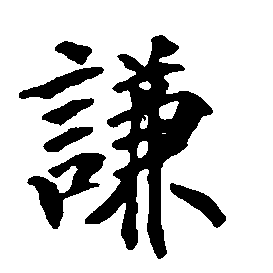 |
15. Ch'ien / Modesty
|
 |
This hexagram is made up of the trigrams Kên, Keeping Still, mountain, and K’un.
- The mountain is the youngest son of the Creative, the representative of heaven on earth.
- It dispenses the blessings of heaven, the clouds and rain that gather round its summit, and thereafter shines forth radiant with heavenly light.
- This shows what modesty is and how it functions in great and strong men.
K’un, the earth, stands above.
- Lowliness is a quality of the earth: this is the very reason why it appears in this hexagram as exalted, by being placed above the mountain.
- This shows how modesty functions in lowly, simple people: they are lifted up by it.
- MODESlY creates success.
- The superior man carries things through.
It is the law of heaven to make fullness empty and to make full what is modest.
- When the sun is at its zenith, it must, according to the law of heaven, turn toward its setting, and at its nadir it rises toward a new dawn.
- In obedience to the same law, the moon when it is full begins to wane, and when empty of light it waxes again.
- This heavenly law works itself out in the fates of men also.
It is the law of earth to alter the full and to contribute to the modest.
- High mountains are worn down by the waters, and the valleys are filled up.
- It is the law of fate to undermine what is full and to prosper the modest.
- And men also hate fullness and love the modest.
The destinies of men are subject to immutable laws that must fulfill themselves.
- But man has it in his power to shape his fate, according as his behavior exposes him to the influence of benevolent or of destructive forces.
- When a man holds a high position and is nevertheless modest, he shines with the light of wisdom;
- If he is in a lowly position and is modest, he cannot be passed by.
- Thus the superior man can carry out his work to the end without boasting of what he has achieved.
- Within the earth, a mountain:
- The image of MODESlY.
- Thus the superior man reduces that which is too much,
- And augments that which is too little.
- He weighs things and makes them equal.
The wealth of the earth in which a mountain is hidden is not visible to the eye, because the depths are offset by the height of the mountain.
- Thus high and low complement each other, and the result is the plain.
- Here an effect that it took a long time to achieve, but that in the end seems easy of accomplishment and self-evident, is used as the image of modesty.
1
1 This hexagram offers a number of parallels to the teachings of the Old and the New Testament, e.g.,
- “And whosoever shall exalt himself shall be abased; and he that shall humble himself shall be exalted” [Matt. 23:12];
- “Every valley shall be exalted, and every mountain and hill shall be made low: and the crooked shall be made straight, and the rough places plain” [Isa. 40:4];
- “God resisteth the proud, but giveth grace unto the humble” [Jas. 4:6].
- The concept of the Last Judgment in the Parsee religion shows similar features.
The Greek notion of the jealousy of the gods might be mentioned in connection with the third of the biblical passages here cited.
- The superior man does the same thing when he establishes order in the world; he equalizes the extremes that are the source of social discontent and thereby creates just and equable conditions.1
Six at the beginning means:
- A superior man modest about his modesty
- May cross the great water.
- Good fortune.
A dangerous enterprise, such as the crossing of a great stream, is made much more difficult if many claims and considerations have to be taken into account.
- On the other hand, the task is easy if it is attended to quickly and simply.
- Therefore the unassuming attitude of mind that goes with modesty fits a man to accomplish even difficult undertakings: he imposes no demands or stipulations but settles matters easily and quickly.
- Where no claims are put forward, no resistances arise.
Six in the second place means:
- Modesty that comes to expression.
- Perseverance brings good fortune.
“Out of the fullness of the heart the mouth speaketh.”
When a man’s attitude of mind is so modest that this expresses itself in his outward behavior, it is a source of good fortune to him.
- For the possibility of exerting a lasting influence arises of itself, and no one can interfere.
Nine in the third place means:
- A superior man of modesty and merit
- Carries things to conclusion.
- Good fortune.
This is the center of the hexagram, where its secret is disclosed.
- A distinguished name is readily earned by great achievements.
- If a man allows himself to be dazzled by fame, he will soon be criticized, and difficulties will arise.
- If, on the contrary, he remains modest despite his merit, he makes himself beloved and wins the support necessary for carrying his work through to the end.
Six in the fourth place means:
- Nothing that would not further modesty
- In movement.
Everything has its proper measure. Even modesty in behavior can be carried too far.
- Here, however, it is appropriate, because the place between a worthy helper below and a kindly ruler above carries great responsibility.
The confidence of the man in superior place must not be abused nor the merits of the man in inferior place concealed.
- There are officials who indeed do not strive for prominence; they hide behind the letter of the ordinances, decline all responsibility, accept pay without giving its equivalent in work, and bear empty titles.
This is the opposite of what is meant here by modesty.
- In such a position, modesty is shown by interest in one’s work.
Six in the fifth place means:
- No boasting of wealth before one’s neighbor.
- It is favorable to attack with force.
- Nothing that would not further.
Modesty is not to be confused with weak good nature that lets things take their own course.
- When a man holds a responsible position, he must at times resort to energetic measures.
- In doing so he must not try to make an impression by boasting of his superiority but must make certain of the people around him.
The measures taken should be purely objective and in no way personally offensive.
- Thus modesty manifests itself even in severity.
Six at the top means:
- Modesty that comes to expression.
- It is favorable to set armies marching
- To chastise one’s own city and one’s country.
A person who is really sincere in his modesty must make it show in reality.
- He must proceed with great energy in this.
When enmity arises nothing is easier than to lay the blame on another.
- A weak man takes offense perhaps, and draws back, feeling self-pity; he thinks that it is modesty that keeps him from defending himself.
Genuine modesty sets one to creating order and inspires one to begin by disciplining one’s own ego and one’s immediate circle.
2
2 There are not many hexagrams in the Book of Changes in which all the lines have an exclusively favorable meaning, as in the hexagram of MODESTY.
This shows how great a value Chinese wisdom places on this virtue.
- Only through having the courage to marshal one’s armies against oneself, will something forceful really be achieved.2
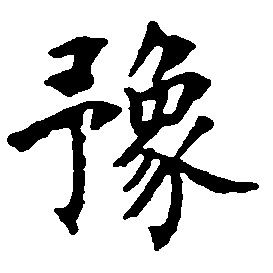 |
16. Yü / Enthusiasm
|
 |
The strong line in the fourth place, that of the leading official, meets with response and obedience from all the other lines, which are all weak.
- The attribute of the upper trigram, Chên, is movement;
- The attributes of K’un, the lower, are obedience and devotion.
This begins a movement that meets with devotion and therefore inspires enthusiasm, carrying all with it.
- Of great importance, furthermore, is the law of movement along the line of least resistance, which in this hexagram is enunciated as the law for natural events and for human life.
- ENTHUSIASM. It furthers one to install helpers
- And to set armies marching.
The time of ENTHUSIASM derives from the fact that there is at hand an eminent man who is in sympathy with the spirit of the people and acts in accord with it.
- Hence he finds universal and willing obedience.
To arouse enthusiasm it is necessary for a man to adjust himself and his ordinances to the character of those whom he has to lead.
- The inviolability of natural laws rests on this principle of movement along the line of least resistance.
- These laws are not forces external to things but represent the harmony of movement immanent in them.
That is why the celestial bodies do not deviate from their orbits and why all events in nature occur with fixed regularity.
- It is the same with human society: only such laws as are rooted in popular sentiment can be enforced, while laws violating this sentiment merely arouse resentment.
Again, it is enthusiasm that enables us to install helpers for the completion of an undertaking without fear of secret opposition.
- It is enthusiasm too that can unify mass movements, as in war, so that they achieve victory.
- Thunder comes resounding out of the earth:
- The image of ENTHUSIASM.
- Thus the ancient kings made music
- In order to honor merit,
- And offered it with splendor
- To the Supreme Deity,
- Inviting their ancestors to be present.
When, at the beginning of summer, thunder — electrical energy — comes rushing forth from the earth again, and the first thunderstorm refreshes nature, a prolonged state of tension is resolved.
- Joy and relief make themselves felt.
So too, music has power to ease tension within the heart and to loosen the grip of obscure emotions.
- The enthusiasm of the heart expresses itself involuntarily in a burst of song, in dance and rhythmic movement of the body.
- From immemorial times the inspiring effect of the invisible sound that moves all hearts, and draws them together, has mystified mankind.
Rulers have made use of this natural taste for music; they elevated and regulated it.
- Music was looked upon as something serious and holy, designed to purify the feelings of men.
- It fell to music to glorify the virtues of heroes and thus to construct a bridge to the world of the unseen.
- In the temple men drew near to God with music and pantomimes (out of this later the theater developed).
Religious feeling for the Creator of the world was united with the most sacred of human feelings, that of reverence for the ancestors.
- The ancestors were invited to these divine services as guests of the Ruler of Heaven and as representatives of humanity in the higher regions.
- This uniting of the human past with the Divinity in solemn moments of religious inspiration established the bond between God and man.
- The ruler who revered the Divinity in revering his ancestors became thereby the Son of Heaven, in whom the heavenly and the earthly world met in mystical contact.
These ideas are the final summation of Chinese culture. Confucius has said of the great sacrifice at which these rites were performed:
“He who could wholly comprehend this sacrifice could rule the world as though it were spinning on his hand.”
Six at the beginning means:
- Enthusiasm that expresses itself
- Brings misfortune.
A man in an inferior position has aristocratic connections about which he boasts enthusiastically.
- This arrogance inevitably invites misfortune.
Enthusiasm should never be an egotistic emotion;
- It is justified only when it is a general feeling that unites one with others.
Six in the second place means:
- Firm as a rock. Not a whole day.
- Perseverance brings good fortune.
This describes a person who does not allow himself to be misled by any illusions.
- While others are letting themselves be dazzled by enthusiasm, he recognizes with perfect clarity the first signs of the time.
- Thus he neither flatters those above nor neglects those beneath him; he is as firm as a rock.
When the first sign of discord appears, he knows the right moment for withdrawing and does not delay even for a day.
- Perseverance in such conduct will bring good fortune.
Confucius says about this line:
“To know the seeds, that is divine indeed. In his association with those above him, the superior man does not flatter. In his association with those beneath him, he is not arrogant. For he knows the seeds. The seeds are the first imperceptible beginning of movement, the first trace of good fortune (or misfortune) that shows itself. The superior man perceives the seeds and immediately takes action. He does not wait even a whole day. In the Book of Changes it is said: “Firm as a rock. Not a whole day. Perseverance brings good fortune.”
Firm as a rock, what need of a whole day?
The judgment can be known.
The superior man knows what is hidden and what is evident.
He knows weakness, he knows strength as well.
Hence the myriads look up to him.
Six in the third place means:
- Enthusiasm that looks upward creates remorse.
- Hesitation brings remorse.
This line is the opposite of the preceding one: the latter bespeaks self-reliance, while here there is enthusiastic looking up to a leader.
- If a man hesitates too long, this also will bring remorse.
- The right moment for approach must be seized: only then will he do the right thing.
Nine in the fourth place means:
- The source of enthusiasm.
- He achieves great things.
- Doubt not.
- You gather friends around you
- As a hair clasp gathers the hair.
This describes a man who is able to awaken enthusiasm through his own sureness and freedom from hesitation.
- He attracts people because he has no doubts and is wholly sincere.
- Owing to his confidence in them he wins their enthusiastic cooperation and attains success.
- Just as a clasp draws the hair together and holds it, so he draws men together by the support he gives them.
Six in the fifth place means:
- Persistently ill, and still does not die.
Here enthusiasm is obstructed. A man is under constant pressure, which prevents him from breathing freely.
- However, this pressure has its advantage — it prevents him from consuming his powers in empty enthusiasm.
- Thus constant pressure can actually serve to keep one alive.
Six at the top means:
- Deluded enthusiasm.
- But if after completion one changes,
- There is no blame.
It is a bad thing for a man to let himself be deluded by enthusiasm.
- But if this delusion has run its course, and he is still capable of changing, he is freed of error.
- A sober awakening from false enthusiasm is quite possible and very favorable.
 |
17. Sui / Following
|
 |
The trigram Tui, the Joyous, whose attribute is gladness, is above;
Chên, the Arousing, which has the attribute of movement, is below.
Chên, the Arousing, which has the attribute of movement, is below.
- Joy in movement induces following.
The Joyous is the youngest daughter, while the Arousing is the eldest son.
- An older man defers to a young girl and shows her consideration.
- By this he moves her to follow him.
- FOLLOWING has supreme success.
- Perseverance furthers. No blame.
In order to obtain a following one must first know how to adapt oneself.
If a man would rule he must first learn to serve, for only in this way does he secure from those below him the joyous assent that is necessary if they are to follow him.
- If he has to obtain a following by force or cunning, by conspiracy or by creating factions, he invariably arouses resistance, which obstructs willing adherence.
- But even joyous movement can lead to evil consequences, hence the added stipulation, “Perseverance furthers” — that is, consistency in doing right— together with “No blame.”
Just as we should not ask others to follow us unless this condition is fulfilled, so it is only under this condition that we can in turn follow others without coming to harm.
- The thought of obtaining a following through adaptation to the demands of the time is a great and significant idea; this is why the appended judgment is so favorable.
- Thunder in the middle of the lake:
- The image of FOLLOWING.
- Thus the superior man at nightfall
- Goes indoors for rest and recuperation.
In the autumn electricity withdraws into the earth again and rests.
- Here it is the thunder in the middle of the lake that serves as the image — thunder in its winter rest, not thunder in motion.
The idea of following in the sense of adaptation to the demands of the time grows out of this image.
- Thunder in the middle of the lake indicates times of darkness and rest.
- Similarly, a superior man, after being tirelessly active all day, allows himself rest and recuperation at night.
No situation can become favorable until one is able to adapt to it and does not wear himself out with mistaken resistance.
Nine at the beginning means:
- The standard is changing.
- Perseverance brings good fortune.
- To go out of the door in company
- Produces deeds.
There are exceptional conditions in which the relation between leader and followers changes.
- It is implicit in the idea of following and adaptation that if one wants to lead others, one must remain accessible and responsive to the views of those under him.
- At the same time, however, he must have firm principles, so that he does not vacillate where there is only a question of current opinion.
Once we are ready to listen to the opinions of others, we must not associate exclusively with people who share our views or with members of our own party;
- Instead, we must go out and mingle freely with all sorts of people, friends or foes.
- That is the only way to achieve something.
Six in the second place means:
- If one clings to the little boy,
- One loses the strong man.
In friendships and close relationships an individual must make a careful choice.
- He surrounds himself either with good or with bad company; he cannot have both at once.
- If he throws himself away on unworthy friends he loses connection with people of intellectual power who could further him in the good.
Six in the third place means:
- If one clings to the strong man,
- One loses the little boy.
- Through following one finds what one seeks.
- It furthers one to remain persevering
When the right connection with distinguished people has been found, a certain loss naturally ensues.
- A man must part company with the inferior and superficial.
- But in his heart he will feel satisfied, because he will find what he seeks and needs for the development of his personality.
- The important thing is to remain firm. He must know what he wants and not be led astray by momentary inclinations.
Nine in the fourth place means:
- Following creates success.
- Perseverance brings misfortune.
- To go one’s way with sincerity brings clarity.
- How could there be blame in this?
It often happens, when a man exerts a certain amount of influence, that he obtains a following by condescension toward inferiors.
- But the people who attach themselves to him are not honest in their intentions.
- They seek personal advantage and try to make themselves indispensable through flattery and subservience.
- If one becomes accustomed to such satellites and cannot do without them, it brings misfortune.
Only when a man is completely free from his ego, and intent, by conviction, upon what is right and essential, does he acquire the clarity that enables him to see through such people, and become free of blame.
Nine in the fifth place means:
- Sincere in the good. Good fortune.
Every man must have something he follows — something that serves him as a lodestar.
- He who follows with conviction the beautiful and the good may feel himself strengthened by this saying.
Six at the top means:
- He meets with firm allegiance
- And is still further bound.
- The king introduces him
- To the Western Mountain.
This refers to a man, an exalted sage, who has already put the turmoil of the world behind him.
- But a follower appears who understands him and is not to be put off.
- So the sage comes back into the world and aids the other in his work.
- Thus there develops an eternal tie between the two.
The allegory is chosen from the annals of the Chou dynasty.
- The rulers of this dynasty honored men who had served them well by awarding them a place in the royal family’s temple of ancestors on the Western Mountain.
- In this way they were regarded as sharing in the destiny of the ruling family.
 |
18. Ku / Work on What Has Been Spoiled [Decay]
|
 |
The Chinese character ku represents a bowl in whose contents worms are breeding. This means decay.
- It has come about because the gentle indifference of the lower trigram has come together with the rigid inertia of the upper, and the result is stagnation.
- Since this implies guilt, the conditions embody a demand for removal of the cause.
- Hence the meaning of the hexagram is not simply “what has been spoiled” but “work on what has been spoiled.”
- WORK ON WHAT HAS BEEN SPOILED
- Has supreme success.
- It furthers one to cross the great water.
- Before the starting point, three days.
- After the starting point, three days.
What has been spoiled through man’s fault can be made good again through man’s work.
- It is not immutable fate, as in the time of STANDSTILL, that has caused the state of corruption, but rather the abuse of human freedom.
- Work toward improving conditions promises well, because it accords with the possibilities of the time.
- We must not recoil from work and danger — symbolized by crossing of the great water — but must take hold energetically.
- Success depends, however, on proper deliberation. This is expressed by the lines,
- “Before the starting point, three days. After the starting point, three days.”
We must first know the causes of corruption before we can do away with them; hence it is necessary to be cautious during the time before the start.
- Then we must see to it that the new way is safely entered upon, so that a relapse may be avoided; therefore we must pay attention to the time after the start.
- Decisiveness and energy must take the place of the inertia and indifference that have led to decay, in order that the ending may be followed by a new beginning.
- The wind blows low on the mountain:
- The image of DECAY.
- Thus the superior man stirs up the people
- And strengthens their spirit.
When the wind blows low on the mountain, it is thrown back and spoils the vegetation. This contains a challenge to improvement.
- It is the same with debasing attitudes and fashions; they corrupt human society.
To do away with this corruption, the superior man must regenerate society.
- His methods likewise must be derived from the two trigrams, but in such a way that their effects unfold in orderly sequence.
- The superior man must first remove stagnation by stirring up public opinion, as the wind stirs everything, and must then strengthen and tranquillize the character of the people, as the mountain gives tranquility and nourishment to all that grows in its vicinity.
Six at the beginning means:
- Setting right what has been spoiled by the father.
- If there is a son,
- No blame rests upon the departed father.
- Danger. In the end good fortune.
Rigid adherence to tradition has resulted in decay.
- But the decay has not yet penetrated deeply and so can still be easily remedied.
- It is as if a son were compensating for the decay his father allowed to creep in.
- Then no blame attaches to the father.
However, one must not overlook the danger or take the matter too lightly.
- Only if one is conscious of the danger connected with every reform will everything go well in the end.
Nine in the second place means:
- Setting right what has been spoiled by the mother.
- One must not be too persevering.
This refers to mistakes that as a result of weakness have brought about decay — hence the symbol, “what has been spoiled by the mother.”
- In setting things right in such a case, a certain gentle consideration is called for. In order not to wound, one should not attempt to proceed too drastically.
Nine in the third place means:
- Setting right what has been spoiled by the father.
- There will be a little remorse. No great blame.
This describes a man who proceeds a little too energetically in righting the mistakes of the past.
- Now and then, as a result, minor discords and annoyances will surely develop. But too much energy is better than too little.
- Therefore, although he may at times have some slight cause for regret, he remains free of any serious blame.
Six in the fourth place means:
- Tolerating what has been spoiled by the father.
- In continuing one sees humiliation.
This shows the situation of someone too weak to take measures against decay that has its roots in the past and is just beginning to manifest itself.
- It is allowed to run its course.
- If this continues, humiliation will result.
Six in the fifth place means:
- Setting right what has been spoiled by the father.
- One meets with praise.
An individual is confronted with corruption originating from neglect in former times.
- He lacks the power to ward it off alone, but with able helpers he can at least bring about a thorough reform, if he cannot create a new beginning, and this also is praiseworthy.
Nine at the top means:
- He does not serve kings and princes,
- Sets himself higher goals.
Not every man has an obligation to mingle in the affairs of the world.
- There are some who are developed to such a degree that they are justified in letting the world go its own way and in refusing to enter public life with a view to reforming it.
But this does not imply a right to remain idle or to sit back and merely criticize.
- Such withdrawal is justified only when we strive to realize in ourselves the higher aims of mankind.
1
1 Goethe’s attitude after the Napoleonic wars is an example of this in European history.
- For although the sage remains distant from the turmoil of daily life, he creates incomparable human values for the future.1
 |
19. Lin / Approach
|
 |
The Chinese word lin has a range of meanings that is not exhausted by any single word of another language.
The ancient explanations in the Book of Changes give as its first meaning, “becoming great.”
- What becomes great are the two strong lines growing into the hexagram from below; the light-giving power expands with them.
- The meaning is then further extended to include the concept of approach, especially the approach of what is strong and highly placed in relation to what is lower.
- Finally the meaning includes the attitude of condescension of a man in high position toward the people, and in general the setting to work on affairs.
This hexagram is linked with the twelfth month (January-February), when, after the winter solstice, the light power begins to ascend again.
- APPPROACH has supreme success.
- Perseverance furthers.
- When the eighth month comes,
- There will be misfortune.
The hexagram as a whole points to a time of joyous, hopeful progress.
- Spring is approaching. Joy and forbearance bring high and low nearer together. Success is certain.
- But we must work with determination and perseverance to make full use of the propitiousness of the time.
And one thing more: spring does not last forever.
- In the eighth month the aspects are reversed.
- Then only two strong, light lines are left; these do not advance but are in retreat (see next hexagram).
We must take heed of this change in good time.
- If we meet evil before it becomes reality — before it has even begun to stir — we can master it.
- The earth above the lake:
- The image of APPROACH.
- Thus the superior man is inexhaustible
- In his will to teach,
- And without limits
- In his tolerance and protection of the people.
1
1 See the two trigrams.
The earth borders upon the lake from above.1
- This symbolizes the approach and condescension of the man of higher position to those beneath him.
The two parts of the image indicate what his attitude toward these people will be.
- Just as the lake is inexhaustible in depth, so the sage is inexhaustible in his readiness to teach mankind, and just as the earth is boundlessly wide, sustaining and caring for all creatures on it, so the sage sustains and cares for all people and excludes no part of humanity.
Nine at the beginning means:
- Joint approach.
- Perseverance brings good fortune.
The good begins to prevail and to find response in influential circles.
- This in turn is an incentive to men of ability.
- It is well to join this upward trend, but we must not let ourselves be carried away by the current of the time; we must adhere perseveringly to what is right.
- This brings good fortune.
Nine in the second place means:
- Joint approach. Good fortune.
- Everything furthers.
When the stimulus to approach comes from a high place, and when a man has the inner strength and consistency that need no admonition, good fortune will ensue.
- Nor need the future cause any concern.
He is well aware that everything earthly is transitory, and that a descent follows upon every rise, but need not be confused by this universal law of fate.
- Everything serves to further. Therefore he will travel the paths oflife swiftly, honestly, and valiantly.
Six in the third place means:
- Comfortable approach.
- Nothing that would further.
- If one is induced to grieve over it,
- One becomes free of blame.
Things are going well for a man: he achieves power and influence.
- But in this lies the danger that he may relax, and confident of his position, allow the easygoing, careless mood to show itself in his dealings with other people.
- This would inevitably be harmful.
But there is possibility of a change of mood.
- If he regrets his mistaken attitude and feels the responsibility of an influential position, he frees himself of faults.
Six in the fourth place means:
- Complete approach.
- No blame.
While the three lower lines indicate rise to power and influence, the three upper lines show the attitude of persons in higher position toward those of lower rank for whom they procure influence.
- Here is shown the open-minded approach of a person of high rank to a man of ability whom he draws into his own circle, regardless of class prejudice.
- This is very favorable.
Six in the fifth place means:
- Wise approach.
- This is right for a great prince.
- Good fortune.
A prince, or anyone in a leading position, must have the wisdom to attract to himself people of ability who are expert in directing affairs.
- His wisdom consists both in selecting the right people and in allowing those chosen to have a free hand without interference from him.
- For only through such self-restraint will he find the experts needed to satisfy all of his requirements.
Six at the top means:
- Greathearted approach.
- Good fortune. No blame.
A sage who has put the world behind him and who in spirit has already withdrawn from life may, under certain circumstances, decide to return once more to the here and now and to approach other men.
- This means great good fortune for the men whom he teaches and helps.
- And for him this greathearted humbling of himself is blameless.
 |
20. Kuan / Contemplation (View)
|
 |
A slight variation of tonal stress gives the Chinese name for this hexagram a double meaning.
- It means both contemplating and being seen, in the sense of being an example.
- These ideas are suggested by the fact that the hexagram can be understood as picturing a type of tower characteristic of ancient China.
A tower of this kind commanded a wide view of the country; at the same time, when situated on a mountain, it became a landmark that could be seen for miles around.
- Thus the hexagram shows a ruler who contemplates the law of heaven above him and the ways of the people below, and who, by means of good government, sets a lofty example to the masses.
This hexagram is linked with the eighth month (September-October).
- The light-giving power retreats and the dark power is again on the increase.
- However, this aspect is not material in the interpretation of the hexagram as a whole.
- CONTEMPLATION. The ablution has been made,
- But not yet the offering.
- Full of trust they look up to him.
The sacrificial ritual in China began with an ablution and a libation by which the Deity was invoked, after which the sacrifice was offered.
- The moment of time between these two ceremonies is the most sacred of all, the moment of deepest inner concentration.
- If piety is sincere and expressive of real faith, the contemplation of it has a transforming and awe-inspiring effect on those who witness it.
- Thus also in nature a holy seriousness is to be seen in the fact that natural occurrences are uniformly subject to law.
Contemplation of the divine meaning underlying the workings of the universe gives to the man who is called upon to influence others the means of producing like effects.
- This requires that power of inner concentration which religious contemplation develops in great men strong in faith.
- It enables them to apprehend the mysterious and divine laws of life, and by means of profoundest inner concentration they give expression to these laws in their own persons.
- Thus a hidden spiritual power emanates from them, influencing and dominating others without their being aware of how it happens.
- The wind blows over the earth:
- The image of CONTEMPLATION.
- Thus the kings of old visited the regions of the world,
- Contemplated the people,
- And gave them instruction.
When the wind blows over the earth it goes far and wide, and the grass must bend to its power.
- These two occurrences find confirmation in the hexagram.
The two images are used to symbolize a practice of the kings of old;
- In making regular journeys the ruler could, in the first place, survey his realm and make certain that none of the existing usages of the people escaped notice;
- In the second, he could exert influence through which such customs as were unsuitable could be changed.
All of this points to the power possessed by a superior personality.
- On the one hand, such a man will have a view of the real sentiments of the great mass of humanity and therefore cannot be deceived;
- On the other, he will impress the people so profoundly, by his mere existence and by the impact of his personality, that they will be swayed by him as the grass by the wind.
Six at the beginning means:
- Boylike contemplation.
- For an inferior man, no blame.
- For a superior man, humiliation.
This means contemplation from a distance, without comprehension.
A man of influence is at hand, but his influence is not understood by the common people.
- This matters little in the case of the masses, for they benefit by the actions of the ruling sage whether they understand them or not.
- But for a superior man it is a disgrace.
- He must not content himself with a shallow, thoughtless view of prevailing forces; he must contemplate them as a connected whole and try to understand them.
Six in the second place means:
- Contemplation through the crack of the door.
- Furthering for the perseverance of a woman.
Through the crack of the door one has a limited outlook; one looks outward from within.
- Contemplation is subjectively limited.
- One tends to relate everything to oneself and cannot put oneself in another’s place and understand his motives.
- This is appropriate for a good housewife. It is not necessary for her to be conversant with the affairs of the world.
- But for a man who must take active part in public life, such a narrow, egotistic way of contemplating things is of course harmful.
Six in the third place means:
- Contemplation of my life
- Decides the choice
- Between advance and retreat.
This is the place of transition.
- We no longer look outward to receive pictures that are more or less limited and confused, but direct our contemplation upon ourselves in order to find a guideline for our decisions.
- This self-contemplation means the overcoming of naive egotism in the person who sees everything solely from his own standpoint.
He begins to reflect and in this way acquires objectivity.
- However, self-knowledge does not mean preoccupation with one’s own thoughts; rather, it means concern about the effects one creates.
- It is only the effects our lives produce that give us the right to judge whether what we have done means progress or regression.
Six in the fourth place means:
- Contemplation of the light of the kingdom.
- It furthers one to exert influence as the guest of a king.
This describes a man who understands the secrets by which a kingdom can be made to flourish.
- Such a man must be given an authoritative position, in which he can exert influence.
- He should be, so to speak, a guest — that is, he should be honored and allowed to act independently, and should not be used as a tool.
Nine in the fifth place means:
- Contemplation of my life.
- The superior man is without blame.
A man in an authoritative position to whom others look up must always be ready for self-examination.
- The right sort of self-examination, however, consists not in idle brooding over oneself but in examining the effects one produces.
- Only when these effects are good, and when one’s influence on others is good, will the contemplation of one’s own life bring the satisfaction of knowing oneself to be free of mistakes.
Nine at the top means:
- Contemplation of his life.
- The superior man is without blame.
While the preceding line represents a man who contemplates himself, here in the highest place everything that is personal, related to the ego, is excluded.
- The picture is that of a sage who stands outside the affairs of the world.
- Liberated from his ego, he contemplates the laws of life and so realizes that knowing how to become free of blame is the highest good.
 |
21. Shih Ho / Biting Through
|
 |
1
1 Apart from the meaning of the hexagram as a whole, the single lines are explained as follows:
- The persons represented by the first and the top line suffer punishment,
- The others inflict it.
- (see the corresponding lines in hexagram 4, Mêng, YOUTHFUL FOLLY)
This hexagram represents an open mouth (cf. hexagram 27) with an obstruction (in the fourth place) between the teeth. As a result the lips cannot meet.
- To bring them together one must bite energetically through the obstacle.
Since the hexagram is made up of the trigrams for thunder and for lightning, it indicates how obstacles are forcibly removed in nature.
- Energetic biting through overcomes the obstacle that prevents joining of the lips;
- The storm with its thunder and lightning overcomes the disturbing tension in nature.
- Recourse to law and penalties overcomes the disturbances of harmonious social life caused by criminals and slanderers.
The theme of this hexagram is a criminal lawsuit, in contradistinction to that of Sung, CONFLICT (6), which refers to civil suits.
- BITING THROUGH has success.
- It is favorable to let justice be administered.
When an obstacle to union arises, energetic biting through brings success. This is true in all situations.
- Whenever unity cannot be established, the obstruction is due to a talebearer and traitor who is interfering and blocking the way.
- To prevent permanent injury, vigorous measures must be taken at once. Deliberate obstruction of this sort does not vanish of its own accord.
- Judgment and punishment are required to deter or obviate it.
However, it is important to proceed in the right way.
- The hexagram combines Li, clarity, and Chên, excitement. Li is yielding, Chên is hard.
- Unqualified hardness and excitement would be too violent in meting out punishment;
- Unqualified clarity and gentleness would be too weak.
- The two together create the just measure.
It is of moment that the man who makes the decisions (represented by the fifth line) is gentle by nature, while he commands respect by his conduct in his position.
- Thunder and lightning:
- The image of BITING THROUGH.
- Thus the kings of former times made firm the laws
- Through clearly defined penalties.
Penalties are the individual applications of the law. The laws specify the penalties.
Clarity prevails when mild and severe penalties are clearly differentiated, according to the nature of the crimes.
- This is symbolized by the clarity of lightning.
The law is strengthened by a just application of penalties.
- This is symbolized by the terror of thunder.
This clarity and severity have the effect of instilling respect; it is not that the penalties are ends in themselves.
The obstructions in the social life of man increase when there is lack of clarity in the penal codes and slackness in executing them.
- The only way to strengthen the law is to make it clear and to make penalties certain and swift.
Nine at the beginning means:
- His feet are fastened in the stocks,
- So that his toes disappear.
- No blame.
If a sentence is imposed the first time a man attempts to do wrong, the penalty is a mild one.
- Only the toes are put in the stocks.
- This prevents him from sinning further and thus he becomes free of blame.
- It is a warning to halt in time on the path of evil.
Six in the second place means:
- Bites through tender meat,
- So that his nose disappears.
- No blame.
It is easy to discriminate between right and wrong in this case; it is like biting through tender meat.
- But one encounters a hardened sinner, and, aroused by anger, one goes a little too far.
- The disappearance of the nose in the course of the bite signifies that indignation blots out finer sensibility.
- However, there is no great harm in this, because the penalty as such is just.
Six in the third place means:
- Bites on old dried meat
- And strikes on something poisonous.
- Slight humiliation. No blame.
Punishment is to be carried out by someone who lacks the power and authority to do so.
- Therefore the culprits do not submit.
The matter at issue is an old one — as symbolized by salted game — and in dealing with it difficulties arise.
- This old meat is spoiled: by taking up the problem the punisher arouses poisonous hatred against himself, and in this way is put in a somewhat humiliating position.
- But since punishment was required by the time, he remains free of blame.
Nine in the fourth place means:
- Bites on dried gristly meat.
- Receives metal arrows.
- It furthers one to be mindful of difficulties
- And to be persevering.
- Good fortune.
There are great obstacles to be overcome, powerful opponents are to be punished.
- Though this is arduous, the effort succeeds.
- But it is necessary to be hard as metal and straight as an arrow to surmount the difficulties.
- If one knows these difficulties and remains persevering, he attains good fortune.
- The difficult task is achieved in the end.
Six in the fifth place means:
- Bites on dried lean meat.
- Receives yellow gold.
- Perseveringly aware of danger.
- No blame.
The case to be decided is indeed not easy but perfectly clear.
- Since we naturally incline to leniency, we must make every effort to be like yellow gold — that is, as true as gold and as impartial as yellow, the color of the middle [the mean].
- It is only by remaining conscious of the dangers growing out of the responsibility we have assumed that we can avoid making mistakes.
Nine at the top means:
- His neck is fastened in the wooden cangue,
- So that his ears disappear.
- Misfortune.
In contrast to the first line, this line refers to a man who is incorrigible.
- His punishment is the wooden cangue, and his ears disappear under it — that is to say, he is deaf to warnings.
2
2 It should be noted here that there is an alternative interpretation of this hexagram, based on the idea, “Above, light (the sun); below, movement.”
- In this interpretation the hexagram symbolizes a market below, full of movement, while the sun is shining in the sky above.
- The allusion to meat suggests that it is a food market. Gold and arrows are articles of trade.
The disappearance of the nose means the vanishing of smell, that is, the person in question is not covetous.
- The idea of poison points to the dangers of wealth, and so on throughout.
Confucius says in regard to the nine at the beginning in this hexagram:
“The inferior man is not ashamed of unkindness and does not shrink from injustice. If no advantage beckons he makes no effort. If he is not intimidated he does not improve himself, but if he is made to behave correctly in small matters he is careful in large ones. This is fortunate for the inferior man.”
On the subject of the nine at the top Confucius says:
“If good does not accumulate, it is not enough to make a name for a man. If evil does not accumulate, it is not strong enough to destroy a man. Therefore the inferior man thinks to himself, ‘Goodness in small things has no value,’ and so neglects it. He thinks, ‘Small sins do no harm,’ and so does not give them up. Thus his sins accumulate until they can no longer be covered up, and his guilt becomes so great that it can no longer be wiped out.”
- This obstinacy leads to misfortune.2
 |
22. Pi / Grace
|
 |
This hexagram shows a fire that breaks out of the secret depths of the earth and, blazing up, illuminates and beautifies the mountain, the heavenly heights.
- Grace — beauty of form — is necessary in any union if it is to be well ordered and pleasing rather than disordered and chaotic.
- GRACE has success.
- In small matters
- It is favorable to undertake something.
Grace brings success. However, it is not the essential or fundamental thing; it is only the ornament and must therefore be used sparingly and only in little things.
- In the lower trigram of fire a yielding line comes between two strong lines and makes them beautiful, but the strong lines are the essential content and the weak line is the beautifying form.
- In the upper trigram of the mountain, the strong line takes the lead, so that here again the strong element must be regarded as the decisive factor.
In nature we see in the sky the strong light of the sun; the life of the world depends on it.
- But this strong, essential thing is changed and given pleasing variety by the moon and the stars.
In human affairs, aesthetic form comes into being when traditions exist that, strong and abiding like mountains, are made pleasing by a lucid beauty.
- By contemplating the forms existing in the heavens we come to understand time and its changing demands.
1
1 This hexagram shows tranquil beauty — clarity within, quiet without.
- This is the tranquillity of pure contemplation.
When desire is silenced and the will comes to rest, the world-as-idea becomes manifest.
- In this aspect the world is beautiful and removed from the struggle for existence.
- This is the world of art.
However, contemplation alone will not put the will to rest absolutely.
- It will awaken again, and then all the beauty of form will appear to have been only a brief moment of exaltation.
- Hence this is still not the true way of redemption.
- For this reason Confucius felt very uncomfortable when once, on consulting the oracle, he obtained the hexagram of GRACE.
- Through contemplation of the forms existing in human society it becomes possible to shape the world.1
- Fire at the foot of the mountain:
- The image of GRACE.
- Thus does the superior man proceed
- When clearing up current affairs.
- But he dare not decide controversial issues in this way.
The fire, whose light illuminates the mountain and makes it pleasing, does not shine far;
- In the same way, beautiful form suffices to brighten and to throw light upon matters of lesser moment, but important questions cannot be decided in this way. They require greater earnestness.
Nine at the beginning means:
- He lends grace to his toes, leaves the carriage, and walks.
A beginner in a subordinate place must take upon himself the labor of advancing.
- There might be an opportunity of surreptitiously easing the way — symbolized by the carriage — but a self-contained man scorns help gained in a dubious fashion.
- He thinks it more graceful to go on foot than to drive in a carriage under false pretenses.
Six in the second place means:
- Lends grace to the beard on his chin.
The beard is not an independent thing; it moves only with the chin.
- The image therefore means that form is to be considered only as a result and attribute of content.
The beard is a superfluous ornament.
- To devote care to it for its own sake, without regard for the inner content of which it is an ornament, would bespeak a certain vanity.
Nine in the third place means:
- Graceful and moist.
- Constant perseverance brings good fortune.
This represents a very charming life situation.
- One is under the spell of grace and the mellow mood induced by wine.
- This grace can adorn, but it can also swamp us.
- Hence the warning not to sink into convivial indolence but to remain constant in perseverance. Good fortune depends on this.
Six in the fourth place means:
- Grace or simplicity?
- A white horse comes as if on wings.
- He is not a robber,
- He will woo at the right time.
An individual is in a situation in which doubts arise as to which is better — to pursue the grace of external brilliance, or to return to simplicity.
- The doubt itself implies the answer.
Confirmation comes from the outside; it comes like a white winged horse.
- The white color indicates simplicity.
- At first it may be disappointing to renounce comforts that might have been obtained, yet one finds peace of mind in a true relationship with the friend who courts him.
- The winged horse is the symbol of the thoughts that transcend all limits of space and time.
Six in the fifth place means:
- Grace in hills and gardens.
- The roll of silk is meager and small.
- Humiliation, but in the end good fortune.
A man withdraws from contact with people of the lowlands, who seek nothing but magnificence and luxury, into the solitude of the heights.
- There he finds an individual to look up to, whom he would like to have as a friend.
- But the gifts he has to offer are poor and few, so that he feels ashamed.
- However, it is not the material gifts that count, but sincerity of feeling, and so all goes well in the end.
Nine at the top means:
- Simple grace. No blame.
Here at the highest stage of development all ornament is discarded.
- Form no longer conceals content but brings out its value to the full.
- Perfect grace consists not in exterior ornamentation of the substance, but in the simple fitness of its form.
 |
23. Po / Splitting Apart
|
 |
The dark lines are about to mount upward and overthrow the last firm, light line by exerting a disintegrating influence on it.
- The inferior, dark forces overcome what is superior and strong, not by direct means, but by undermining it gradually and imperceptibly, so that it finally collapses.
- The lines of the hexagram present the image of a house, the top line being the roof, and because the roof is being shattered the house collapses.
The hexagram belongs to the ninth month (October-November).
- The yin power pushes up ever more powerfully and is about to supplant the yang power altogether.
- SPLITTING APART. It does not further one
- To go anywhere.
This pictures a time when inferior people are pushing forward and are about to crowd out the few remaining strong and superior men.
- Under these circumstances, which are due to the time, it is not favorable for the superior man to undertake anything.
The right behavior in such adverse times is to be deduced from the images and their attributes.
- The lower trigram stands for the earth, whose attributes are docility and devotion.
- The upper trigram stands for the mountain, whose attribute is stillness.
This suggests that one should submit to the bad time and remain quiet.
- For it is a question not of man’s doing but of time conditions, which, according to the laws of heaven, show an alternation of increase and decrease, fullness and emptiness.
- It is impossible to counteract these conditions of the time.
- Hence it is not cowardice but wisdom to submit and avoid action.
- The mountain rests on the earth:
- The image of SPLITTING APART.
- Thus those above can ensure their position
- Only by giving generously to those below.
The mountain rests on the earth.
- When it is steep and narrow, lacking a broad base, it must topple over.
- Its position is strong only when it rises out of the earth broad and great, not proud and steep.
So likewise those who rule rest on the broad foundation of the people.
- They too should be generous and benevolent, like the earth that carries all.
- Then they will make their position as secure as a mountain is in its tranquility.
Six at the beginning means:
- The leg of the bed is split.
- Those who persevere are destroyed.
- Misfortune.
Inferior people are on the rise and stealthily begin their destructive burrowing from below in order to undermine the place where the superior man rests.
- Those followers of the ruler who remain loyal are destroyed by slander and intrigue.
- The situation bodes disaster, yet there is nothing to do but wait.
Six in the second place means:
- The bed is split at the edge.
- Those who persevere are destroyed.
- Misfortune.
The power of the inferior people is growing.
- The danger draws close to one’s person; already there are clear indications, and rest is disturbed.
Moreover, in this dangerous situation one is as yet without help or friendly advances from above or below.
- Extreme caution is necessary in this isolation. One must adjust to the time and promptly avoid the danger.
- Stubborn perseverance in maintaining one’s standpoint would lead to downfall.
Six in the third place means:
- He splits with them. No blame.
An individual finds himself in an evil environment to which he is committed by external ties.
- But he has an inner relationship with a superior man, and through this he attains the stability to free himself from the way of the inferior people around him.
- This brings him into opposition to them of course, but that is not wrong.
Six in the fourth place means:
- The bed is split up to the skin.
- Misfortune.
Here the disaster affects not only the resting place but even the occupant.
- No warning or other comment is added.
- Misfortune has reached its peak: it can no longer be warded off.
Six in the fifth place means:
- A shoal of fishes. Favor comes through the court ladies.
- Everything acts to further.
Here, in immediate proximity to the strong, light-giving principle at the top, the nature of the dark force undergoes a change.
- It no longer opposes the strong principle by means of intrigues but submits to its guidance.
- Indeed, as the head of the other weak lines, it leads all of these to the strong line, just as a princess leads her maids-in-waiting like a shoal of fishes to her husband and thus gains his favor.
- Inasmuch as the lower element thus voluntarily places itself under the higher, it attains happiness and the higher also receives its due. Therefore all goes well.
Nine at the top means:
- There is a large fruit still uneaten.
- The superior man receives a carriage.
- The house of the inferior man is split apart.
Here the splitting apart reaches its end.
- When misfortune has spent itself, better times return.
- The seed of the good remains, and it is just when the fruit falls to the ground that good sprouts anew from its seed.
The superior man again attains influence and effectiveness.
- He is supported by public opinion as if in a carriage.
- But the inferior man’s wickedness is visited upon himself.
- His house is split apart.
A law of nature is at work here.
- Evil is not destructive to the good alone but inevitably destroys itself as well.
- For evil, which lives solely by negation, cannot continue to exist on its own strength alone.
- The inferior man himself fares best when held under control by a superior man.
 |
24. Fu / Return (The Turning Point)
|
 |
The idea of a turning point arises from the fact that after the dark lines have pushed all of the light lines upward and out of the hexagram, another light line enters the hexagram from below.
- The time of darkness is past.
- The winter solstice brings the victory of light.
- This hexagram is linked with the eleventh month, the month of the solstice (December-January).
- RETURN. Success.
- Going out and coming in without error.
- Friends come without blame.
- To and fro goes the way.
- On the seventh day comes return.
- It furthers one to have somewhere to go.
After a time of decay comes the turning point.
- The powerful light that has been banished returns.
- There is movement, but it is not brought about by force.
The upper trigram K’un is characterized by devotion; thus the movement is natural, arising spontaneously.
- For this reason the transformation of the old becomes easy.
- The old is discarded and the new is introduced.
- Both measures accord with the time; therefore no harm results.
Societies of people sharing the same views are formed.
- But since these groups come together in full public knowledge and are in harmony with the time, all selfish separatist tendencies are excluded, and no mistake is made.
The idea of RETURN is based on the course of nature.
- The movement is cyclic, and the course completes itself.
- Therefore it is not necessary to hasten anything artificially.
- Everything comes of itself at the appointed time.
- This is the meaning of heaven and earth.
All movements are accomplished in six stages, and the seventh brings return.
- Thus the winter solstice, with which the decline of the year begins, comes in the seventh month after the summer solstice;
- So too sunrise comes in the seventh double hour after sunset.
Therefore seven is the number of the young light, and it arises when six, the number of the great darkness, is increased by one.
- In this way the state of rest gives place to movement.
- Thunder within the earth:
- The image of THE TURNING POINT.
- Thus the kings of antiquity closed the passes
- At the time of solstice.
- Merchants and strangers did not go about,
- And the ruler
- Did not travel through the provinces.
The winter solstice has always been celebrated in China as the resting time of the year — a custom that survives in the time of rest observed at the new year.
- In winter the life energy, symbolized by thunder, the Arousing, is still underground.
- Movement is just at its beginning; therefore it must be strengthened by rest, so that it will not be dissipated by being used prematurely.
This principle, i.e., of allowing energy that is renewing itself to be reinforced by rest, applies to all similar situations.
- The return of health after illness, the return of understanding after an estrangement: everything must be treated tenderly and with care at the beginning, so that the return may lead to a flowering.
Nine at the beginning means:
- Return from a short distance.
- No need for remorse.
- Great good fortune.
Slight digressions from the good cannot be avoided, but one must turn back in time, before going too far.
- This is especially important in the development of character; every faintly evil thought must be put aside immediately, before it goes too far and takes root in the mind.
- Then there is no cause for remorse, and all goes well.
Six in the second place means:
- Quiet return. Good fortune.
Return always calls for a decision and is an act of self-mastery.
- It is made easier if a man is in good company.
- If he can bring himself to put aside pride and follow the example of good men, good fortune results.
Six in the third place means:
- Repeated return. Danger. No blame.
There are people of a certain inner instability who feel a constant urge to reverse themselves.
- There is danger in continually deserting the good because of uncontrolled desires, then turning back to it again because of a better resolution.
- However, since this does not lead to habituation in evil, a general inclination to overcome the defect is not wholly excluded.
Six in the fourth place means:
- Walking in the midst of others,
- One returns alone.
A man is in a society composed of inferior people, but is connected spiritually with a strong and good friend, and this makes him turn back alone.
- Although nothing is said of reward and punishment, this return is certainly favorable, for such a resolve to choose the good brings its own reward.
Six in the fifth place means:
- Noblehearted return. No remorse.
When the time for return has come, a man should not take shelter in trivial excuses, but should look within and examine himself.
- And if he has done something wrong he should make a noblehearted resolve to confess his fault.
- No one will regret having taken this road.
Six at the top means:
- Missing the return. Misfortune.
- Misfortune from within and without.
- If armies are set marching in this way,
- One will in the end suffer a great defeat,
- Disastrous for the ruler of the country.
- For ten years
- It will not be possible to attack again.
If a man misses the right time for return, he meets with misfortune.
- The misfortune has its inner cause in a wrong attitude toward the world.
- The misfortune coming upon him from without results from this wrong attitude.
- What is pictured here is blind obstinacy and the judgment that is visited upon it.
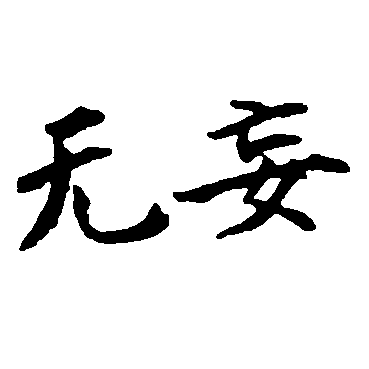 |
25. Wu Wang / Innocence (The Unexpected)
|
 |
Ch’ien, heaven, is above; Chên, movement, is below.
- The lower trigram Chên is under the influence of the strong line it has received from above, from heaven.
When, in accord with this, movement follows the law of heaven, man is innocent and without guile.
- His mind is natural and true, unshadowed by reflection or ulterior designs.
- For wherever conscious purpose is to be seen, there the truth and innocence of nature have been lost.
Nature that is not directed by the spirit is not true but degenerate nature.
- Starting out with the idea of the natural, the train of thought in part goes somewhat further and thus the hexagram includes also the idea of the unintentional or unexpected.
- INNOCENCE. Supreme success.
- Perseverance furthers.
- If someone is not as he should be,
- He has misfortune,
- And it does not further him
- To undertake anything.
Man has received from heaven a nature innately good, to guide him in all his movements.
- By devotion to this divine spirit within himself, he attains an unsullied innocence that leads him to do right with instinctive sureness and without any ulterior thought of reward and personal advantage.
- This instinctive certainty brings about supreme success and “furthers through perseverance.”
However, not everything instinctive is nature in this higher sense of the word, but only that which is right and in accord with the will of heaven.
- Without this quality of rightness, an unreflecting, instinctive way of acting brings only misfortune.
Confucius says about this:
“He who departs from innocence, what does he come to?
Heaven’s will and blessing do not go with his deeds.”
- Under heaven thunder rolls:
- All things attain the natural state of innocence.
- Thus the kings of old,
- Rich in virtue, and in harmony with the time,
- Fostered and nourished all beings.
In springtime when thunder, life energy, begins to move again under the heavens, everything sprouts and grows, and all beings receive from the creative activity of nature the childlike innocence of their original state.
So it is with the good rulers of mankind: drawing on the spiritual wealth at their command, they take care of all forms of life and all forms of culture and do everything to further them, and at the proper time.
Nine at the beginning means:
- Innocent behavior brings good fortune.
The original impulses of the heart are always good, so that we may follow them confidently, assured of good fortune and achievement of our aims.
Six in the second place means:
- If one does not count on the harvest while plowing,
- Nor on the use of the ground while clearing it,
- It furthers one to undertake something.
We should do every task for its own sake as time and place demand and not with an eye to the result.
- Then each task turns out well, and anything we undertake succeeds.
Six in the third place means:
- Undeserved misfortune.
- The cow that was tethered by someone
- Is the wanderer’s gain, the citizen’s loss.
Sometimes undeserved misfortune befalls a man at the hands of another, as for instance when someone passes by and takes a tethered cow along with him.
- His gain is the owner’s loss.
- In all transactions, no matter how innocent, we must accommodate ourselves to the demands of the time, otherwise unexpected misfortune overtakes us.
Nine in the fourth place means:
- He who can be persevering
- Remains without blame.
We cannot lose what really belongs to us, even if we throw it away.
- Therefore we need have no anxiety.
- All that need concern us is that we should remain true to our own natures and not listen to others.
Nine in the fifth place means:
- Use no medicine in an illness
- Incurred through no fault of your own.
- It will pass of itself.
An unexpected evil may come accidentally from without.
- If it does not originate in one’s own nature or have a foothold there, one should not resort to external means to eradicate it, but should quietly let nature take its course. Then improvement will come of itself.
Nine at the top means:
- Innocent action brings misfortune.
- Nothing furthers.
When, in a given situation, the time is not ripe for further progress, the best thing to do is to wait quietly, without ulterior designs.
- If one acts thoughtlessly and tries to push ahead in opposition to fate, success will not be achieved.
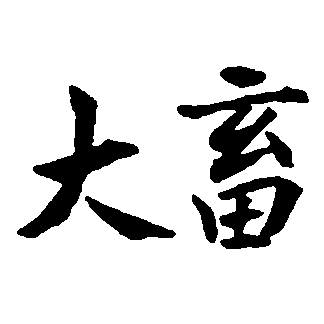 |
26. Ta Ch'u / The Taming Power of the Great
|
 |
The Creative is tamed by Kên, Keeping Still.
This produces great power, a situation in contrast to that of the ninth hexagram, Hsiao Ch’u, THE TAMING POWER OF THE SMALL, in which the Creative is tamed by the Gentle alone.
- There one weak line must tame five strong lines, but here four strong lines are restrained by two weak lines;
- In addition to a minister, there is a prince, and the restraining power therefore is far stronger.
The hexagram has a threefold meaning, expressing different aspects of the concept “holding firm.”
- Heaven within the mountain gives the idea of holding firm in the sense of holding together;
- The trigram Kên, which holds the trigram Ch’ien still, gives the idea of holding firm in the sense of holding back;
- The third idea is that of holding firm in the sense of caring for and nourishing.
This last is suggested by the fact that a strong line at the top, which is the ruler of the hexagram, is honored and tended as a sage.
- The third of these meanings also attaches specifically to this strong line at the top, which represents the sage.
- THE TAMING POWER OF THE GREAT.
- Perseverance furthers.
- Not eating at home brings good fortune.
- It furthers one to cross the great water.
To hold firmly to great creative powers and store them up, as set forth in this hexagram, there is need of a strong, clearheaded man who is honored by the ruler.
- The trigram Ch’ien points to strong creative power; Kên indicates firmness and truth.
- Both point to light and clarity and to the daily renewal of character.
- Only through such daily self-renewal can a man continue at the height of his powers.
Force of habit helps to keep order in quiet times; but in periods when there is a great storing up of energy, everything depends on the power of the personality.
- However, since the worthy are honored, as in the case of the strong personality entrusted with leadership by the ruler, it is an advantage not to eat at home but rather to earn one’s bread by entering upon public office.
- Such a man is in harmony with heaven; therefore even great and difficult undertakings, such as crossing the great water, succeed.
- Heaven within the mountain:
- The image of THE TAMING POWER OF THE GREAT.
- Thus the superior man acquaints himself with many sayings of antiquity
- And many deeds of the past,
- In order to strengthen his character thereby.
Heaven within the mountain points to hidden treasures.
- In the words and deeds of the past there lies hidden a treasure that men may use to strengthen and elevate their own characters.
- The way to study the past is not to confine oneself to mere knowledge of history but, through application of this knowledge, to give actuality to the past.
Nine at the beginning means:
- Danger is at hand. It furthers one to desist.
A man wishes to make vigorous advance, but circumstances present an obstacle.
- He sees himself held back firmly.
- If he should attempt to force an advance, it would lead him into misfortune.
- Therefore it is better for him to compose himself and to wait until an outlet is offered for release of his stored-up energies
Nine in the second place means:
- The axletrees are taken from the wagon.
Here advance is checked just as in the third line of THE TAMING POWER OF THE SMALL (9).
- However, in the latter the restraining force is slight; thus a conflict arises between the propulsive and the restraining movement, as a result of which the spokes fall out of the wagon wheels,
- While here the restraining force is absolutely superior; hence no struggle takes place.
One submits and removes the axletrees from the wagon — in other words, contents himself with waiting.
- In this way energy accumulates for a vigorous advance later on.
Nine in the third place means:
- A good horse that follows others.
- Awareness of danger,
- With perseverance, furthers.
- Practice chariot driving and armed defense daily.
- It furthers one to have somewhere to go.
The way opens; the hindrance has been cleared away.
- A man is in contact with a strong will acting in the same direction as his own, and goes forward like one good horse following another.
- But danger still threatens, and he must remain aware of it, or he will be robbed of his firmness.
Thus he must acquire skill on the one hand in what will take him forward, and on the other in what will protect him against unforeseen attacks.
- It is good in such a pass to have a goal toward which to strive.
Six in the fourth place means:
- The headboard of a young bull.
- Great good fortune.
This line and the one following it are the two that tame the forward-pushing lower lines.
- Before a bull’s horns grow out, a headboard is fastened to its forehead, so that later when the horns appear they cannot do harm.
- A good way to restrain wild force is to forestall it.
- By so doing one achieves an easy and a great success.
Six in the fifth place means:
- he tusk of a gelded boar.
- Good fortune.
Here the restraining of the impetuous forward drive is achieved in an indirect way.
- A boar’s tusk is in itself dangerous, but if the boar’s nature is altered, the tusk is no longer a menace.
- Thus also where men are concerned, wild force should not be combated directly; instead, its roots should be eradicated.
Nine at the top means:
- One attains the way of heaven. Success.
The time of obstruction is past.
- The energy long dammed up by inhibition forces its way out and achieves great success.
- This refers to a man who is honored by the ruler and whose principles now prevail and shape the world.
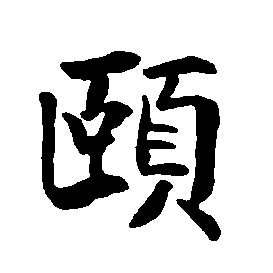 |
27. I / The Corners of the Mouth
|
 |
This hexagram is a picture of an open mouth; above and below are the firm lines of the lips, and between them the opening.
- Starting with the mouth, through which we take food for nourishment, the thought leads to nourishment itself.
- Nourishment of oneself, specifically of the body, is represented in the three lower lines,
- While the three upper lines represent nourishment and care of others, in a higher, spiritual sense.
- THE CORNERS OF THE MOUTH.
- Perseverance brings good fortune.
- Pay heed to the providing of nourishment
- And to what a man seeks
- To fill his own mouth with.
In bestowing care and nourishment, it is important that the right people should be taken care of and that we should attend to our own nourishment in the right way.
- If we wish to know what anyone is like, we have only to observe on whom he bestows his care and what sides of his own nature he cultivates and nourishes.
Nature nourishes all creatures.
- The great man fosters and takes care of superior men, in order to take care of all men through them.
Mencius says about this:
“If we wish to know whether anyone is superior or not, we need only observe what part of his being he regards as especially important. The body has superior and inferior, important and unimportant parts. We must not injure important parts for the sake of the unimportant, nor must we injure the superior parts for the sake of the inferior. He who cultivates the inferior parts of his nature is an inferior man. He who cultivates the superior parts of his nature is a superior man.”1
1
1 Book of Mencius, bk. VI, sec. A, 14. [Mencius lived from 389 to 305 B.C.]
1 Book of Mencius, bk. VI, sec. A, 14. [Mencius lived from 389 to 305 B.C.]
- At the foot of the mountain, thunder:
- The image of PROVIDING NOURISHMENT.
- Thus the superior man is careful of his words
- And temperate in eating and drinking.
2
2 See Book II, page 268, sec. 5.
“God comes forth in the sign of the Arousing”2:
- When in the spring the life forces stir again, all things come into being anew.
“He brings to perfection in the sign of Keeping Still”:
- Thus in the early spring, when the seeds fall to earth, all things are made ready.
- This is an image of providing nourishment through movement and tranquillity.
The superior man takes it as a pattern for the nourishment and cultivation of his character.
- Words are a movement going from within outward.
- Eating and drinking are movements from without inward.
- Both kinds of movement can be modified by tranquillity.
For tranquillity keeps the words that come out of the mouth from exceeding proper measure, and keeps the food that goes into the mouth from exceeding its proper measure. Thus character is cultivated.
Nine at the beginning means:
- You let your magic tortoise go,
- And look at me with the corners of your mouth drooping.
- Misfortune.
The magic tortoise is a creature possessed of such supernatural powers that it lives on air and needs no earthly nourishment.
- The image means that a man fitted by nature and position to live freely and independently renounces this self-reliance and instead looks with envy and discontent at others who are outwardly in better circumstances.
- But such base envy only arouses derision and contempt in those others.
- This has bad results.
Six in the second place means:
- Turning to the summit for nourishment,
- Deviating from the path
- To seek nourishment from the hill.
- Continuing to do this brings misfortune.
Normally a person either provides his own means of nourishment or is supported in a proper way by those whose duty and privilege it is to provide for him.
- If, owing to weakness of spirit, a man cannot support himself, a feeling of uneasiness comes over him;
- This is because in shirking the proper way of obtaining a living, he accepts support as a favor from those in higher place.
- This is unworthy, for he is deviating from his true nature.
- Kept up indefinitely, this course leads to misfortune.
Six in the third place means:
- Turning away from nourishment.
- Perseverance brings misfortune.
- Do not act thus for ten years.
- Nothing serves to further.
He who seeks nourishment that does not nourish reels from desire to gratification and in gratification craves desire.
- Mad pursuit of pleasure for the satisfaction of the senses never brings one to the goal.
- One should never (ten years is a complete cycle of time) follow this path, for nothing good can come of it.
Six in the fourth place means:
- Turning to the summit For provision of nourishment
- Brings good fortune.
- Spying about with sharp eyes
- Like a tiger with insatiable craving.
- No blame.
In contrast to the six in the second place, which refers to a man bent exclusively on his own advantage, this line refers to one occupying a high position and striving to let his light shine forth.
- To do this he needs helpers, because he cannot attain his lofty aim alone.
- With the greed of a hungry tiger he is on the lookout for the right people.
- Since he is not working for himself but for the good of all, there is no wrong in such zeal.
Six in the fifth place means:
- Turning away from the path.
- To remain persevering brings good fortune.
- One should not cross the great water.
A man may be conscious of a deficiency in himself.
- He should be undertaking the nourishment of the people, but he has not the strength to do it.
- Thus he must turn from his accustomed path and beg counsel and help from a man who is spiritually his superior but undistinguished outwardly.
If he maintains this attitude of mind perseveringly, success and good fortune are his.
- But he must remain aware of his dependence.
- He must not put his own person forward nor attempt great labors, such as crossing the great water.
Nine at the top means:
- The source of nourishment.
- Awareness of danger brings good fortune.
- It furthers one to cross the great water.
This describes a sage of the highest order, from whom emanate all influences that provide nourishment for others.
- Such a position brings with it heavy responsibility.
- If he remains conscious of this fact, he has good fortune and may confidently undertake even great and difficult labors, such as crossing the great water.
- These undertakings bring general happiness for him and for all others.
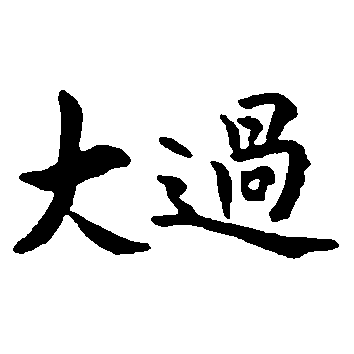 |
28. Ta Kuo / Preponderance of the Great
|
 |
This hexagram consists of four strong lines inside and two weak lines outside.
- When the strong are outside and the weak inside, all is well and there is nothing out of balance, nothing extraordinary in the situation.
- Here, however, the opposite is the case.
The hexagram represents a beam that is thick and heavy in the middle but too weak at the ends.
- This is a condition that cannot last; it must be changed, must pass, or misfortune will result.
- PREPONDERANCE OF THE GREAT.
- The ridgepole sags to the breaking point.
- It furthers one to have somewhere to go.
- Success.
The weight of the great is excessive. The load is too heavy for the strength of the supports.
- The ridgepole, on which the whole roof rests, sags to the breaking point, because its supporting ends are too weak for the load they bear.
- It is an exceptional time and situation; therefore extraordinary measures are demanded.
- It is necessary to find a way of transition as quickly as possible, and to take action.
This promises success. For although the strong element is in excess, it is in the middle, that is, at the center of gravity, so that a revolution is not to be feared.
- Nothing is to be achieved by forcible measures.
- The problem must be solved by gentle penetration to the meaning of the situation (as is suggested by the attribute of the inner trigram, Sun); then the change-over to other conditions will be successful.
- It demands real superiority; therefore the time when the great preponderates is a momentous time.
- The lake rises above the trees:
- The image of PREPONDERANCE OF THE GREAT.
- Thus the superior man, when he stands alone,
- Is unconcerned,
- And if he has to renounce the world,
- He is undaunted.
Extraordinary times when the great preponderates are like floodtimes when the lake rises over the treetops.
- But such conditions are temporary.
The two trigrams indicate the attitude proper to such exceptional times:
- The symbol of the trigram Sun is the tree, which stands firm even though it stands alone,
- And the attribute of Tui is joyousness, which remains undaunted even if it must renounce the world.
Six at the beginning means:
- To spread white rushes underneath.
- No blame.
When a man wishes to undertake an enterprise in extraordinary times, he must be extraordinarily cautious, just as when setting a heavy thing down on the floor, one takes care to put rushes under it, so that nothing will break.
- This caution, though it may seem exaggerated, is not a mistake.
- Exceptional enterprises cannot succeed unless utmost caution is observed in their beginnings and in the laying of their foundations.
Nine in the second place means:
- A dry poplar sprouts at the root.
- An older man takes a young wife.
- Everything furthers.
Wood is near water; hence the image of an old poplar sprouting at the root.
- This means an extraordinary reanimation of the processes of growth.
In the same way, an extraordinary situation arises when an older man marries a young girl who suits him.
- Despite the unusualness of the situation, all goes well.
- From the point of view of politics, the meaning is that in exceptional times one does well to join with the lowly, for this affords a possibility of renewal.
Nine in the third place means:
- The ridgepole sags to the breaking point.
- Misfortune.
This indicates a type of man who in times of preponderance of the great insists on pushing ahead.
- He accepts no advice from others, and therefore they in turn are not willing to lend him support.
- Because of this the burden grows, until the structure of things bends or breaks.
- Plunging willfully ahead in times of danger only hastens the catastrophe.
Nine in the fourth place means:
- The ridgepole is braced. Good fortune.
- If there are ulterior motives, it is humiliating.
Through friendly relations with people of lower rank, a responsible man succeeds in becoming master of the situation.
- But if, instead of working for the rescue of the whole, he were to misuse his connections to obtain personal power and success, it would lead to humiliation.
Nine in the fifth place means:
- A withered poplar puts forth flowers.
- An older woman takes a husband.
- No blame. No praise.
A withered poplar that flowers exhausts its energies thereby and only hastens its end.
- An older woman may marry once more, but no renewal takes place. Everything remains barren.
- Thus, though all the amenities are observed, the net result is only the anomaly of the situation.
Applied to politics, the metaphor means that if in times of insecurity we give up alliance with those below us and keep up only the relationships we have with people of higher rank, an unstable situation is created.
Six at the top means:
- One must go through the water.
- It goes over one’s head.
- Misfortune. No blame.
Here is a situation in which the unusual has reached a climax.
- One is courageous and wishes to accomplish one’s task, no matter what happens.
- This leads into danger. The water rises over one’s head. This is the misfortune.
- But one incurs no blame in giving up one’s life that the good and the right may prevail.
- There are things that are more important than life.
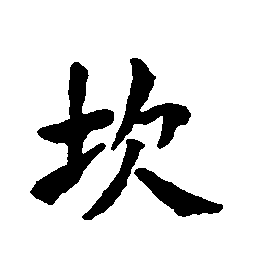 |
29. K'an / The Abysmal (Water)
|
 |
This hexagram consists of a doubling of the trigram K’an.
It is one of the eight hexagrams in which doubling occurs.
- The trigram K’an means a plunging in.
- A yang line has plunged in between two yin lines and is closed in by them like water in a ravine.
The trigram K’an is also the middle son.
- The Receptive has obtained the middle line of the Creative, and thus K’an develops.
As an image it represents water, the water that comes from above and is in motion on earth in streams and rivers, giving rise to all life on earth.
In man’s world K’an represents the heart, the soul locked up within the body, the principle of light inclosed in the dark — that is, reason.
- The name of the hexagram, because the trigram is doubled, has the additional meaning, “repetition of danger.”
- Thus the hexagram is intended to designate an objective situation to which one must become accustomed, not a subjective attitude.
For danger due to a subjective attitude means either foolhardiness or guile.
- Hence too a ravine is used to symbolize danger; it is a situation in which a man is in the same pass as the water in a ravine, and, like the water, he can escape if he behaves correctly.
- The Abysmal repeated.
- If you are sincere, you have success in your heart,
- And whatever you do succeeds.
Through repetition of danger we grow accustomed to it.
- Water sets the example for the right conduct under such circumstances.
- It flows on and on, and merely fills up all the places through which it flows; it does not shrink from any dangerous spot nor from any plunge, and nothing can make it lose its own essential nature.
- It remains true to itself under all conditions.
Thus likewise, if one is sincere when confronted with difficulties, the heart can penetrate the meaning of the situation.
- And once we have gained inner mastery of a problem, it will come about naturally that the action we take will succeed.
- In danger all that counts is really carrying out all that has to be done — thoroughness — and going forward, in order not to perish through tarrying in the danger.
Properly used, danger can have an important meaning as a protective measure.
- Thus heaven has its perilous height protecting it against every attempt at invasion, and earth has its mountains and bodies of water, separating countries by their dangers.
- Thus also rulers make use of danger to protect themselves against attacks from without and against turmoil within.
- Water flows on uninterruptedly and reaches its goal:
- The image of the Abysmal repeated.
- Thus the superior man walks in lasting virtue
- And carries on the business of teaching.
Water reaches its goal by flowing continually.
- It fills up every depression before it flows on.
The superior man follows its example; he is concerned that goodness should be an established attribute of character rather than an accidental and isolated occurrence.
- So likewise in teaching others everything depends on consistency, for it is only through repetition that the pupil makes the material his own.
Six at the beginning means:
- Repetition of the Abysmal.
- In the abyss one falls into a pit.
- Misfortune.
By growing used to what is dangerous, a man can easily allow it to become part of him.
- He is familiar with it and grows used to evil.
- With this he has lost the right way, and misfortune is the natural result.
Nine in the second place means:
- The abyss is dangerous.
- One should strive to attain small things only.
When we are in danger we ought not to attempt to get out of it immediately, regardless of circumstances; at first we must content ourselves with not being overcome by it.
- We must calmly weigh the conditions of the time and be satisfied with small gains, because for the time being a great success cannot be attained.
- A spring flows only sparingly at first, and tarries for some time before it makes its way into the open.
Six in the third place means:
- Forward and backward, abyss on abyss.
- In danger like this, pause at first and wait,
- Otherwise you will fall into a pit in the abyss.
- Do not act in this way.
Here every step, forward or backward, leads into danger. Escape is out of the question.
- Therefore we must not be misled into action, as a result of which we should only bog down deeper into the danger;
- Disagreeable as it may be to remain in such a situation, we must wait until a way out shows itself.
Six in the fourth place means:
- Six in the fourth place means:
- A jug of wine, a bowl of rice1 with it;
1
1 The usual translation, “two bowls of rice,” has been corrected on the basis of Chinese commentaries.
- Earthen vessels
- Simply handed in through the window.
- There is certainly no blame in this.
In times of danger ceremonious forms are dropped. What matters most is sincerity.
- Although as a rule it is customary for an official to present certain introductory gifts and recommendations before he is appointed, here everything is simplified to the utmost.
- The gifts are insignificant, there is no one to sponsor him, he introduces himself; yet all this need not be humiliating if only there is the honest intention of mutual help in danger.
Still another idea is suggested. The window is the place through which light enters the room.
- If in difficult times we want to enlighten someone, we must begin with that which is in itself lucid and proceed quite simply from that point on.
Nine in the fifth place means:
- The abyss is not filled to overflowing,
- It is filled only to the rim.
- No blame.
Danger comes because one is too ambitious.
- In order to flow out of a ravine, water does not rise higher than the lowest point of the rim.
- So likewise a man when in danger has only to proceed along the line of least resistance; thus he reaches the goal.
- Great labors cannot be accomplished in such times; it is enough to get out of the danger.
Six at the top means:
- Bound with cords and ropes,
- Shut in between thorn-hedged prison walls:
- For three years one does not find the way.
- Misfortune.
A man who in the extremity of danger has lost the right way and is irremediably entangled in his sins has no prospect of escape.
- He is like a criminal who sits shackled behind thorn-hedged prison walls.
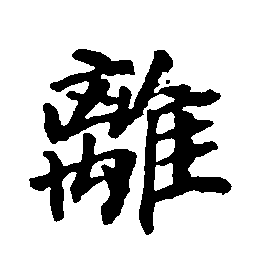 |
30. Li / The Clinging, Fire
|
 |
This hexagram is another double sign.
The trigram Li means, “to cling to something,” “to be conditioned,” “to depend or rest on something,” and also “brightness.”
- A dark line clings to two light lines, one above and one below-the image of an empty space between two strong lines, whereby the two strong lines are made bright.
The trigram represents the middle daughter.
- The Creative has incorporated the central line of the Receptive, and thus Li develops.
As an image, it is fire.
- Fire has no definite form but clings to the burning object and thus is bright.
- As water pours down from heaven, so fire flames up from the earth.
- While K’an means the soul shut within the body, Li stands for nature in its radiance.
- THE CLINGING. Perseverance furthers.
- It brings success.
- Care of the cow brings good fortune.
What is dark clings to what is light and so enhances the brightness of the latter.
- A luminous thing giving out light must have within itself something that perseveres; otherwise it will in time burn itself out.
- Everything that gives light is dependent on something to which it clings, in order that it may continue to shine.
Thus sun and moon cling to heaven, and grain, grass, and trees cling to the earth.
- So too the twofold clarity of the dedicated man clings to what is right and thereby can shape the world.
Human life on earth is conditioned and unfree, and when man recognizes this limitation and makes himself dependent upon the harmonious and beneficent forces of the cosmos, he achieves success.
- The cow is the symbol of extreme docility.
1
1 It is a noteworthy and curious coincidence that fire and care of the cow are connected here just as in the Parsee religion.
- According to the Parsee belief the Divine Light, or Fire, was manifested in the mineral, vegetable, and animal worlds
before it appeared in human form. - Its animal incarnation was the cow, and Ahura-Mazda was nourished on her milk.
- By cultivating in himself an attitude of compliance and voluntary dependence, man acquires clarity without sharpness and finds his place in the world.1
- That which is bright rises twice:
- The image of FIRE.
- Thus the great man, by perpetuating this brightness,
- Illumines the four quarters of the world.
Each of the two trigrams represents the sun in the course of a day.
- The two together represent the repeated movement of the sun, the function of light with respect to time.
The great man continues the work of nature in the human world.
- Through the clarity of his nature he causes the light to spread farther and farther and to penetrate the nature of man ever more deeply.
Nine at the beginning means:
- The footprints run crisscross.
- If one is seriously intent, no blame.
It is early morning and work begins. The mind has been closed to the outside world in sleep; now its connections with the world begin again.
- The traces of one’s impressions run crisscross.
- Activity and haste prevail.
- It is important then to preserve inner composure and not to allow oneself to be swept along by the bustle of life.
If one is serious and composed, he can acquire the clarity of mind needed for coming to terms with the innumerable impressions that pour in.
- It is precisely at the beginning that serious concentration is important, because the beginning holds the seed of all that is to follow.
Six in the second place means:
- Yellow light. Supreme good fortune.
Midday has come; the sun shines with a yellow light.
- Yellow is the color of measure and mean.
- Yellow light is therefore a symbol of the highest culture and art, whose consummate harmony consists in holding to the mean.
Nine in the third place means:
- In the light of the setting sun,
- Men either beat the pot and sing
- Or loudly bewail the approach of old age.
- Misfortune.
Here the end of the day has come.
- The light of the setting sun calls to mind the fact that life is transitory and conditional.
Caught in this external bondage, men are usually robbed of their inner freedom as well.
- The sense of the transitoriness of life impels them to uninhibited revelry in order to enjoy life while it lasts,
- Or else they yield to melancholy and spoil the precious time by lamenting the approach of old age.
- Both attitudes are wrong.
To the superior man it makes no difference whether death comes early or late.
- He cultivates himself, awaits his allotted time, and in this way secures his fate.
Nine in the fourth place means:
- Its coming is sudden;
- It flames up, dies down, is thrown away.
Clarity of mind has the same relation to life that fire has to wood.
- Fire clings to wood, but also consumes it.
- Clarity of mind is rooted in life but can also consume it.
- Everything depends upon how the clarity functions.
Here the image used is that of a meteor or a straw fire.
- A man who is excitable and restless may rise quickly to prominence but produces no lasting effects.
- Thus matters end badly when a man spends himself too rapidly and consumes himself like a meteor.
Six in the fifth place means:
- Tears in floods, sighing and lamenting.
- Good fortune.
Here the zenith of life has been reached.
- Were there no warning, one would at this point consume oneself like a flame.
Instead, understanding the vanity of all things, one may put aside both hope and fear, and sigh and lament:
- If one is intent on retaining his clarity of mind, good fortune will come from this grief.
- For here we are dealing not with a passing mood, as in the nine in the third place, but with a real change of heart.
Nine at the top means:
- The king uses him to march forth and chastise.
- Then it is best to kill the leaders
- And take captive the followers. No blame.
It is not the purpose of chastisement to impose punishment blindly but to create discipline.
Evil must be cured at its roots.
- To eradicate evil in political life, it is best to kill the ringleaders and spare the followers.
- In educating oneself it is best to root out bad habits and tolerate those that are harmless.
- For asceticism that is too strict, like sentences of undue severity, fails in its purpose.
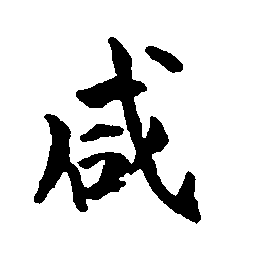 |
31. Hsien / Influence (Wooing)
|
 |
The name of the hexagram means “universal,” “general,” and in a figurative sense “to influence,” “to stimulate.”
- The upper trigram is Tui, the Joyous;
- The lower is Kên, Keeping Still.
By its persistent, quiet influence, the lower, rigid trigram stimulates the upper, weak trigram, which responds to this stimulation cheerfully and joyously.
- Kên, the lower trigram, is the youngest son; the upper, Tui, is the youngest daughter.
- Thus the universal mutual attraction between the sexes is represented.
- In courtship, the masculine principle must seize the initiative and place itself below the feminine principle.
Just as the first part of the book I begins with the hexagrams of heaven and earth, the foundations of all that exists, the second part begins with the hexagrams of courtship and marriage, the foundations of all social relationship
- Influence. Success.
- Perseverance furthers
- To take a maiden to wife brings good fortune.
The weak element is above, the strong below; hence their powers attract each other, so that they unite.
- This brings about success, for all success depends on the effect of mutual attraction.
- By keeping still within while experiencing joy without, one can prevent the joy from going to excess and hold it within proper bounds
This is the meaning of the added admonition, “Perseverance furthers,” for it is perseverance that makes the difference between seduction and courtship;
- In the latter the strong man takes a position inferior to that of the weak girl and shows consideration for her.
This attraction between affinities is a general law of nature.
- Heaven and earth attract each other and thus all creatures come into being.
- Through such attraction the sage influences men’s hearts, and thus the world attains peace.
- From the attractions they exert we can learn the nature of all beings in heaven and on earth.
- A lake on the mountain:
- The image of influence.
- Thus the superior man encourages people to approach him
- By his readiness to receive them.
A mountain with a lake on its summit is stimulated by the moisture from the lake.
- It has this advantage because its summit does not jut out as a peak but is sunken.
The image counsels that the mind should be kept humble and free, so that it may remain receptive to good advice.
- People soon give up counseling a man who thinks that he knows everything better than anyone else.
Six at the beginning means:
- The influence shows itself in the big toe.
A movement, before it is actually carried out, shows itself first in the toes.
- The idea of an influence is already present, but it is not immediately apparent to others.
- As long as the intention has no visible effect, it is of no importance to the outside world and leads neither to good nor to evil.
Six in the second place means:
- The influence shows itself in the calves of the legs.
- Misfortune.
- Tarrying brings good fortune.
In movement, the calf of the leg follows the foot; by itself it can neither go forward nor stand still.
- Since the movement is not self-governed, it bodes ill.
- One should wait quietly until one is impelled to action by a real influence.
- Then one remains uninjured.
Nine in the third place means:
- The influence shows itself in the thighs.
- Holds to that which follows it.
- To continue is humiliating.
Every mood of the heart influences us to movement.
- What the heart desires, the thighs run after without a moment’s hesitation; they hold to the heart, which they follow.
In the life of man, however, acting on the spur of every caprice is wrong and if continued leads to humiliation. Three considerations suggest themselves here.
- First, a man should not run precipitately after all the persons whom he would like to influence, but must be able to hold back under certain circumstances.
- As little should he yield immediately to every whim of those in whose service he stands.
- Finally, where the moods of his own heart are concerned, he should never ignore the possibility of inhibition, for this is the basis of human freedom.
Nine in the fourth place means:
- Perseverance brings good fortune.
- Remorse disappears.
- If a man is agitated in mind,
- And his thoughts go hither and thither,
- Only those friends
- On whom he fixes his conscious thoughts
- Will follow.
Here the place of the heart is reached.
- The impulse that springs from this source is the most important of all.
- It is of particular concern that this influence be constant and good; then, in spite of the danger arising from the great susceptibility of the human heart, there will be no cause for remorse.
When the quiet power of a man’s own character is at work, the effects produced are right.
- All those who are receptive to the vibrations of such a spirit will then be influenced.
Influence over others should not express itself as a conscious and willed effort to manipulate them.
- Through practicing such conscious incitement one becomes wrought up and is exhausted by the eternal stress and strain.
- Moreover, the effects produced are then limited to those on whom one’s thoughts are consciously fixed.
Nine in the fifth place means:
- The influence shows itself in the back of the neck.
- No remorse.
The back of the neck is the most rigid part of the body.
- When the influence shows itself there, the will remains firm and the influence does not lead to confusion.
- Hence remorse does not enter into consideration here.
What takes place in the depths of one’s being, in the unconscious, can neither be called forth nor prevented by the conscious mind.
- It is true that if we cannot be influenced ourselves, we cannot influence the outside world.
Six at the top means:
- The influence shows itself in the jaws, cheeks, and tongue.
The most superficial way of trying to influence others is through talk that has nothing real behind it.
- The influence produced by such mere tongue wagging must necessarily remain insignificant.
- Hence no indication is added regarding good or bad fortune.
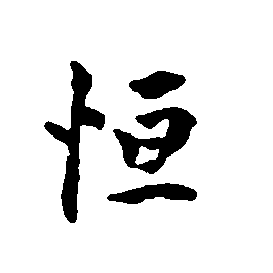 |
32. Hêng / Duration
|
 |
The strong trigram Chên is above, the weak trigram Sun below. This hexagram is the inverse of the preceding one.
- In the latter we have influence, here we have union as an enduring condition.
- The two images are thunder and wind, which are likewise constantly paired phenomena.
- The lower trigram indicates gentleness within; the upper, movement without.
In the sphere of social relationships, the hexagram represents the institution of marriage as the enduring union of the sexes.
- During courtship the young man subordinates himself to the girl,
- But in marriage, which is represented by the coming together of the eldest son and the eldest daughter, the husband is the directing and moving force outside, while the wife, inside, is gentle and submissive.
- DURATION. Success. No blame.
- Perseverance furthers.
- It furthers one to have somewhere to go.
Duration is a state whose movement is not worn down by hindrances.
- It is not a state of rest, for mere standstill is regression.
- Duration is rather the self-contained and therefore self-renewing movement of an organized, firmly integrated whole, taking place in accordance with immutable laws and beginning anew at every ending.
- The end is reached by an inward movement, by inhalation, systole, contraction, and this movement turns into a new beginning, in which the movement is directed outward, in exhalation, diastole, expansion.
Heavenly bodies exemplify duration.
- They move in their fixed orbits, and because of this their light-giving power endures.
- The seasons of the year follow a fixed law of change and transformation, hence can produce effects that endure.
So likewise the dedicated man embodies an enduring meaning in his way of life, and thereby the world is formed.
- In that which gives things their duration, we can come to understand the nature of all beings in heaven and on earth.
- Thunder and wind: the image of DURATION.
- Thus the superior man stands firm
- And does not change his direction.
Thunder rolls, and the wind blows; both are examples of extreme mobility and so are seemingly the very opposite of duration, but the laws governing their appearance and subsidence, their coming and going, endure.
- In the same way the independence of the superior man is not based on rigidity and immobility of character.
- He always keeps abreast of the time and changes with it.
- What endures is the unswerving directive, the inner law of his being, which determines all his actions.
Six at the beginning means:
- Seeking duration too hastily brings misfortune persistently.
- Nothing that would further.
Whatever endures can be created only gradually by long-continued work and careful reflection.
In the same sense Lao-tse says:
“If we wish to compress something, we must first let it fully expand.”
He who demands too much at once is acting precipitately, and because he attempts too much, he ends by succeeding in nothing.
Nine in the second place means:
- Remorse disappears.
The situation is abnormal.
- A man’s force of character is greater than the available material power.
- Thus he might be afraid of allowing himself to attempt something beyond his strength.
- However, since it is the time of DURATION, it is possible for him to control his inner strength and so to avoid excess.
- Cause for remorse then disappears.
Nine in the third place means:
- He who does not give duration to his character
- Meets with disgrace.
- Persistent humiliation.
If a man remains at the mercy of moods of hope or fear aroused by the outer world, he loses his inner consistency of character.
- Such inconsistency invariably leads to distressing experiences.
- These humiliations often come from an unforeseen quarter.
- Such experiences are not merely effects produced by the external world, but logical consequences evoked by his own nature.
Nine in the fourth place means:
- No game in the field.
If we are in pursuit of game and want to get a shot at a quarry, we must set about it in the right way.
- A man who persists in stalking game in a place where there is none may wait forever without finding any.
- Persistence in search is not enough. What is not sought in the right way is not found.
Six in the fifth place means:
- Giving duration to one’s character through perseverance.
- This is good fortune for a woman, misfortune for a man.
A woman should follow a man her whole life long, but a man should at all times hold to what is his duty at the given moment.
- Should he persistently seek to conform to the woman, it would be a mistake for him.
- Accordingly it is altogether right for a woman to hold conservatively to tradition,
- But a man must always be flexible and adaptable and allow himself to be guided solely by what his duty requires of him at the moment.
Six at the top means:
- Restlessness as an enduring condition brings misfortune.
There are people who live in a state of perpetual hurry without ever attaining inner composure.
- Restlessness not only prevents all thoroughness but actually becomes a danger if it is dominant in places of authority.
 |
33. Tun / Retreat
|
 |
The power of the dark is ascending.
- The light retreats to security, so that the dark cannot encroach upon it.
1
1 The idea expressed by this hexagram is similar to that in the saying of Jesus:
“But I say unto you, That ye resist not evil” (Matt. 5:39).
This retreat is a matter not of man’s will but of natural law.
- Therefore in this case withdrawal is proper; it is the correct way to behave in order not to exhaust one’s forces.1
In the calendar this hexagram is linked with the sixth month (July-August), in which the forces of winter are already showing their influence.
- RETREAT. Success.
- In what is small, perseverance furthers.
Conditions are such that the hostile forces favored by the time are advancing.
- In this case retreat is the right course, and it is through retreat that success is achieved.
- But success consists in being able to carry out the retreat correctly.
Retreat is not to be confused with flight.
- Flight means saving oneself under any circumstances, whereas retreat is a sign of strength.
We must be careful not to miss the right moment while we are in full possession of power and position.
- Then we shall be able to interpret the signs of the time before it is too late and to prepare for provisional retreat instead of being drawn into a desperate life-and-death struggle.
- Thus we do not simply abandon the field to the opponent; we make it difficult for him to advance by showing perseverance in single acts of resistance.
- In this way we prepare, while retreating, for the counter-movement.
Understanding the laws of a constructive retreat of this sort is not easy.
- The meaning that lies hidden in such a time is important.
- Mountain under heaven: the image of RETREAT.
- Thus the superior man keeps the inferior man at a distance,
- Not angrily but with reserve.
The mountain rises up under heaven, but owing to its nature it finally comes to a stop.
- Heaven on the other hand retreats upward before it into the distance and remains out of reach.
This symbolizes the behavior of the superior man toward a climbing inferior; he retreats into his own thoughts as the inferior man comes forward.
- He does not hate him, for hatred is a form of subjective involvement by which we are bound to the hated object.
- The superior man shows strength (heaven) in that he brings the inferior man to a standstill (mountain) by his dignified reserve.
Six at the beginning means:
- At the tail in retreat. This is dangerous.
- One must not wish to undertake anything.
Since the hexagram is the picture of something that is retreating, the lowest line represents the tail and the top line the head.
- In a retreat it is advantageous to be at the front. Here one is at the back, in immediate contact with the pursuing enemy.
- This is dangerous, and under such circumstances it is not advisable to undertake anything.
- Keeping still is the easiest way of escaping from the threatening danger.
Six in the second place means:
- He holds him fast with yellow oxhide.
- No one can tear him loose.
Yellow is the color of the middle.
- It indicates that which is correct and in line with duty.
- Oxhide is strong and not to be torn.
While the superior men retreat and the inferior press after them,
- The inferior man represented here holds on so firmly and tightly to the superior men that the latter cannot shake him off.
2
2 A similar idea is suggested in the story of Jacob’s battle with the angel of Peniel:
“I will not let thee go, except thou bless me” (Gen. 32:26).
- And because he is in quest of what is right and so strong in purpose, he reaches his goal.2
Thus the line confirms what is said in the Judgment:
- “In what is small” — here equivalent to “in the inferior man” — “perseverance furthers”.
Nine in the third place means:
- A halted retreat
- Is nerve-wracking and dangerous.
- To retain people as men- and maidservants
- Brings good fortune.
When it is time to retreat it is both unpleasant and dangerous to be held back, because then one no longer has freedom of action.
- In such a case the only expedient is to take into one’s service, so to speak, those who refuse to let one go, so that one may at least keep one’s initiative and not fall helplessly under their domination.
- But even with this expedient the situation is far from satisfactory — for what can one hope to accomplish with such servants?
Nine in the fourth place means:
- Voluntary retreat brings good fortune to the superior man
- And downfall to the inferior man.
In retreating the superior man is intent on taking his departure willingly and in all friendliness.
- He easily adjusts his mind to retreat, because in retreating he does not have to do violence to his convictions.
- The only one who suffers is the inferior man from whom he retreats, who will degenerate when deprived of the guidance of the superior man.
Nine in the fifth place means:
- Friendly retreat. Perseverance brings good fortune.
It is the business of the superior man to recognize in time that the moment for retreat has come.
- If the right moment is chosen, the retreat can be carried out within the forms of perfect friendliness, without the necessity of disagreeable discussions.
- Yet, for all the observance of amenities, absolute firmness of decision is necessary if one is not to be led astray by irrelevant considerations.
Nine at the top means:
- Cheerful retreat. Everything serves to further.
The situation is unequivocal.
- Inner detachment has become an established fact, and we are at liberty to depart.
When one sees the way ahead thus clearly, free of all doubt, a cheerful mood sets in, and one chooses what is right without further thought.
- Such a clear path ahead always leads to the good.
 |
34. Ta Chuang / The Power of the Great
|
 |
The great lines, that is, the light, strong lines, are powerful.
- Four light lines have entered the hexagram from below and are about to ascend higher.
The upper trigram is Chên, the Arousing; the lower is Ch’ien, the Creative.
- Ch’ien is strong, Chên produces movement.
- The union of movement and strength gives the meaning of THE POWER OF THE GREAT.
The hexagram is linked with the second month (March-April).
- THE POWER OF THE GREAT. Perseverance furthers.
The hexagram points to a time when inner worth mounts with great force and comes to power.
- But its strength has already passed beyond the median line, hence there is danger that one may rely entirely on one’s own power and forget to ask what is right.
- There is danger too that, being intent on movement, we may not wait for the right time.
- Therefore the added statement that perseverance furthers.
For that is truly great power which does not degenerate into mere force but remains inwardly united with the fundamental principles of right and of justice.
- When we understand this point — namely, that greatness and justice must be indissolubly united — we understand the true meaning of all that happens in heaven and on earth.
- Thunder in heaven above:
- The image of THE POWER OF THE GREAT
- Thus the superior man does not tread upon paths
- That do not accord with established order.
Thunder — electrical energy — mounts upward in the spring.
- The direction of this movement is in harmony with that of the movement of heaven.
- It is therefore a movement in accord with heaven, producing great power.
However, true greatness depends on being in harmony with what is right.
- Therefore in times of great power the superior man avoids doing anything that is not in harmony with the established order.
Nine at the beginning means:
- Power in the toes.
- Continuing brings misfortune.
- This is certainly true.
The toes are in the lowest place and are ready to advance.
- So likewise great power in lowly station is inclined to effect advance by force.
- This, if carried further, would certainly lead to misfortune, and therefore by way of advice a warning is added.
Nine in the second place means:
- Perseverance brings good fortune.
The premise here is that the gates to success are beginning to open.
- Resistance gives way and we forge ahead.
- This is the point at which, only too easily, we become the prey of exuberant self-confidence.
- This is why the oracle says that perseverance (i.e., perseverance in inner equilibrium, without excessive use of power) brings good fortune.
Nine in the third place means:
- The inferior man works through power.
- The superior man does not act thus.
- To continue is dangerous.
- A goat butts against a hedge
- And gets its horns entangled.
Making a boast of power leads to entanglements, just as a goat entangles its horns when it butts against a hedge.
- Whereas an inferior man revels in power when he comes into possession of it, the superior man never makes this mistake.
- He is conscious at all times of the danger of pushing ahead regardless of circumstances, and therefore renounces in good time the empty display of force.
Nine in the fourth place means:
- Perseverance brings good fortune.
- Remorse disappears.
- The hedge opens; there is no entanglement.
- Power depends upon the axle of a big cart.
If a man goes on quietly and perseveringly working at the removal of resistances, success comes in the end.
- The obstructions give way and all occasion for remorse arising from excessive use of power disappears.
- Such a man’s power does not show externally, yet it can move heavy loads, like a big cart whose real strength lies in its axle.
- The less that power is applied outwardly, the greater its effect.
Six in the fifth place means:
- Loses the goat with ease.
- No remorse.
The goat is noted for hardness outwardly and weakness within.
- Now the situation is such that everything is easy; there is no more resistance.
- One can give up a belligerent, stubborn way of acting and will not have to regret it.
Six at the top means:
- A goat butts against a hedge.
- It cannot go backward, it cannot go forward.
- Nothing serves to further.
- If one notes the difficulty, this brings good fortune.
If we venture too far we come to a deadlock, unable either to advance or to retreat, and whatever we do merely serves to complicate things further.
- Such obstinacy leads to insuperable difficulties.
- But if, realizing the situation, we compose ourselves and decide not to continue, everything will right itself in time.
 |
35. Chin / Progress
|
 |
The hexagram represents the sun rising over the earth.
- It is therefore the symbol of rapid, easy progress, which at the same time means ever widening expansion and clarity.
- PROGRESS. The powerful prince
- Is honored with horses in large numbers.
- In a single day he is granted audience three times.
As an example of progress, this pictures a time when a powerful feudal lord rallies the other lords around the sovereign and pledges fealty and peace.
- The sovereign rewards him richly and invites him to a closer intimacy.
A twofold idea is set forth here.
- The actual effect of the progress emanates from a man who is in a dependent position and whom the others regard as their equal and are therefore willing to follow.
- This leader has enough clarity of vision not to abuse his great influence but to use it rather for the benefit of his ruler.
- His ruler in turn is free of all jealousy, showers presents on the great man, and invites him continually to his court.
An enlightened ruler and an obedient servant — this is the condition on which great progress depends.
- The sun rises over the earth:
- The image of PROGRESS.
- Thus the superior man himself
- Brightens his bright virtue.
The light of the sun as it rises over the earth is by nature clear.
- The higher the sun rises, the more it emerges from the dark mists, spreading the pristine purity of its rays over an ever widening area.
1
1 This is the theme dealt with in detail in the Great Learning, Ta Hsüeh [The Chinese Classics, I: Confucian Analects, etc., tr. James Legge, 2nd edn., Oxford, 1893, pp. 355-81].
The real nature of man is likewise originally good, but it becomes clouded by contact with earthly things and therefore needs purification before it can shine forth in its native clarity.1
Six at the beginning means:
- Progressing, but turned back.
- Perseverance brings good fortune.
- If one meets with no confidence, one should remain calm.
- No mistake.
At a time when all elements are pressing for progress, we are still uncertain whether in the course of advance we may not meet with a rebuff.
- Then the thing to do is simply to continue in what is right; in the end this will bring good fortune.
It may be that we meet with no confidence.
- In this case we ought not to try to win confidence regardless of the situation, but should remain calm and cheerful and refuse to be roused to anger.
- Thus we remain free of mistakes.
Six in the second place means:
- Progressing, but in sorrow.
- Perseverance brings good fortune.
- Then one obtains great happiness from one’s ancestress.
Progress is halted; an individual is kept from getting in touch with the man in authority with whom he has a connection.
- When this happens, he must remain persevering, although he is grieved; then with a maternal gentleness the man in question will bestow great happiness upon him.
- This happiness comes to him — and is well deserved — because in this case mutual attraction does not rest on selfish or partisan motives but on firm and correct principles.
Six in the third place means:
- All are in accord. Remorse disappears.
A man strives onward, in association with others whose backing encourages him.
- This dispels any cause for regret over the fact that he does not have enough independence to triumph unaided over every hostile turn of fate.
Nine in the fourth place means:
- Progress like a hamster.
- Perseverance brings danger.
In times of progress it is easy for strong men in the wrong places to amass great possessions.
- But such conduct shuns the light.
- And since times of progress are also always times in which dubious procedures are inevitably brought to light, perseverance in such action always leads to danger.
Six in the fifth place means:
- Remorse disappears.
- Take not gain and loss to heart.
- Undertakings bring good fortune.
- Everything serves to further.
The situation described here is that of one who, finding himself in an influential position in a time of progress, remains gentle and reserved.
- He might reproach himself for lack of energy in making the most of the propitiousness of the time and obtaining all possible advantage.
- However, this regret passes away. He must not take either loss or gain to heart; they are minor considerations.
- What matters much more is the fact that in this way he has assured himself of opportunities for successful and beneficent influence.
Nine at the top means:
- Making progress with the horns is permissible
- Only for the purpose of punishing one’s own city.
- To be conscious of danger brings good fortune.
- No blame.
- Perseverance brings humiliation.
Making progress with lowered horns — i.e., acting on the offensive — is permissible, in times like those referred to here, only in dealing with the mistakes of one’s own people.
- Even then we must bear in mind that proceeding on the offensive may always be dangerous.
- In this way we avoid the mistakes that otherwise threaten, and succeed in what we set out to do.
- On the other hand, perseverance in such overenergetic behavior, especially toward persons with whom there is no close connection, will lead to humiliation.
 |
36. Ming / Darkening of the Light
|
 |
Here the sun has sunk under the earth and is therefore darkened.
- The name of the hexagram means literally “wounding of the bright”; hence the individual lines contain frequent references to wounding.
The situation is the exact opposite of that in the foregoing hexagram.
- In the latter a wise man at the head of affairs has able helpers, and in company with them makes progress;
- Here a man of dark nature is in a position of authority and brings harm to the wise and able man.
- DARKENING OF THE LIGHT. In adversity
- It furthers one to be persevering.
One must not unresistingly let himself be swept along by unfavorable circumstances, nor permit his steadfastness to be shaken.
- He can avoid this by maintaining his inner light, while remaining outwardly yielding and tractable.
- With this attitude he can overcome even the greatest adversities.
In some situations indeed a man must hide his light, in order to make his will prevail in spite of difficulties in his immediate environment.
- Perseverance must dwell in inmost consciousness and should not be discernible from without.
- Only thus is a man able to maintain his will in the face of difficulties.
- The light has sunk into the earth:
- The image of DARKENING OF THE LIGHT.
- Thus does the superior man live with the great mass:
- He veils his light, yet still shines.
In a time of darkness it is essential to be cautious and reserved.
- One should not needlessly awaken overwhelming enmity by inconsiderate behavior.
- In such times one ought not to fall in with the practices of others; neither should one drag them censoriously into the light.
- In social intercourse one should not try to be all-knowing. One should let many things pass, without being duped.
Nine at the beginning means:
- Darkening of the light during flight.
- He lowers his wings.
- The superior man does not eat for three days
- On his wanderings.
- But he has somewhere to go.
- The host has occasion to gossip about him.
With grandiose resolve a man endeavors to soar above all obstacles, but thus encounters a hostile fate.
- He retreats and evades the issue. The time is difficult.
- Without rest, he must hurry along, with no permanent abiding place.
- If he does not want to make compromises within himself, but insists on remaining true to his principles, he suffers deprivation.
- Nevertheless he has a fixed goal to strive for, even though the people with whom he lives do not understand him and speak ill of him.
Six in the second place means:
- Darkening of the light injures him in the left thigh.
- He gives aid with the strength of a horse.
- Good fortune.
Here the Lord of Light is in a subordinate place and is wounded by the Lord of Darkness.
- But the injury is not fatal; it is only a hindrance.
- Rescue is still possible.
The wounded man gives no thought to himself; he thinks only of saving the others who are also in danger.
- Therefore he tries with all his strength to save all that can be saved.
- There is good fortune in thus acting according to duty.
Nine in the third place means:
- Darkening of the light during the hunt in the south.
- Their great leader is captured.
- One must not expect perseverance too soon.
It seems as if chance were at work.
- While the strong, loyal man is striving eagerly and in good faith to create order, he meets the ringleader of the disorder, as if by accident, and seizes him.
- Thus victory is achieved.
But in abolishing abuses one must not be too hasty.
- This would turn out badly because the abuses have been in existence so long.
Six in the fourth place means:
- He penetrates the left side of the belly.
- One gets at the very heart of the darkening of the light,
- And leaves gate and courtyard.
We find ourselves close to the commander of darkness and so discover his most secret thoughts.
- In this way we realize that there is no longer any hope of improvement, and thus we are enabled to leave the scene of disaster before the storm breaks.
Six in the fifth place means:
- Darkening of the light as with Prince Chi.
- Perseverance furthers.
Prince Chi lived at the court of the evil tyrant Chou Hsin, who, although not mentioned by name, furnishes the historical example on which this whole situation is based.
- Prince Chi was a relative of the tyrant and could not withdraw from court; therefore he concealed his true sentiments and feigned insanity.
Although he was held a slave, he did not allow external misery to deflect him from his convictions.
- This provides a teaching for those who cannot leave their posts in times of darkness.
- In order to escape danger, they need invincible perseverance of spirit and redoubled caution in their dealings with the world.
Six at the top means:
- Not light but darkness.
- First he climbed up to heaven,
- Then he plunged into the depths of the earth.
Here the climax of the darkening is reached.
- The dark power at first held so high a place that it could wound all who were on the side of good and of the light.
But in the end it perishes of its own darkness,
- For evil must itself fall at the very moment when it has wholly overcome the good, and thus consumed the energy to which it owed its duration.
 |
37. Chia Jên / The Family [The Clan]
|
 |
This hexagram represents the laws obtaining within the family.
- The strong line at the top represents the father, the lowest the son.
- The strong line in the fifth place represents the husband, the yielding second line the wife.
- On the other hand, the two strong lines in the fifth and the third place represent two brothers,
- And the two weak lines correlated with them in the fourth and the second place stand for their respective wives.
- Thus all the connections and relationships within the family find their appropriate expression.
Each individual line has the character according with its place.
- The fact that a strong line occupies the sixth place — where a weak line might be expected — indicates very clearly the strong leadership that must come from the head of the family.
- The line is to be considered here not in its quality as the sixth but in its quality as the top line.
THE FAMILY shows the laws operative within the household that, transferred to outside life, keep the state and the world in order.
- The influence that goes out from within the family is represented by the symbol of the wind created by fire
- THE FAMILY. The perseverance of the woman furthers.
The foundation of the family is the relationship between husband and wife.
- The tie that holds the family together lies in the loyalty and perseverance of the wife.
- Her place is within (second line), while that of the husband is without (fifth line).
- It is in accord with the great laws of nature that husband and wife take their proper places.
Within the family a strong authority is needed; this is represented by the parents.
- If the father is really a father and the son a son, if the elder brother fulfills his position, and the younger fulfills his, if the husband is really a husband and the wife a wife,then the family is in order.
- When the family is in order, all the social relationships of mankind will be in order.
Three of the five social relationships are to be found within the family
- That between father and son, which is the relation of love,
- That between husband and wife, which is the relation of chaste conduct,
- And that between elder and younger brother, which is the relation of correctness.
The loving reverence of the son is then carried over to the prince in the form of faithfulness to duty;
- The affection and correctness of behavior existing between the two brothers are extended to a friend in the form of loyalty,
- And to a person of superior rank in the form of deference.
The family is society in embryo; it is the native soil on which performance of moral duty is made easy through natural affection, so that within a small circle a basis of moral practice is created, and this is later widened to include human relationships in general.
- The image of THE FAMILY.
- Thus the superior man has substance in his words
- And duration in his way of life.
Heat creates energy: this is signified by the wind stirred up by the fire and issuing forth from it.
- This represents influence working from within outward.
- The same thing is needed in the regulation of the family.
- Here too the influence on others must proceed from one’s own person.
In order to be capable of producing such an influence, one’s words must have power, and this they can have only if they are based on something real, just as flame depends on its fuel.
- Words have influence only when they are pertinent and clearly related to definite circumstances.
- General discourses and admonitions have no effect whatsoever.
- Furthermore, the words must be supported by one’s entire conduct, just as the wind is made effective by its duration.
- Only firm and consistent conduct will make such an impression on others that they can adapt and conform to it.
- If words and conduct are not in accord and not consistent, they will have no effect.
Nine at the beginning means:
- Firm seclusion within the family.
- Remorse disappears.
The family must form a well-defined unit within which each member knows his place.
- From the beginning each child must be accustomed to firmly established rules of order, before ever its will is directed to other things.
- If we begin too late to enforce order, when the will of the child has already been overindulged, the whims and passions, grown stronger with the years, offer resistance and give cause for remorse.
If we insist on order from the outset, occasions for remorse may arise — in general social life these are unavoidable — but the remorse always disappears again, and everything rights itself.
1
1 (Editor’s note:) The translation’s phrase “breaking a child’s will” is easily misread in a modern context as domination or emotional cruelty. In the I Ching’s family-order framing, the intent is better understood as establishing early structure and discipline so the child is not ruled by whim, appetite, or impulsiveness. This should not be taken as justification for authoritarian control or the crushing of individuality.
- For there is nothing more easily avoided and more difficult to carry through than “breaking a child’s will.”1
Six in the second place means:
- She should not follow her whims.
- She must attend within to the food.
- Perseverance brings good fortune.
The wife must always be guided by the will of the master of the house, be he father, husband, or grown son.
- Her place is within the house.
- There, without having to look for them, she has great and important duties.
- She must attend to the nourishment of her family and to the food for the sacrifice.
- In this way she becomes the center of the social and religious life of the family, and her perseverance in this position brings good fortune to the whole house.
In relation to general conditions, the counsel given here is to seek nothing by means of force, but quietly to confine oneself to the duties at hand.
Nine in the third place means:
- When tempers flare up in the family,
- Too great severity brings remorse.
- Good fortune nonetheless.
- When woman and child dally and laugh,
- It leads in the end to humiliation.
In the family the proper mean between severity and indulgence ought to prevail.
- Too great severity toward one’s own flesh and blood leads to remorse.
- The wise thing is to build strong dikes within which complete freedom of movement is allowed each individual.
- But in doubtful instances too great severity, despite occasional mistakes, is preferable, because it preserves discipline in the family, whereas too great weakness leads to disgrace.
Six in the fourth place means:
- She is the treasure of the house.
- Great good fortune.
It is upon the woman of the house that the well-being of the family depends.
- Well-being prevails when expenditures and income are soundly balanced.
- This leads to great good fortune.
In the sphere of public life, this line refers to the faithful steward whose measures further the general welfare.
Nine in the fifth place means:
- As a king he approaches his family.
- Fear not.
- Good fortune.
A king is the symbol of a fatherly man who is richly endowed in mind.
- He does nothing to make himself feared; on the contrary, the whole family can trust him, because love governs their intercourse.
- His character of itself exercises the right influence.
Nine at the top means:
- His work commands respect.
- In the end good fortune comes.
In the last analysis, order within the family depends on the character of the master of the house.
- If he cultivates his personality so that it works impressively through the force of inner truth, all goes well with the family.
- In a ruling position one must of his own accord assume responsibility.
 |
38. K'uei / Opposition
|
 |
This hexagram is composed of the trigram Li above, i.e., flame, which burns upward, and Tui below, i.e., the lake, which seeps downward.
- These two movements are in direct contrast.
- Furthermore, Li is the second daughter and Tui the youngest daughter, and although they live in the same house they belong to different men; hence their wills are not the same but are divergently directed.
- OPPOSITION. In small matters, good fortune.
When people live in opposition and estrangement they cannot carry out a great undertaking in common; their points of view diverge too widely.
- In such circumstances one should above all not proceed brusquely, for that would only increase the existing opposition;
- Instead, one should limit oneself to producing gradual effects in small matters.
- Here success can still be expected, because the situation is such that the opposition does not preclude all agreement.
In general, opposition appears as an obstruction, but when it represents polarity within a comprehensive whole, it has also its useful and important functions.
- The oppositions of heaven and earth, spirit and nature, man and woman, when reconciled, bring about the creation and reproduction of life.
In the world of visible things, the principle of opposites makes possible the differentiation by categories through which order is brought into the world.
- Above, fire; below, the lake:
- The image of OPPOSITION.
- Thus amid all fellowship
- The superior man retains his individuality.
The two elements, fire and water, never mingle but even when in contact retain their own natures.
- So the cultured man is never led into baseness or vulgarity through intercourse or community of interests with persons of another sort;
- Regardless of all commingling, he will always preserve his individuality.
Nine at the beginning means:
- THE_JUDGMENT2
- If you lose your horse, do not run after it;
- It will come back of its own accord.
- When you see evil people,
- Guard yourself against mistakes.
Even in times when oppositions prevail, mistakes can be avoided, so that remorse disappears.
- When opposition begins to manifest itself, a man must not try to bring about unity by force, for by so doing he would only achieve the contrary, just as a horse goes farther and farther away if one runs after it.
- If it is one’s own horse, one can safely let it go; it will come back of its own accord.
So too when someone who belongs with us is momentarily estranged because of a misunderstanding, he will return of his own accord if we leave matters to him.
- On the other hand, it is well to be cautious when evil men who do not belong with us force themselves upon us, again as the result of a misunderstanding.
- Here the important thing is to avoid mistakes.
We must not try to shake off these evil men by force; this would give rise to real hostility.
- We must simply endure them.
- They will eventually withdraw of their own accord.
Nine in the second place means:
- One meets his lord in a narrow street.
- No blame.
As a result of misunderstandings, it has become impossible for people who by nature belong together to meet in the correct way.
- This being so, an accidental meeting under informal circumstances may serve the purpose, provided there is an inner affinity between them.
Six in the third place means:
- One sees the wagon dragged back,
- The oxen halted,
- A man’s hair and nose cut off.
- Not a good beginning, but a good end.
1
1 Cutting off of the hair and nose was a severe and degrading punishment.
Often it seems to a man as though everything were conspiring against him.
- He sees himself checked and hindered in his progress, insulted and dishonored.1
- However, he must not let himself be misled; despite this opposition, he must cleave to the man with whom he knows he belongs.
- Thus, notwithstanding the bad beginning, the matter will end well.
Nine in the fourth place means:
- Isolated through opposition,
- One meets a like-minded man
- With whom one can associate in good faith.
- Despite the danger, no blame.
If a man finds himself in a company of people from whom he is separated by an inner opposition, he becomes isolated.
- But if in such a situation a man meets someone who fundamentally, by the very law of his being, is kin to him, and whom he can trust completely, he overcomes all the dangers of isolation.
- His will achieves its aim, and he becomes free of faults.
Six in the fifth place means:
- Remorse disappears.
- The companion bites his way through the wrappings.If one goes to him,
- How could it be a mistake?
Coming upon a sincere man, one fails to recognize him at first because of the general estrangement.
- However, he bites his way through the wrappings that are causing the separation.
- When such a companion thus reveals himself in his true character, it is one’s duty to go to meet him and to work with him.
Nine at the top means:
- Isolated through opposition,
- One sees one’s companion as a pig covered with dirt,
- As a wagon full of devils.
- First one draws a bow against him,
- Then one lays the bow aside.
- He is not a robber; he will woo at the right time.
- As one goes, rain falls; then good fortune comes.
Here the isolation is due to misunderstanding; it is brought about not by outer circumstances but by inner conditions.
- A man misjudges his best friends, taking them to be as unclean as a dirty pig and as dangerous as a wagon full of devils.
- He adopts an attitude of defense.
- But in the end, realizing his mistake, he lays aside the bow, perceiving that the other is approaching with the best intentions for the purpose of close union.
- Thus the tension is relieved.
The union resolves the tension, just as falling rain relieves the sultriness preceding a thunderstorm.
- All goes well, for just when opposition reaches its climax it changes over to its antithesis.
 |
39. Chien / Obstruction
|
 |
The hexagram pictures a dangerous abyss lying before us and a steep, inaccessible mountain rising behind us.
- We are surrounded by obstacles; at the same time, since the mountain has the attribute of keeping still, there is implicit a hint as to how we can extricate ourselves.
The hexagram represents obstructions that appear in the course of time but that can and should be overcome.
- Therefore all the instruction given is directed to overcoming them.
- OBSTRUCfION. The southwest furthers.
- The northeast does not further.
- It furthers one to see the great man.
- Perseverance brings good fortune.
The southwest is the region of retreat, the northeast that of advance.
- Here an individual is confronted by obstacles that cannot be overcome directly.
- In such a situation it is wise to pause in view of the danger and to retreat.
- However, this is merely a preparation for overcoming the obstructions.
One must join forces with friends of like mind and put himself under the leadership of a man equal to the situation: then one will succeed in removing the obstacles.
- This requires the will to persevere just when one apparently must do something that leads away from his goal.
- This unswerving inner purpose brings good fortune in the end.
- An obstruction that lasts only for a time is useful for self-development.
- This is the value of adversity.
- Water on the mountain:
- The image of OBSTRUCfION.
- Thus the superior man turns his attention to himself
- And molds his character.
Difficulties and obstructions throw a man back upon himself.
- While the inferior man seeks to put the blame on other persons, bewailing his fate,
- The superior man seeks the error within himself, and through this introspection the external obstacle becomes for him an occasion for inner enrichment and education.
Six at the beginning means:
- Going leads to obstructions,
- Coming meets with praise.
When one encounters an obstruction, the important thing is to reflect on how best to deal with it.
- The correct thing is, on the contrary, to retreat for the time being, not in order to give up the struggle but to await the right moment for action.
- The correct thing is, on the contrary, to retreat for the time being, not in order to give up the struggle but to await the right moment for action.
Six in the second place means:
- The king’s servant is beset by obstruction upon obstruction,
- But it is not his own fault.
Ordinarily it is best to go around an obstacle and try to overcome it along the line of least resistance.
- But there is one instance in which a man must go out to meet the trouble, even though difficulty piles upon difficulty: this is when the path of duty leads directly to it — in other words, when he cannot act of his own volition but is duty bound to go and seek out danger in the service of a higher cause.
- Then he may do it without compunction, because it is not through any fault of his that he is putting himself in this difficult situation.
Nine in the third place means:
- Going leads to obstructions;
- Hence he comes back.
While the preceding line shows the official compelled by duty to follow the way of danger, this line shows the man who must act as father of a family or as head of his kin.
- If he were to plunge recklessly into danger, it would be a useless act, because those entrusted to his care cannot get along by themselves.
- But if he withdraws and turns back to his own, they welcome him with great joy.
Six in the fourth place means:
- Going leads to obstructions,
- Coming leads to union.
This too describes a situation that cannot be managed singlehanded.
- In such a case the direct way is not the shortest.
- If a person were to forge ahead on his own strength and without the necessary preparations, he would not find the support he needs and would realize too late that he has been mistaken in his calculations, inasmuch as the conditions on which he hoped he could rely would prove to be inadequate.
- In this case it is better, therefore, to hold back for the time being and to gather together trustworthy companions who can be counted upon for help in overcoming the obstructions.
Nine in the fifth place means:
- In the midst of the greatest obstructions,
- Friends come.
Here we see a man who is called to help in an emergency.
- He should not seek to evade the obstructions, no matter how dangerously they pile up before him.
- But because he is really called to the task, the power of his spirit is strong enough to attract helpers whom he can effectively organize, so that through the well-directed co-operation of all participants the obstruction is overcome.
Six at the top means:
- Going leads to obstructions,
- Coming leads to great good fortune.
- It furthers one to see the great man.
This refers to a man who has already left the world and its tumult behind him.
- When the time of obstructions arrives, it might seem that the simplest thing for him to do would be to turn his back upon the world and take refuge in the beyond.
- But this road is barred to him.
- He must not seek his own salvation and abandon the world to its adversity.
- Duty calls him back once more into the turmoil of life.
Precisely because of his experience and inner freedom, he is able to create something both great and complete that brings good fortune.
- And it is favorable to see the great man in alliance with whom one can achieve the work of rescue.
 |
40. Hsieh / Deliverance
|
 |
Here the movement goes out of the sphere of danger.
- The obstacle has been removed, the difficulties are being resolved.
- Deliverance is not yet achieved; it is just in its beginning, and the hexagram represents its various stages.
- DELIVERANCE. The southwest furthers.
- If there is no longer anything where one has to go,
- Return brings good fortune.
- If there is still something where one has to go,
- Hastening brings good fortune.
This refers to a time in which tensions and complications begin to be eased.
- At such times we ought to make our way back to ordinary conditions as soon as possible; this is the meaning of “the southwest.”
These periods of sudden change have great importance.
- Just as rain relieves atmospheric tension, making all the buds burst open, so a time of deliverance from burdensome pressure has a liberating and stimulating effect on life.
- One thing is important, however: in such times we must not overdo our triumph.
- The point is not to push on farther than is necessary.
- Returning to the regular order of life as soon as deliverance is achieved brings good fortune.
- If there are any residual matters that ought to be attended to, it should be done as quickly as possible, so that a clean sweep is made and no retardations occur.
- Thunder and rain set in:
- The image of DELIVERANCE.
- Thus the superior man pardons mistakes
- And forgives misdeeds.
A thunderstorm has the effect of clearing the air; the superior man produces a similar effect when dealing with mistakes and sins of men that induce a condition of tension.
- Through clarity he brings deliverance.
However, when failings come to light, he does not dwell on them; he simply passes over mistakes, the unintentional transgressions, just as thunder dies away.
- He forgives misdeeds, the intentional transgressions, just as water washes everything clean.
Six at the beginning means:
- Without blame.
In keeping with the situation, few words are needed.
- The hindrance is past, deliverance has come.
- One recuperates in peace and keeps still.
- This is the right thing to do in times when difficulties have been overcome.
Nine in the second place means:
- One kills three foxes in the field
- And receives a yellow arrow.
- Perseverance brings good fortune.
The image is taken from the hunt. The hunter catches three cunning foxes and receives a yellow arrow as a reward.
- The obstacles in public life are the designing foxes who try to influence the ruler through flattery.
- They must be removed before there can be any deliverance.
But the struggle must not be carried on with the wrong weapons.
- The yellow color points to measure and mean in proceeding against the enemy; the arrow signifies the straight course.
- If one devotes himself wholeheartedly to the task of deliverance, he develops so much inner strength from his rectitude that it acts as a weapon against all that is false and low.
Six in the third place means:
- If a man carries a burden on his back
- And nonetheless rides in a carriage,
- He thereby encourages robbers to draw near.
- Perseverance leads to humiliation.
This refers to a man who has come out of needy circumstances into comfort and freedom from want.
- If now, in the manner of an upstart, he tries to take his ease in comfortable surroundings that do not suit his nature, he thereby attracts robbers.
- If he goes on thus he is sure to bring disgrace upon himself.
Confucius says about this line:
“Carrying a burden on the back is the business of a common man; a carriage is the appurtenance of a man of rank. Now, when a common man uses the appurtenance of a man of rank, robbers plot to take it away from him. If a man is insolent toward those above him and hard toward those below him, robbers plot to attack him. Carelessness in guarding things tempts thieves to steal. Sumptuous ornaments worn by a maiden are an enticement to rob her of her virtue.”
Nine in the fourth place means:
- Deliver yourself from your great toe.
- Then the companion comes,
- And him you can trust.
In times of standstill it will happen that inferior people attach themselves to a superior man, and through force of daily habit they may grow very close to him and become indispensable, just as the big toe is indispensable to the foot because it makes walking easier.
- But when the time of deliverance draws near, with its call to deeds, a man must free himself from such chance acquaintances with whom he has no inner connection.
- For otherwise the friends who share his views, on whom he could really rely and together with whom he could accomplish something, mistrust him and stay away.
Six in the fifth place means:
- If only the superior man can deliver himself,
- It brings good fortune.
- Thus he proves to inferior men that he is in earnest.
Times of deliverance demand inner resolve.
- Inferior people cannot be driven off by prohibitions or any external means.
- If one desires to be rid of them, he must first break completely with them in his own mind; they will see for themselves that he is in earnest and will withdraw.
Six at the top means:
- The prince shoots at a hawk on a high wall.
- He kills it. Everything serves to further.
The hawk on a high wall is the symbol of a powerful inferior in a high position who is hindering the deliverance.
- He withstands the force of inner influences, because he is hardened in his wickedness.
- He must be forcibly removed, and this requires appropriate means.
Confucius says about this line:
“The hawk is the object of the hunt; bow and arrow are the tools and means. The marksman is man (who must make proper use of the means to his end). The superior man contains the means in his own person. He bides his time and then acts. Why then should not everything go well? He acts and is free. Therefore all he has to do is to go forth, and he takes his quarry. This is how a man fares who acts after he has made ready the means.”
 |
41. Sun / Decrease
|
 |
1
1 The present hexagram and the following one, INCREASE, are regarded as formed by changes in T’ai, PEACE (11), and P’i, STANDSTILL (12), respectively. See Book III, 42. Increase, Miscellaneous Notes.
This hexagram represents a decrease of the lower trigram in favor of the upper, because the third line, originally strong, has moved up to the top, and the top line, originally weak, has replaced it.1
- What is below is decreased to the benefit of what is above.
- This is out-and-out decrease.
- If the foundations of a building are decreased in strength and the upper walls are strengthened, the whole structure loses its stability.
Likewise, a decrease in the prosperity of the people in favor of the government is out-and-out decrease.
- And the entire theme of the hexagram is directed to showing how this shift of wealth can take place without causing the sources of wealth in the nation and its lower classes to fail.
- DECREASE combined with sincerity
- Brings about supreme good fortune
- Without blame.
- One may be persevering in this.
- It furthers one to undertake something.
- How is this to be carried out?
- One may use two small bowls for the sacrifice.
Decrease does not under all circumstances mean something bad.
- Increase and decrease come in their own time.
- What matters here is to understand the time and not to try to cover up poverty with empty pretense.
If a time of scanty resources brings out an inner truth, one must not feel ashamed of simplicity. For simplicity is then the very thing needed to provide inner strength for further undertakings.
- Indeed, there need be no concern if the outward beauty of the civilization, even the elaboration of religious forms, should have to suffer because of simplicity.
- One must draw on the strength of the inner attitude to compensate for what is lacking in externals;
- then the power of the content makes up for the simplicity of form.
2
2 Cf. the story of the widow’s mite in the Gospel of Luke.
There is no need of presenting false appearances to God.
- Even with slender means, the sentiment of the heart can be expressed.2
- At the foot of the mountain, the lake:
- The image of DECREASE.
- Thus the superior man controls his anger
- And restrains his instincts.
The lake at the foot of the mountain evaporates.
- In this way it decreases to the benefit of the mountain, which is enriched by its moisture.
The mountain stands as the symbol of a stubborn strength that can harden into anger.
The lake is the symbol of unchecked gaiety that can develop into passionate drives at the expense of the life forces.
Therefore decrease is necessary; anger must be decreased by keeping still, the instincts must be curbed by restriction.
- By this decrease of the lower powers of the psyche, the higher aspects of the soul are enriched.
Nine at the beginning means:
- Going quickly when one’s tasks are finished
- Is without blame.
- But one must reflect on how much one may decrease others.
It is unselfish and good when a man, after completing his own urgent tasks, uses his strength in the service of others, and without bragging or making much of it, helps quickly where help is needed.
- But the man in a superior position who is thus aided must weigh carefully how much he can accept without doing the helpful servant or friend real harm.
- Only where such delicacy of feeling exists can one give oneself unconditionally and without hesitation.
Nine in the second place means:
- Perseverance furthers.
- To undertake something brings misfortune.
- Without decreasing oneself,
- One is able to bring increase to others.
A high-minded self-awareness and a consistent seriousness with no forfeit of dignity are necessary if a man wants to be of service to others.
- He who throws himself away in order to do the bidding of a superior diminishes his own position without thereby giving lasting benefit to the other. This is wrong.
- To render true service of lasting value to another, one must serve him without relinquishing oneself
Six in the third place means:
- When three people journey together,
- Their number decreases by one.
- When one man journeys alone,
- He finds a companion.
When there are three people together, jealousy arises. One of them will have to go.
- A very close bond is possible only between two people.
- But when one man is lonely, he is certain to find a companion who complements him.
Six in the fourth place means:
- If a man decreases his faults.
- It makes the other hasten to come and rejoice.
- No blame.
A man’s faults often prevent even well-disposed people from coming closer to him.
- His faults are sometimes reinforced by the environment in which he lives.
- But if in humility he can bring himself to the point of giving them up, he frees his well-disposed friends from an inner pressure and causes them to approach the more quickly, and there is mutual joy.
Six in the fifth place means:
- Someone does indeed increase him.
- Ten pairs of tortoises cannot oppose it.
- Supreme good fortune.
If someone is marked out by fate for good fortune, it comes without fail.
- All oracles — as for instance those that are read from the shells of tortoises — are bound to concur in giving him favorable signs.
- He need fear nothing, because his luck is ordained from on high.
Nine at the top means:
- If one is increased without depriving others,
- There is no blame.
- Perseverance brings good fortune.
- It furthers one to undertake something.
- One obtains servants
- But no longer has a separate home.
There are people who dispense blessings to the whole world.
- Every increase in power that comes to them benefits the whole of mankind and therefore does not bring decrease to others.
- Through perseverance and zealous work a man wins success and finds helpers as they are needed.
- But what he accomplishes is not a limited private advantage; it is a public good and available to everyone.
 |
42. I / Increase
|
 |
The idea of increase is expressed in the fact that the strong lowest line of the upper trigram has sunk down and taken its place under the lower trigram.
This conception also expresses the fundamental idea on which the Book of Changes is based.
- To rule truly is to serve.
A sacrifice of the higher element that produces an increase of the lower is called an out-and-out increase:
- It indicates the spirit that alone has power to help the world.
- INCREASE. It furthers one
- To undertake something.
- It furthers one to cross the great water.
Sacrifice on the part of those above for the increase of those below fills the people with a sense of joy and gratitude that is extremely valuable for the flowering of the commonwealth.
- When people are thus devoted to their leaders, undertakings are possible, and even difficult and dangerous enterprises will succeed.
- Therefore in such times of progress and successful development it is necessary to work and make the best use of the time.
This time resembles that of the marriage of heaven and earth, when the earth partakes of the creative power of heaven, forming and bringing forth living beings.
- The time of INCREASE does not endure, therefore it must be utilized while it lasts.
- Wind and thunder: the image of INCREASE.
- Thus the superior man:
- If he sees good, he imitates it;
- If he has faults, he rids himself of them.
While observing how thunder and wind increase and strengthen each other, a man can note the way to self-increase and self-improvement.
- When he discovers good in others, he should imitate it and thus make everything on earth his own.
- If he perceives something bad in himself, let him rid himself of it.
- In this way he becomes free of evil.
This ethical change represents the most important increase of personality.
Nine at the beginning means:
- It furthers one to accomplish great deeds.
- Supreme good fortune. No blame.
If great help comes to a man from on high, this increased strength must be used to achieve something great for which he might otherwise never have found energy, or readiness to take responsibility.
- Great good fortune is produced by selflessness, and in bringing about great good fortune, he remains free of reproach
Six in the second place means:
- Someone does indeed increase him;
- Ten pairs of tortoises cannot oppose it.
- Constant perseverance brings good fortune.
- The king presents him before God.
- Good fortune.
A man brings about real increase by producing in himself the conditions for it, that is, through receptivity to and love of the good.
- Thus the thing for which he strives comes of itself, with the inevitability of natural law.
Where increase is thus in harmony with the highest laws of the universe, it cannot be prevented by any constellation of accidents.
- But everything depends on his not letting unexpected good fortune make him heedless; he must make it his own through inner strength and steadfastness.
- Then he acquires meaning before God and man, and can accomplish something for the good of the world.
Six in the third place means:
- One is enriched through unfortunate events.
- No blame, if you are sincere
- And walk in the middle,
- And report with a seal to the prince.
A time of blessing and enrichment has such powerful effects that even events ordinarily unfortunate must turn out to the advantage of those affected by them.
- These persons become free of error, and by acting in harmony with truth they gain such inner authority that they exert influence as if sanctioned by letter and seal.
Six in the fourth place means:
- If you walk in the middle
- And report to the prince,
- He will follow.
- It furthers one to be used
- In the removal of the capital.
It is important that there should be men who mediate between leaders and followers.
- These should be disinterested people, especially in times of increase, since the benefit is to spread from the leader to the people.
- Nothing of this benefit should be held back in a selfish way; it should really reach those for whom it is intended.
- This sort of intermediary, who also exercises a good influence on the leader, is especially important in times when it is a matter of great undertakings, decisive for the future and requiring the inner assent of all concerned.
Nine in the fifth place means:
- If in truth you have a kind heart, ask not.
- Supreme good fortune.
- Truly, kindness will be recognized as your virtue.
True kindness does not count upon nor ask about merit and gratitude but acts from inner necessity.
- And such a truly kind heart finds itself rewarded in being recognized, and thus the beneficent influence will spread unhindered.
Nine at the top means:
- He brings increase to no one.
- Indeed, someone even strikes him.
- He does not keep his heart constantly steady.
- Misfortune.
The meaning here is that through renunciation those in high place should bring increase to those below.
- By neglecting this duty and helping no one, they in turn lose the furthering influence of others and soon find themselves alone.
- In this way they invite attacks.
- An attitude not permanently in harmony with the demands of the time will necessarily bring misfortune with it.
Confucius says about this line:
“The superior man sets his person at rest before he moves; he composes his mind before he speaks; he makes his relations firm before he asks for something. By attending to these three matters, the superior man gains complete security. But if a man is brusque in his movements, others will not co-operate. If he is agitated in his words, they awaken no echo in others. If he asks for something without having first established relations, it will not be given to him. If no one is with him, those who would harm him draw near.”
 |
43. Kuai / Break-through (Resoluteness)
|
 |
This hexagram signifies on the one hand a break-through after a long accumulation of tension,
- As a swollen river breaks through its dikes, or in the manner of a cloudburst.
On the other hand, applied to human conditions, it refers to the time when inferior people gradually begin to disappear.
- Their influence is on the wane; as a result of resolute action, a change in conditions occurs, a break-through.
The hexagram is linked with the third month [April-May].
- BREAK-THROUGH. One must resolutely make the matter known
- At the court of the king.
- It must be announced truthfully. Danger.
- It is necessary to notify one’s own city.
- It does not further to resort to arms.
- It furthers one to undertake something.
Even if only one inferior man is occupying a ruling position in a city, he is able to oppress superior men.
- Even a single passion still lurking in the heart has power to obscure reason.
- Passion and reason cannot exist side by side — therefore fight without quarter is necessary if the good is to prevail.
In a resolute struggle of the good against evil, there are, however, definite rules that must not be disregarded, if it is to succeed.
First, resolution must be based on a union of strength and friendliness.
Second, a compromise with evil is not possible;
- Evil must under all circumstances be openly discredited.
- Nor must our own passions and shortcomings be glossed over.
Third, the struggle must not be carried on directly by force.
- If evil is branded, it thinks of weapons, and if we do it the favor of fighting against it blow for blow, we lose in the end because thus we ourselves get entangled in hatred and passion.
Therefore it is important to begin at home, to be on guard in our own persons against the faults we have branded.
- In this way, finding no opponent, the sharp edges of the weapons of evil become dulled.
For the same reasons we should not combat our own faults directly.
- As long as we wrestle with them, they continue victorious.
Finally, the best way to fight evil is to make energetic progress in the good.
- The lake has risen up to heaven:
- The image of BREAK-THROUGH.
- Thus the superior man
- Dispenses riches downward
- And refrains from resting on his virtue.
When the water of a lake has risen up to heaven, there is reason to fear a cloudburst.
- Taking this as a warning, the superior man forestalls a violent collapse.
- If a man were to pile up riches for himself alone, without considering others, he would certainly experience a collapse.
- For all gathering is followed by dispersion.
Therefore the superior man begins to distribute while he is accumulating.
- In the same way, in developing his character he takes care not to become hardened in obstinacy but to remain receptive to impressions by help of strict and continuous self-examination.
Nine at the beginning means:
- Mighty in the forward-striding toes.
- When one goes and is not equal to the task,
- One makes a mistake.
In times of a resolute advance, the beginning is especially difficult.
- We feel inspired to press forward but resistance is still strong; therefore we ought to gauge our own strength and venture only so far as we can go with certainty of success.
- To plunge blindly ahead is wrong, because it is precisely at the beginning that an unexpected setback can have the most disastrous results.
Nine in the second place means:
- A cry of alarm. Arms at evening and at night.
- Fear nothing.
Readiness is everything. Resolution is indissolubly bound up with caution.
- If an individual is careful and keeps his wits about him, he need not become excited or alarmed.
- If he is watchful at all times, even before danger is present, he is armed when danger approaches and need not be afraid.
The superior man is on his guard against what is not yet in sight and on the alert for what is not yet within hearing;
- Therefore he dwells in the midst of difficulties as though they did not exist.
If a man develops his character, people submit to him of their own accord.
If reason triumphs, the passions withdraw of themselves.
- To be circumspect and not to forget one’s armor is the right way to security.
Nine in the third place means:
- To be powerful in the cheekbones
- Brings misfortune.
- The superior man is firmly resolved.
- He walks alone and is caught in the rain.
- He is bespattered,
- And people murmur against him.
- No blame.
Here we have a man in an ambiguous situation.
- While all others are engaged in a resolute fight against all that is inferior, he alone has a certain relationship with an inferior man.
- If he were to show strength outwardly and turn against this man before the time is ripe, he would only endanger the entire situation, because the inferior man would too quickly have recourse to countermeasures.
The task of the superior man becomes extremely difficult here.
- He must be firmly resolved within himself and, while maintaining association with the inferior man, avoid any participation in his vileness.
- He will of course be misjudged.
- It will be thought that he belongs to the party of the inferior man.
- He will be lonely because no one will understand him.
- His relations with the inferior man will sully him in the eyes of the multitude, and they will turn against him, grumbling.
- But he can endure this lack of appreciation and makes no mistake, because he remains true to himself.
Nine in the fourth place means:
- There is no skin on his thighs,
- And walking comes hard.
- If a man were to let himself be led like a sheep,
- Remorse would disappear.
- But if these words are heard
- They will not be believed.
Here a man is suffering from inner restlessness and cannot abide in his place.
- He would like to push forward under any circumstances, but encounters insuperable obstacles.
- Thus his situation entails an inner conflict.
- This is due to the obstinacy with which he seeks to enforce his will.
If he would desist from this obstinacy, everything would go well.
- But this advice, like so much other good counsel, will be ignored.
- For obstinacy makes a man unable to hear, for all that he has ears.
Nine in the fifth place means:
- In dealing with weeds,
- Firm resolution is necessary.
- Walking in the middle
- Remains free of blame.
Weeds always grow back again and are difficult to exterminate.
- So too the struggle against an inferior man in a high position demands firm resolution.
- One has certain relations with him, hence there is danger that one may give up the struggle as hopeless.
- But this must not be.
One must go on resolutely and not allow himself to be deflected from his course.
- Only in this way does one remain free of blame.
Six at the top means:
- No cry.
- In the end misfortune comes.
Victory seems to have been achieved.
- There remains merely a remnant of the evil resolutely to be eradicated as the time demands.
- Everything looks easy.
Just there, however, lies the danger.
- If we are not on guard, evil will succeed in escaping by means of concealment, and when it has eluded us new misfortunes will develop from the remaining seeds, for evil does not die easily.
So too in dealing with the evil in one’s own character, one must go to work with thoroughness.
- If out of carelessness anything were to be overlooked, new evil would arise from it.
 |
44. Kou / Coming to Meet
|
 |
This hexagram indicates a situation in which the principle of darkness, after having been eliminated, furtively and unexpectedly obtrudes again from within and below.
- Of its own accord the female principle comes to meet the male.
- It is an unfavorable and dangerous situation, and we must understand and promptly prevent the possible consequence
The hexagram is linked with the fifth month [June-July], because at the summer solstice the principle of darkness gradually becomes ascendant again.
- COMING TO MEET. The maiden is powerful.
- One should not marry such a maiden.
The rise of the inferior element is pictured here in the image of a bold girl who lightly surrenders herself and thus seizes power.
- This would not be possible if the strong and light-giving element had not in turn come halfway.
- The inferior thing seems so harmless and inviting that a man delights in it;
- It looks so small and weak that he imagines he may dally with it and come to no harm.
The inferior man rises only because the superior man does not regard him as dangerous and so lends him power.
- If he were resisted from the first, he could never gain influence.
The time of COMING TO MEET is important in still another way.
- Although as a general rule the weak should not come to meet the strong, there are times when this has great significance.
- When heaven and earth come to meet each other, all creatures prosper;
- When a prince and his official come to meet each other, the world is put in order.
It is necessary for elements predestined to be joined and mutually dependent to come to meet one another halfway.
- But the coming together must be free of dishonest ulterior motives, otherwise harm will result.
- Under heaven, wind:
- The image of COMING TO MEET.
- Thus does the prince act when disseminating his commands
- And proclaiming them to the four quarters of heaven.
The situation here resembles that in hexagram 20, Kuan, CONTEMPLATION (VIEW).
- In the latter the wind blows over the earth, here it blows under heaven; in both cases it goes everywhere.
- There the wind is on the earth and symbolizes the ruler taking note of the conditions in his kingdom;
- Here the wind blows from above and symbolizes the influence exercised by the ruler through his commands.
Heaven is far from the things of earth, but it sets them in motion by means of the wind.
- The ruler is far from his people, but he sets them in motion by means of his commands and decrees.
Six at the beginning means:
- It must be checked with a brake of bronze.
- Perseverance brings good fortune.
- If one lets it take its course, one experiences misfortune.
- Even a lean pig has it in him to rage around.
If an inferior element has wormed its way in, it must be energetically checked at once.
- By consistently checking it, bad effects can be avoided.
If it is allowed to take its course, misfortune is bound to result;
- The insignificance of that which creeps in should not be a temptation to underrate it.
- A pig that is still young and lean cannot rage around much, but after it has eaten its fill and become strong, its true nature comes out if it has not previously been curbed.
Nine in the second place means:
- There is a fish in the tank. No blame.
- Does not further guests.
The inferior element is not overcome by violence but is kept under gentle control.
- Then nothing evil is to be feared.
- But care must be taken not to let it come in contact with those further away, because once free it would unfold its evil aspects unchecked.
Nine in the third place means:
- There is no skin on his thighs,
- And walking comes hard.
- If one is mindful of the danger,
- No great mistake is made.
There is a temptation to fall in with the evil element offering itself — a very dangerous situation.
- Fortunately circumstances prevent this; one would like to do it, but cannot.
- This leads to painful indecision in behavior.
- But if we gain clear insight into the danger of the situation, we shall at least avoid more serious mistakes.
Nine in the fourth place means:
- No fish in the tank.
- This leads to misfortune.
Insignificant people must be tolerated in order to keep them well disposed.
- Then we can make use of them if we should need them.
- If we become alienated from them and do not meet them halfway, they turn their backs on us and are not at our disposal when we need them.
- But this is our own fault.
Nine in the fifth place means:
- A melon covered with willow leaves.
- Hidden lines.
- Then it drops down to one from heaven.
The melon, like the fish, is a symbol of the principle of darkness.
- It is sweet but spoils easily and for this reason is protected with a cover of willow leaves.
This is a situation in which a strong, superior, well-poised man tolerates and protects the inferiors in his charge.
- He has the firm lines of order and beauty within himself but he does not lay stress upon them.
- He does not bother his subordinates with outward show or tiresome admonitions but leaves them quite free, putting his trust in the transforming power of a strong and upright personality.
- And behold! Fate is favorable. His inferiors respond to his influence and fall to his disposition like ripe fruit.
Nine at the top means:
- He comes to meet with his horns.
- Humiliation. No blame.
When a man has withdrawn from the world, its tumult often becomes unbearable to him.
- There are many people who in a noble pride hold themselves aloof from all that is low and rebuff it brusquely wherever it comes to meet them.
- Such persons are reproached for being proud and distant, but since active duties no longer hold them to the world, this does not greatly matter.
- They know how to bear the dislike of the masses with composure.
 |
45. Ts'ui / Gathering Together [Massing]
|
 |
This hexagram is related in form and meaning to Pi, HOLDING TOGETHER (8).
- In the latter, water is over the earth;
- Here a lake is over the earth.
But since the lake is a place where water collects, the idea of gathering together is even more strongly expressed here than in the other hexagram.
- The same idea also arises from the fact that in the present case it is two strong lines (the fourth and the fifth) that bring about the gathering together,
- Whereas in the former case one strong line (the fifth) stands in the midst of weak lines.
- GATHERING TOGETHER. Success.
- The king approaches his temple.
- It furthers one to see the great man.
- This brings success. Perseverance furthers.
- To bring great offerings creates good fortune.
- It furthers one to undertake something.
The gathering together of people in large communities is either a natural occurrence, as in the case of the family, or an artificial one, as in the case of the state.
- The family gathers about the father as its head.
The perpetuation of this gathering in groups is achieved through the sacrifice to the ancestors, at which the whole clan is gathered together.
- Through the collective piety of the living members of the family, the ancestors become so integrated in the spiritual life of the family that it cannot be dispersed or dissolved.
Where men are to be gathered together, religious forces are needed.
- But there must also be a human leader to serve as the center of the group.
- In order to be able to bring others together, this leader must first of all be collected within himself.
Only collective moral force can unite the world.
- Such great times of unification will leave great achievements behind them.
- This is the significance of the great offerings that are made.
In the secular sphere likewise there is need of great deeds in the time of GATHERING TOGETHER.
- Over the earth, the lake:
- The image of GATHERING TOGETHER.
- Thus the superior man renews his weapons
- In order to meet the unforeseen.
If the water in the lake gathers until it rises above the earth, there is danger of a break-through.
- Precautions must be taken to prevent this.
Similarly where men gather together in great numbers, strife is likely to arise;
- Where possessions are collected, robbery is likely to occur.
- Thus in the time of GATHERING TOGETHER we must arm promptly to ward off the unexpected.
- Human woes usually come as a result of unexpected events against which we are not forearmed.
- If we are prepared, they can be prevented.
Six at the beginning means:
- If you are sincere, but not to the end,
- There will sometimes be confusion, sometimes gathering together.
- If you call out,
- Then after one grasp of the hand you can laugh again.
- Regret not. Going is without blame.
The situation is this: people desire to gather around a leader to whom they look up.
- But they are in a large group, by which they allow themselves to be influenced, so that they waver in their decision.
- Thus they lack a firm center around which to gather.
But if expression is given to this need, and if they call for help, one grasp of the hand from the leader is enough to turn away all distress.
- Therefore they must not allow themselves to be led astray.
- It is undoubtedly right that they should attach themselves to this leader.
Six in the second place means:
- Letting oneself be drawn
- Brings good fortune and remains blameless.
- If one is sincere,
- It furthers one to bring even a small offering.
In the time of GATHERING TOGETHER, we should make no arbitrary choice of the way.
- There are secret forces at work, leading together those who belong together.
- We must yield to this attraction; then we make no mistakes.
Where inner relationships exist, no great preparations and formalities are necessary.
- People understand one another forthwith, just as the Divinity graciously accepts a small offering if it comes from the heart.
Six in the third place means:
- Gathering together amid sighs.
- Nothing that would further.
- Going is without blame.
- Slight humiliation.
Often a man feels an urge to unite with others, but the individuals around him have already formed themselves into a group, so that he remains isolated.
- The whole situation proves untenable.
- Then he ought to choose the way of progress, resolutely allying himself with a man who stands nearer to the center of the group, and can help him to gain admission to the closed circle.
- This is not a mistake, even though at first his position as an outsider is somewhat humiliating.
Nine in the fourth place means:
- Great good fortune. No blame.
This describes a man who gathers people around him in the name of his ruler.
- Since he is not striving for any special advantages for himself but is working unselfishly to bring about general unity, his work is crowned with success, and everything becomes as it should be.
Nine in the fifth place means:
- If in gathering together one has position,
- This brings no blame.
- If there are some who are not yet sincerely in the work,
- Sublime and enduring perseverance is needed.
- Then remorse disappears.
When people spontaneously gather around a man, it is only a good.
- It gives him a certain influence that can be altogether useful.
- But of course there is also the possibility that many may gather around him not because of a feeling of confidence but merely because of his influential position.
- This is certainly to be regretted.
The only means of dealing with such people is to gain their confidence through steadfastness and intensified, unswerving devotion to duty.
- In this way secret mistrust will gradually be overcome, and there will be no occasion for regret.
Six at the top means:
- Lamenting and sighing, floods of tears.
- No blame.
It may happen that an individual would like to ally himself with another, but his good intentions are misunderstood.
- Then he becomes sad and laments. But this is the right course.
- For it may cause the other person to come to his senses, so that the alliance that has been sought and so painfully missed is after all achieved.
 |
46. Shêng / Pushing Upward
|
 |
The lower trigram, Sun, represents wood, and the upper, K’un, means the earth.
- Linked with this is the idea that wood in the earth grows upward.
In contrast to the meaning of Chin, PROGRESS (35), this pushing upward is associated with effort, just as a plant needs energy for pushing upward through the earth.
- That is why this hexagram, although it is connected with success, is associated with effort of the will.
In PROGRESS the emphasis is on expansion; PUSHING UPWARD indicates rather a vertical ascent — direct rise from obscurity and lowliness to power and influence.
- PUSHING UPWARD has supreme success.
- One must see the great man.
- Fear not.
- Departure toward the south
- Brings good fortune.
The pushing upward of the good elements encounters no obstruction and is therefore accompanied by great success.
- The pushing upward is made possible not by violence but by modesty and adaptability.
Since the individual is borne along by the propitiousness of the time, he advances.
- He must go to see authoritative people.
- He need not be afraid to do this, because success is assured.
- But he must set to work, for activity (this is the meaning of “the south.”) brings good fortune.
- Within the earth, wood grows:
- The image of PUSHING UPWARD.
- Thus the superior man of devoted character
- Heaps up small things
- In order to achieve something high and great.
Adapting itself to obstacles and bending around them, wood in the earth grows upward without haste and without rest.
- Thus too the superior man is devoted in character and never pauses in his progress.
Six at the beginning means:
- Pushing upward that meets with confidence
- Brings great good fortune.
This is the situation at the beginning of ascent.
- Just as wood draws strength for its upward push from the root, which in itself is in the lowest place, so the power to rise comes from this low and obscure station.
- But there is a spiritual affinity with the rulers above, and this solidarity creates the confidence needed to accomplish something.
Nine in the second place means:
- If one is sincere,
- It furthers one to bring even a small offering.
- No blame.
Here a strong man is presupposed.
- It is true that he does not fit in with his environment, inasmuch as he is too brusque and pays too little attention to form.
- But as he is upright in character, he meets with response, and his lack of outward form does no harm.
- Here uprightness is the outcome of sound qualities of character, whereas in the corresponding line of the preceding hexagram it is the result of innate humility.
Nine in the third place means:
- One pushes upward into an empty city.
All obstructions that generally block progress fall away here.
- Things proceed with remarkable ease.
- Unhesitatingly one follows this road, in order to profit by one’s success.
Seen from without, everything seems to be in the best of order.
- However, no promise of good fortune is added.
- It is a question how long such unobstructed success can last.
But it is wise not to yield to such misgivings, because they only inhibit one’s power.
- Instead, the point is to profit by the propitiousness of the time.
Six in the fourth place means:
- The king offers him Mount Ch’i.
- Good fortune. No blame.
Mount Ch’i is in western China, the homeland of King Wên, whose son, the Duke of Chou, added the words to the individual lines.
- The pronouncement takes us back to a time when the Chou dynasty was coming into power.
- At that time King Wên introduced his illustrious helpers to the god of his native mountain, and they received their places in the halls of the ancestors by the side of the ruler.
This indicates a stage in which pushing upward attains its goal.
- One acquires fame in the sight of gods and men, is received into the circle of those who foster the spiritual life of the nation, and thereby attains a significance that endures beyond time.
Six in the fifth place means:
- Perseverance brings good fortune.
- One pushes upward by steps.
When a man is advancing farther and farther, it is important for him not to become intoxicated by success.
- Precisely when he experiences great success it is necessary to remain sober and not to try to skip any stages; he must go on slowly, step by step, as though hesitant.
- Only such calm, steady progress, overleaping nothing, leads to the goal.
Six at the top means:
- Pushing upward in darkness.
- It furthers one
- To be unremittingly persevering.
He who pushes upward blindly deludes himself.
- He knows only advance, not retreat. But this means exhaustion.
- In such a case it is important to be constantly mindful that one must be conscientious and consistent and must remain so.
- Only thus does one become free of blind impulse, which is always harmful.
 |
47. K'un / Oppression (Exhaustion)
|
 |
1
1 Literally, “exhausted.”
The lake is above, water below; the lake is empty, dried up.1
Exhaustion is expressed in yet another way:
- At the top, a dark line is holding down two light lines;
- Below, a light line is hemmed in between two dark ones.
- The upper trigram belongs to the principle of darkness,
- The lower to the principle of light.
- Thus everywhere superior men are oppressed and held in restraint by inferior men.
- OPPPRESSION. Success. Perseverance.
- The great man brings about good fortune.
- No blame.
- When one has something to say,
- It is not believed.
Times of adversity are the reverse of times of success, but they can lead to success if they befall the right man.
- When a strong man meets with adversity, he remains cheerful despite all danger, and this cheerfulness is the source of later successes;
- It is that stability which is stronger than fate.
- He who lets his spirit be broken by exhaustion certainly has no success.
But if adversity only bends a man, it creates in him a power to react that is bound in time to manifest itself.
- No inferior man is capable of this.
- Only the great man brings about good fortune and remains blameless.
It is true that for the time being outward influence is denied him, because his words have no effect.
- Therefore in times of adversity it is important to be strong within and sparing of words.
- There is no water in the lake:
- The image of EXHAUSTION.
- Thus the superior man stakes his life
- On following his will.
When the water has flowed out below, the lake must dry up and become exhausted.
- That is fate.
This symbolizes an adverse fate in human life.
- In such times there is nothing a man can do but acquiesce in his fate and remain true to himself.
- This concerns the deepest stratum of his being, for this alone is superior to all external fate.
Six at the beginning means:
- One sits oppressed under a bare tree
- And strays into a gloomy valley.
- For three years one sees nothing.
When adversity befalls a man, it is important above all things for him to be strong and to overcome the trouble inwardly.
- If he is weak, the trouble overwhelms him.
Instead of proceeding on his way, he remains sitting under a bare tree and falls ever more deeply into gloom and melancholy.
- This makes the situation only more and more hopeless.
- Such an attitude comes from an inner delusion that he must by all means overcome.
Nine in the second place means:
- One is oppressed while at meat and drink.
- The man with the scarlet knee bands is just coming.
- It furthers one to offer sacrifice.
- To set forth brings misfortune.
- No blame.
This pictures a state of inner oppression.
- Externally, all is well, one has meat and drink.
But one is exhausted by the commonplaces of life, and there seems to be no way of escape.
- Then help comes from a high place.
- A prince — in ancient China princes wore scarlet knee bands — is in search of able helpers.
But there are still obstructions to be overcome.
- Therefore it is important to meet these obstructions in the invisible realm by offerings and prayer.
- To set forth without being prepared would be disastrous, though not morally wrong.
- Here a disagreeable situation must be overcome by patience of spirit.
Six in the third place means:
- A man permits himself to be oppressed by stone,
- And leans on thorns and thistles.
- He enters his house and does not see his wife.
- Misfortune.
This shows a man who is restless and indecisive in times of adversity.
- At first he wants to push ahead, then he encounters obstructions that, it is true, mean oppression only when recklessly dealt with.
- He butts his head against a wall and in consequence feels himself oppressed by the wall.
- Then he leans on things that have in themselves no stability and that are merely a hazard for him who leans on them.
- Thereupon he turns back irresolutely and retires into his house, only to find, as a fresh disappointment, that his wife is not there.
Confucius says about this line:
“If a man permits himself to be oppressed by something that ought not to oppress him, his name will certainly be disgraced. If he leans on things upon which one cannot lean, his life will certainly be endangered. For him who is in disgrace and danger, the hour of death draws near; how can he then still see his wife?”
Nine in the fourth place means:
- He comes very quietly, oppressed in a golden carriage.
- Humiliation, but the end is reached.
A well-to-do man sees the need of the lower classes and would like very much to be of help.
- But instead of proceeding with speed and energy where there is need, he begins in a hesitant and measured way.
Then he encounters obstructions.
- Powerful and wealthy acquaintances draw him into their circle;
- He has to do as they do and cannot withdraw from them.
- Hence he finds himself in great embarrassment.
But the trouble is transitory.
- The original strength of his nature offsets the mistake he has made, and the goal is reached.
Nine in the fifth place means:
- His nose and feet are cut off.
- Oppression at the hands of the man with the purple knee bands.
- Joy comes softly.
- It furthers one to make offerings and libations.
An individual who has the good of mankind at heart is oppressed from above and below (this is the meaning of the cutting off of nose and feet).
- He finds no help among the people whose duty it would be to aid in the work of rescue (ministers wore purple knee bands).
- But little by little, things take a turn for the better.
- Until that time, he should turn to God, firm in his inner composure, and pray and offer sacrifice for the general well-being.
Six at the top means:
- He is oppressed by creeping vines.
- He moves uncertainly and says,
- “Movement brings remorse.”
- If one feels remorse over this and makes a start,
- Good fortune comes.
A man is oppressed by bonds that can easily be broken.
- The distress is drawing to an end.
- But he is still irresolute; he is still influenced by the previous condition and fears that he may have cause for regret if he makes a move.
- But as soon as he grasps the situation, changes this mental attitude, and makes a firm decision, he masters the oppress
 |
48. Ching / The Well
|
 |
Wood is below, water above.
- The wood goes down into the earth to bring up water.
The image derives from the pole-and-bucket well of ancient China.
- The wood represents not the buckets, which in ancient times were made of clay, but rather the wooden poles by which the water is hauled up from the well.
- The image also refers to the world of plants, which lift water out of the earth by means of their fibers.
The well from which water is drawn conveys the further idea of an inexhaustible dispensing of nourishment.
- THE WELL. The town may be changed,
- But the well cannot be changed.
- It neither decreases nor increases.
- They come and go and draw from the well.
- If one gets down almost to the water
- And the rope does not go all the way,
- Or the jug breaks, it brings misfortune.
In ancient China the capital cities were sometimes moved, partly for the sake of more favorable location, partly because of a change in dynasties.
- The style of architecture changed in the course of centuries, but the shape of the well has remained the same from ancient times to this day.
- Thus the well is the symbol of that social structure which, evolved by mankind in meeting its most primitive needs, is independent of all political forms.
- Political structures change, as do nations, but the life of man with its needs remains eternally the same — this cannot be changed.
Life is also inexhaustible.
- It grows neither less nor more; it exists for one and for all.
- The generations come and go, and all enjoy life in its inexhaustible abundance.
However, there are two prerequisites for a satisfactory political or social organization of mankind.
- We must go down to the very foundations of life.
- For any merely superficial ordering of life that leaves its deepest needs unsatisfied is as ineffectual as if no attempt at order had ever been made.
- Carelessness — by which the jug is broken — is also disastrous.
- If for instance the military defense of a state is carried to such excess that it provokes wars by which the power of the state is annihilated, this is a breaking of the jug.
This hexagram applies also to the individual.
- However men may differ in disposition and in education, the foundations of human nature are the same in everyone.
- And every human being can draw in the course of his education from the inexhaustible wellspring of the divine in man’s nature.
But here likewise two dangers threaten:
- A man may fail in his education to penetrate to the real roots of humanity and remain fixed in convention — a partial education of this sort is as bad as none
- Or he may suddenly collapse and neglect his self-development.
- Water over wood: the image of THE WELL.
- Thus the superior man encourages the people at their work,
- And exhorts them to help one another.
The trigram Sun, wood, is below, and the trigram K’an, water, is above it.
- Wood sucks water upward.
- Just as wood as an organism imitates the action of the well, which benefits all parts of the plant, the superior man organizes human society, so that, as in a plant organism, its parts co-operate for the benefit of the whole.
Six at the beginning means:
- One does not drink the mud of the well.
- No animals come to an old well.
If a man wanders around in swampy lowlands, his life is submerged in mud.
- Such a man loses all significance for mankind.
- He who throws himself away is no longer sought out by others.
- In the end no one troubles about him any more.
Nine in the second place means:
- At the wellhole one shoots fishes.
- The jug is broken and leaks.
The water itself is clear, but it is not being used.
- Thus the well is a place where only fish will stay, and whoever comes to it, comes only to catch fish.
- But the jug is broken, so that the fish cannot be kept in it.
This describes the situation of a person who possesses good qualities but neglects them.
- No one bothers about him.
- As a result he deteriorates in mind.
- He associates with inferior men and can no longer accomplish anything worthwhile.
Nine in the third place means:
- The well is cleaned, but no one drinks from it.
- This is my heart’s sorrow.
- For one might draw from it.
- If the king were clear-minded,
- Good fortune might be enjoyed in common.
An able man is available.
- He is like a purified well whose water is drinkable.
- But no use is made of him.
- This is the sorrow of those who know him.
- One wishes that the prince might learn about it; this would be good fortune for all concerned.
Six in the fourth place means:
- The well is being lined. No blame.
True, if a well is being lined with stone, it cannot be used while the work is going on.
- But the work is not in vain; the result is that the water stays clear.
In life also there are times when a man must put himself in order.
- During such a time he can do nothing for others, but his work is nonetheless valuable, because by enhancing his powers and abilities through inner development, he can accomplish all the more later on.
Nine in the fifth place means:
- In the well there is a clear, cold spring
- From which one can drink.
A well that is fed by a spring of living water is a good well.
- A man who has virtues like a well of this sort is born to be a leader and savior of men, for he has the water of life.
- Nevertheless, the character for “good fortune” is left out here.
The all-important thing about a well is that its water be drawn.
- The best water is only a potentiality for refreshment as long as it is not brought up.
- So too with leaders of mankind: it is all-important that one should drink from the spring of their words and translate them into life.
Six at the top means:
- One draws from the well
- Without hindrance.
- It is dependable.
- Supreme good fortune.
The well is there for all.
- No one is forbidden to take water from it.
- No matter how many come, all find what they need, for the well is dependable.
- It has a spring and never runs dry.
- Therefore it is a great blessing to the whole land.
The same is true of the really great man, whose inner wealth is inexhaustible;
- The more that people draw from him, the greater his wealth becomes.
 |
49. Ko / Revolution (Molting)
|
 |
The Chinese character for this hexagram means in its original sense an animal’s pelt, which is changed in the course of the year by molting.
- From this the word is carried over to apply to the “moltings” in political life, the great revolutions connected with changes of governments.
The two trigrams making up the hexagram are the same two that appear in K’uei, OPPOSITION (38), that is, the two younger daughters, Li and Tui.
- But while there the elder of the two daughters is above, and what results is essentially only an opposition of tendencies, here the younger daughter is above.
- The influences are in actual conflict, and the forces combat each other like fire and water (lake), each trying to destroy the other.
- Hence the idea of revolution.
- REVOLUTION. On your own day
- You are believed.
- Supreme success,
- Furthering through perseverance.
- Remorse disappears.
Political revolutions are extremely grave matters.
- They should be undertaken only under stress of direst necessity, when there is no other way out.
Not everyone is called to this task, but only the man who has the confidence of the people, and even he only when the time is ripe.
- He must then proceed in the right way, so that he gladdens the people and, by enlightening them, prevents excesses.
- Furthermore, he must be quite free of selfish aims and must really relieve the need of the people.
- Only then does he have nothing to regret.
Times change, and with them their demands.
- Thus the seasons change in the course of the year.
- In the world cycle also there are spring and autumn in the life of peoples and nations, and these call for social transformations.
- Fire in the lake: the image of REVOLUTION.
- Thus the superior man
- Sets the calendar in order
- And makes the seasons clear.
Fire below and the lake above combat and destroy each other.
- So too in the course of the year a combat takes place between the forces of light and the forces of darkness, eventuating in the revolution of the seasons.
Man masters these changes in nature by noting their regularity and marking off the passage of time accordingly.
- In this way order and clarity appear in the apparently chaotic changes of the seasons, and man is able to adjust himself in advance to the demands of the different times.
Nine at the beginning means:
- Wrapped in the hide of a yellow cow.
Changes ought to be undertaken only when there is nothing else to be done.
- Therefore at first the utmost restraint is necessary.
- One must become firm in one’s mind, control oneself — yellow is the color of the mean, and the cow is the symbol of docility — and refrain from doing anything for the time being, because any premature offensive will bring evil results.
Six in the second place means:
- When one’s own day comes, one may create revolution.
- Starting brings good fortune.
- No blame.
When we have tried in every way to bring about reforms, but without success, revolution becomes necessary.
- But such a thoroughgoing upheaval must be carefully prepared.
- There must be available a man who has the requisite abilities and who possesses public confidence.
- To such a man we may well turn.
- This brings good fortune and is not a mistake.
The first thing to be considered is our inner attitude toward the new condition that will inevitably come.
- We have to go out to meet it, as it were.
- Only in this way can it be prepared for.
Nine in the third place means:
- Starting brings misfortune.
- Perseverance brings danger.
- When talk of revolution has gone the rounds three times,
- One may commit himself,
- And men will believe him.
When change is necessary, there are two mistakes to be avoided.
- One lies in excessive haste and ruthlessness, which bring disaster.
- The other lies in excessive hesitation and conservatism, which are also dangerous.
- Not every demand for change in the existing order should be heeded.
On the other hand, repeated and well-founded complaints should not fail of a hearing.
- When talk of change has come to one’s ears three times, and has been pondered well, he may believe and acquiesce in it.
1
1 Cf. Goethe’s tale, “Das Marchen,” in which the phrase, “The hour has come!” is repeated three times before the great transformation begins.
- Then he will meet with belief and will accomplish something.1
Nine in the fourth place means:
- Remorse disappears. Men believe him.
- Changing the form of government brings good fortune.
Radical changes require adequate authority.
- A man must have inner strength as well as influential position.
- What he does must correspond with a higher truth and must not spring from arbitrary or petty motives; then it brings great good fortune.
If a revolution is not founded on such inner truth, the results are bad, and it has no success.
- For in the end men will support only those undertakings which they feel instinctively to be just.
Nine in the fifth place means:
- The great man changes like a tiger.
- Even before he questions the oracle
- He is believed.
A tigerskin, with its highly visible black stripes on a yellow ground, shows its distinct pattern from afar.
- It is the same with a revolution brought about by a great man: large, clear guiding lines become visible, understandable to everyone.
- Therefore he need not first consult the oracle, for he wins the spontaneous support of the people.
Six at the top means:
- The superior man changes like a panther.
- The inferior man molts in the face.
- Starting brings misfortune.
- To remain persevering brings good fortune.
After the large and fundamental problems are settled, certain minor reforms, and elaborations of these, are necessary.
- These detailed reforms may be likened to the equally distinct but relatively small marks of the panther’s coat.
- As a consequence, a change also takes place among the inferior people.
- In conformity with the new order, they likewise “molt.”
This molting, it is true, does not go very deep, but that is not to be expected.
- We must be satisfied with the attainable.
- If we should go too far and try to achieve too much, it would lead to unrest and misfortune.
- For the object of a great revolution is the attainment of clarified, secure conditions ensuring a general stabilization on the basis of what is possible at the moment.
 |
50. Ting / The Caldron
|
 |
The six lines construct the image of Ting, THE CALDRON;
- At the bottom are the legs,
- Over them the belly,
- Then come the ears (handles),
- And at the top the carrying rings.
At the same time, the image suggests the idea of nourishment.
- The ting, cast of bronze, was the vessel that held the cooked viands in the temple of the ancestors and at banquets.
1
1 There are beautiful examples of the ting in most of our museums, where they are classified as ritual vessels.
- The German word used by Wilhelm for ting is Tiegel, meaning literally “caldron” and, in another sense, “crucible.”
- Since this characteristic Chinese vessel is unique in form, so different from either a caldron or a crucible in the usual sense, the word ting has been retained wherever feasible here.
- The head of the family served the food from the ting into the bowls of the guests.1
THE WELL (48) likewise has the secondary meaning of giving nourishment, but rather more in relation to the people.
2
2 Cf. the other three hexagrams dealing with nourishment, viz., hexagrams 5, 27, 48.
- The ting, as a utensil pertaining to a refined civilization, suggests the fostering and nourishing of able men, which redounded to the benefit of the state.2
This hexagram and THE WELL are the only two in the Book of Changes that represent concrete, man-made objects.
- Yet here too the thought has its abstract connotation.
Sun, below, is wood and wind; Li, above, is flame.
- Thus together they stand for the flame kindled by wood and wind, which likewise suggests the idea of preparing food.
- THE CALDRON. Supreme good fortune.
- Success.
While THE WELL relates to the social foundation of our life, and this foundation is likened to the water that serves to nourish growing wood, the present hexagram refers to the cultural superstructure of society.
- Here it is the wood that serves as nourishment for the flame, the spirit.
- All that is visible must grow beyond itself, extend into the realm of the invisible.
- Thereby it receives its true consecration and clarity and takes firm root in the cosmic order.
Here we see civilization as it reaches its culmination in religion.
- The ting serves in offering sacrifice to God.
- The highest earthly values must be sacrificed to the divine.
But the truly divine does not manifest itself apart from man.
- The supreme revelation of God appears in prophets and holy men.
- To venerate them is true veneration of God.
The will of God, as revealed through them, should be accepted in humility;
- This brings inner enlightenment and true understanding of the world, and this leads to great good fortune and success.
- Fire over wood:
- The image of THE CALDRON.
- Thus the superior man consolidates his fate
- By making his position correct.
The fate of fire depends on wood; as long as there is wood below, the fire bums above.
- It is the same in human life; there is in man likewise a fate that lends power to his life.
- And if he succeeds in assigning the right place to life and to fate, thus bringing the two into harmony, he put his fate on a firm footing.
These words contain hints about the fostering of life as handed on by oral tradition in the secret teachings of Chinese yoga.
Six at the beginning means:
- A ting with legs upturned.
- Furthers removal of stagnating stuff.
- One takes a concubine for the sake of her son.
- No blame.
If a ting is turned upside down before being used, no harm is done — on the contrary, this clears it of refuse.
- A concubine’s position is lowly, but because she has a son she comes to be honored.
These two metaphors express the idea that in a highly developed civilization, such as that indicated by this hexagram, every person of good will can in some way or other succeed.
- No matter how lowly he may be, provided he is ready to purify himself, he is accepted.
- He attains a station in which he can prove himself fruitful in accomplishment, and as a result he gains recognition.
Nine in the second place means:
- There is food in the ting.
- My comrades are envious,
- But they cannot harm me.
- Good fortune.
In a period of advanced culture, it is of the greatest importance that one should achieve something significant.
- If a man concentrates on such real undertakings, he may indeed experience envy and disfavor, but that is not dangerous.
- The more he limits himself to his actual achievements, the less harm can the envious inflict on him.
Nine in the third place means:
- The handle of the ting is altered.
- One is impeded in his way of life.
- The fat of the pheasant is not eaten.
- Once rain falls, remorse is spent.
- Good fortune comes in the end.
The handle is the means for lifting up the ting.
- If the handle is altered, the ting cannot be lifted up and used, and, sad to say, the delicious food in it, such as pheasant fat, cannot be eaten by anyone.
This describes a man who, in a highly evolved civilization, finds himself in a place where no one notices or recognizes him.
- This is a severe block to his effectiveness.
- All of his good qualities and gifts of mind thus needlessly go to waste.
But if he will only see to it that he is possessed of something truly spiritual, the time is bound to come, sooner or later, when the difficulties will be resolved and all will go well.
- The fall of rain symbolizes here, as in other instances, release of tension.
Nine in the fourth place means:
- The legs of the ting are broken.
- The prince’s meal is spilled
- And his person is soiled.
- Misfortune.
A man has a difficult and responsible task to which he is not adequate.
- Moreover, he does not devote himself to it with all his strength but goes about with inferior people;
- Therefore the execution of the work fails. In this way he also incurs personal opprobrium.
Confucius says about this line:
“Weak character coupled with honored place, meager knowledge with large plans, limited powers with heavy responsibility, will seldom escape disaster.”
Six in the fifth place means:
- The ting has yellow handles, golden carrying rings.
- Perseverance furthers.
Here we have, in a ruling position, a man who is approachable and modest in nature.
- As a result of this attitude he succeeds in finding strong and able helpers who complement and aid him in his work.
- Having achieved this attitude, which requires constant self-abnegation, it is important for him to hold to it and not to let himself be led astray.
Nine at the top means:
- The ting has rings of jade.
- Great good fortune.
- Nothing that would not act to further.
In the preceding line the carrying rings are described as golden, to denote their strength; here they are said to be of jade.
- Jade is notable for its combination of hardness with soft luster.
This counsel, in relation to the man who is open to it, works greatly to his advantage.
- Here the counsel is described in relation to the sage who imparts it.
- In imparting it, he will be mild and pure, like precious jade.
- Thus the work finds favor in the eyes of the Deity, who dispenses great good fortune, and becomes pleasing to men, wherefore all goes well.
 |
51. Chên / The Arousing (Shock, Thunder)
|
 |
The hexagram Chên represents the eldest son, who seizes rule with energy and power.
- A yang line develops below two yin lines and presses upward forcibly.
- This movement is so violent that it arouses terror.
- It is symbolized by thunder, which bursts forth from the earth and by its shock causes fear and trembling.
- SHOCK brings success.
- Shock comes — oh, oh!
- Laughing words — ha, ha!
- The shock terrifies for a hundred miles,
- And he does not let fall the sacrificial spoon and chalice.
The shock that comes from the manifestation of God within the depths of the earth makes man afraid, but this fear of God is good, for joy and merriment can follow upon it.
When a man has learned within his heart what fear and trembling mean, he is safeguarded against any terror produced by outside influences.
- Let the thunder roll and spread terror a hundred miles around: he remains so composed and reverent in spirit that the sacrificial rite is not interrupted.
- This is the spirit that must animate leaders and rulers of men — a profound inner seriousness from which all outer terrors glance off harmlessly.
- Thunder repeated: the image of SHOCK
- Thus in fear and trembling
- The superior man sets his life in order
- And examines himself.
The shock of continuing thunder brings fear and trembling.
- The superior man is always filled with reverence at the manifestation of God;
- He sets his life in order and searches his heart, lest it harbor any secret opposition to the will of God.
- Thus reverence is the foundation of true culture.
Nine at the beginning means:
- Shock comes — oh, oh!
- Then follow laughing words — ha, ha!
- Good fortune.
The fear and trembling engendered by shock come to an individual at first in such a way that he sees himself placed at a disadvantage as against others.
- But this is only transitory.
- When the ordeal is over, he experiences relief, and thus the very terror he had to endure at the outset brings good fortune in the long run.
Six in the second place means:
- Shock comes bringing danger.
- A hundred thousand times
- You lose your treasures
- And must climb the nine hills.
- Do not go in pursuit of them.
- After seven days you will get them back again.
This pictures a situation in which a shock endangers a man and he suffers great losses.
- Resistance would be contrary to the movement of the time and for this reason unsuccessful.
- Therefore he must simply retreat to heights inaccessible to the threatening forces of danger.
- He must accept his loss of property without worrying too much about it.
- When the time of shock and upheaval that has robbed him of his possessions has passed, he will get them back again without going in pursuit of them.
Six in the third place means:
- Shock comes and makes one distraught.
- If shock spurs to action
- One remains free of misfortune.
There are three kinds of shock-the shock of heaven, which is thunder, the shock of fate, and, finally, the shock of the heart.
- The present hexagram refers less to inner shock than to the shock of fate.
In such times of shock, presence of mind is all too easily lost:
- The individual overlooks all opportunities for action and mutely lets fate take its course.
- But if he allows the shocks of fate to induce movement within his mind, he will overcome these external blows with little effort.
Nine in the fourth place means:
- Shock is mired.
Movement within the mind depends for its success partly on circumstances.
- If there is neither a resistance that might be vigorously combated, nor yet a yielding that permits of victory — if, instead, everything is tough and inert like mire — movement is crippled.
Six in the fifth place means:
- Shock goes hither and thither.
- Danger.
- However, nothing at all is lost.
- Yet there are things to be done.
This is a case not of a single shock but of repeated shocks with no breathing space between.
- Nonetheless, the shock causes no loss, because one takes care to stay in the center of movement and in this way to be spared the fate of being helplessly tossed hither and thither.
Six at the top means:
- Shock brings ruin and terrified gazing around.
- Going ahead brings misfortune.
- If it has not yet touched one’s own body
- But has reached one’s neighbor first,
- There is no blame.
- One’s comrades have something to talk about.
When inner shock is at its height, it robs a man of reflection and clarity of vision.
- In such a state of shock it is of course impossible to act with presence of mind.
- Then the right thing is to keep still until composure and clarity are restored.
But this a man can do only when he himself is not yet infected by the agitation, although its disastrous effects are already visible in those around him.
- If he withdraws from the affair in time, he remains free of mistakes and injury.
- But his comrades, who no longer heed any warning, will in their excitement certainly be displeased with him.
- However, he must not take this into account.
 |
52. Kên / Keeping Still, Mountain
|
 |
The image of this hexagram is the mountain, the youngest son of heaven and earth.
- The male principle is at the top, because it strives upward by nature;
- The female principle is below, since the direction of its movement is downward.
- Thus there is rest because the movement has come to its normal end.
In its application to man, the hexagram turns upon the problem of achieving a quiet heart.
- It is very difficult to bring quiet to the heart.
- While Buddhism strives for rest through an ebbing away of all movement in nirvana,
- The Book of Changes holds that rest is merely a state of polarity that always posits movement as its complement.
Possibly the words of the text embody directions for the practice of yoga.
- KEEPING STILL. Keeping his back still
- So that he no longer feels his body.
- He goes into his courtyard
- And does not see his people.
- No blame.
True quiet means keeping still when the time has come to keep still, and going forward when the time has come to go forward.
- In this way rest and movement are in agreement with the demands of the time, and thus there is light in life.
The hexagram signifies the end and the beginning of all movement.
The back is named because in the back are located all the nerve fibers that mediate movement.
- If the movement of these spinal nerves is brought to a standstill, the ego, with its restlessness, disappears as it were.
- When a man has thus become calm, he may turn to the outside world.
- He no longer sees in it the struggle and tumult of individual beings, and therefore he has that true peace of mind which is needed for understanding the great laws of the universe and for acting in harmony with them.
- Whoever acts from these deep levels makes no mistakes.
- Mountains standing close together:
- The image of KEEPING STILL.
- Thus the superior man
- Does not permit his thoughts
- To go beyond his situation.
The heart thinks constantly.
- This cannot be changed, but the movements of the heart — that is, a man’s thoughts — should restrict themselves to the immediate situation.
- All thinking that goes beyond this only makes the heart sore.
Six at the beginning means:
- Keeping his toes still.
- No blame.
- Continued perseverance furthers.
Keeping the toes still means halting before one has even begun to move.
- The beginning is the time of few mistakes.
- At that time one is still in harmony with primal innocence.
- Not yet influenced by obscuring interests and desires, one sees things intuitively as they really are.
A man who halts at the beginning, so long as he has not yet abandoned truth, finds the right way.
- But persisting firmness is needed to keep one from drifting irresolutely.
Six in the second place means:
- Keeping his calves still.
- He cannot rescue him whom he follows.
- His heart is not glad.
The leg cannot move independently; it depends on the movement of the body.
- If a leg is suddenly stopped while the whole body is in vigorous motion, the continuing body movement will make one fall.
The same is true of a man who serves a master stronger than himself.
- He is swept along, and even though he may himself halt on the path of wrongdoing, he can no longer check the other in his powerful movement.
- Where the master presses forward, the servant, no matter how good his intentions, cannot save him.
Nine in the third place means:
- Keeping his hips still.
- Making his sacrum stiff.
- Dangerous. The heart suffocates.
This refers to enforced quiet.
- The restless heart is to be subdued by forcible means.
But fire when it is smothered changes into acrid smoke that suffocates as it spreads.
- Therefore, in exercises in meditation and concentration, one ought not to try to force results.
- Rather, calmness must develop naturally out of a state of inner composure.
If one tries to induce calmness by means of artificial rigidity, meditation will lead to very unwholesome results.
Six in the fourth place means:
- Keeping his trunk still.
- No blame.
As has been pointed out above in the comment on the Judgment, keeping the back at rest means forgetting the ego.
- This is the highest stage of rest.
Here this stage has not yet been reached:
- The individual in this instance, though able to keep the ego, with its thoughts and impulses, in a state of rest, is not yet quite liberated from its dominance.
Nonetheless, keeping the heart at rest is an important function, leading in the end to the complete elimination of egotistic drives.
- Even though at this point one does not yet remain free from all the dangers of doubt and unrest, this frame of mind is not a mistake, as it leads ultimately to that other, higher level.
Six in the fifth place means:
- Keeping his jaws still.
- The words have order.
- Remorse disappears.
A man in a dangerous situation, especially when he is not adequate to it, is inclined to be very free with talk and presumptuous jokes.
- But injudicious speech easily leads to situations that subsequently give much cause for regret.
- However, if a man is reserved in speech, his words take ever more definite form, and every occasion for regret vanishes.
Nine at the top means:
- Noblehearted keeping still.
- Good fortune.
This marks the consummation of the effort to attain tranquility.
- One is at rest, not merely in a small, circumscribed way in regard to matters of detail,
- But one has also a general resignation in regard to life as a whole, and this confers peace and good fortune in relation to every individual matter.
 |
53. Chien / Development (Gradual Progress)
|
 |
This hexagram is made up of Sun (wood, penetration) above, i.e., without, and Kên (mountain, stillness) below, i.e., within.
- A tree on a mountain develops slowly according to the law of its being and consequently stands firmly rooted.
- This gives the idea of a development that proceeds gradually, step by step.
The attributes of the trigrams also point to this:
- Within is tranquility, which guards against precipitate actions, and
- Without is penetration, which makes development and progress possible.
- DEVELOPMENT. The maiden
- Is given in marriage.
- Good fortune.
- Perseverance furthers.
The development of events that leads to a girl’s following a man to his home proceeds slowly.
- The various formalities must be disposed of before the marriage takes place.
This principle of gradual development can be applied to other situations as well;
- It is always applicable where it is a matter of correct relationships of co-operation, as for instance in the appointment of an official.
- The development must be allowed to take its proper course.
- Hasty action would not be wise.
This is also true, finally, of any effort to exert influence on others, for here too the essential factor is a correct way of development through cultivation of one’s own personality.
- No influence such as that exerted by agitators has a lasting effect.
Within the personality too, development must follow the same course if lasting results are to be achieved.
- Gentleness that is adaptable, but at the same time penetrating, is the outer form that should proceed from inner calm.
The very gradualness of the development makes it necessary to have perseverance, for perseverance alone prevents slow progress from dwindling to nothing
- On the mountain, a tree:
- The image of DEVELOPMENT.
- Thus the superior man abides in dignity and virtue,
- In order to improve the mores.
The tree on the mountain is visible from afar, and its development influences the landscape of the entire region.
- It does not shoot up like a swamp plant; its growth proceeds gradually.
Thus also the work of influencing people can be only gradual.
- No sudden influence or awakening is of lasting effect.
Progress must be quite gradual, and in order to obtain such progress in public opinion and in the mores of the people, it is necessary for the personality to acquire influence and weight.
- This comes about through careful and constant work on one’s own moral development.
Six at the beginning means:
- The wild goose gradually draws near the shore.
- The young son is in danger.
- There is talk. No blame.
All the individual lines in this hexagram symbolize the gradual flight of the wild goose.
- The wild goose is the symbol of conjugal fidelity, because it is believed that this bird never takes another mate after the death of the first.
- The initial line suggests the first resting place in the flight of water birds from the water to the heights. The shore is reached.
The situation is that of a lonely young man who is just starting out to make his way in life.
- Since no one comes to help him, his first steps are slow and hesitant, and he is surrounded by danger.
- Naturally he is subjected to much criticism.
- But these very difficulties keep him from being too hasty, and his progress is successful.
Six in the second place means:
- The wild goose gradually draws near the cliff.
- Eating and drinking in peace and concord.
- Good fortune.
The cliff is a safe place on shore. The development has gone a step further.
- The initial insecurity has been overcome, and a safe position in life has been found, giving one enough to live on.
- This first success, opening up a path to activity, brings a certain joyousness of mood, and one goes to meet the future reassured.
It is said of the wild goose that it calls to its comrades whenever it finds food;
- This is the symbol of peace and concord in good fortune.
- A man does not want to keep his good luck for himself only, but is ready to share it with others
Nine in the third place means:
- The wild goose gradually draws near the plateau.
- The man goes forth and does not return.
- The woman carries a child but does not bring it forth.
- Misfortune.
- It furthers one to fight off robbers.
The high plateau is dry and unsuitable for the wild goose.
- If it goes there, it has lost its way and gone too far.
- This is contrary to the law of development.
It is the same in human life.
- If we do not let things develop quietly but plunge of our own choice too rashly into a struggle, misfortune results.
- A man jeopardizes his own life, and his family perishes thereby.
However, this is not at all necessary; it is only the result of transgressing the law of natural development.
- If one does not willfully provoke a conflict, but confines himself to vigorously maintaining his own position and to warding off unjustified attacks, all goes well.
Six in the fourth place means:
- The wild goose gradually draws near the tree.
- Perhaps it will find a flat branch. No blame.
A tree is not a suitable place for a wild goose.
- But if it is clever, it will find a flat branch on which it can get a footing.
A man’s life too, in the course of its development, often brings him into inappropriate situations, in which he finds it difficult to hold his own without danger.
- Then it is important to be sensible and yielding.
- This enables him to discover a safe place in which life can go on, although he may be surrounded by danger.
Nine in the fifth place means:
- The wild goose gradually draws near the summit.
- For three years the woman has no child.
- In the end nothing can hinder her.
- Good fortune.
The summit is a high place.
- In a high position one easily becomes isolated.
- One is misjudged by the very person on whom one is dependent — the woman by her husband, the official by his superior.
This is the work of deceitful persons who have wormed their way in.
- The result is that relationships remain sterile, and nothing is accomplished.
- But in the course of further development, such misunderstandings are cleared away, and reconciliation is achieved after all.
Nine at the top means:
- The wild goose gradually draws near the cloud heights.
- Its feathers can be used for the sacred dance.
- Good fortune.
Here life comes to its end. A man’s work stands completed.
- The path rises high toward heaven, like the flight of wild geese when they have left the earth far behind.
- There they fly, keeping to the order of their flight in strict formation.
And if their feathers fall, they can serve as ornaments in the sacred dance pantomimes performed in the temples.
- Thus the life of a man who has perfected himself is a bright light for the people of the earth, who look up to him as an example.
 |
54. Kuei Mei / The Marrying Maiden
|
 |
Above we have Chên, the eldest son, and below, Tui, the youngest daughter.
- The man leads and the girl follows him in gladness.
- The picture is that of the entrance of the girl into her husband’s house.
In all, there are four hexagrams depicting the relationship between husband and wife.
- Hsien, INFLUENCE (31), describes the attraction that a young couple have for each other;
- Hêng, DURATION (32), portrays the permanent relationships of marriage;
- Chien, DEVELOPMENT (53), reflects the protracted, ceremonious procedures attending the arrangement of a proper marriage; finally,
1
1 In China, monogamy is formally the rule, and every man has but one official wife.
- This marriage, which is less the concern of the two participants than of their families, is contracted with strict observance of forms.
- But the husband retains the right also to indulge his more personal inclinations.
- Indeed, it is the most gracious duty of a good wife to be helpful to him in this respect.
In this way the relationship that develops becomes a beautiful and open one, and the girl who enters the family at the husband’s wish subordinates herself modestly to the wife as a younger sister.
- Of course it is a most difficult and delicate matter, requiring tact on the part of all concerned.
- But under favorable circumstances this represents the solution of a problem for which European culture has failed to find an answer.
- Needless to say, the ideal set for woman in China is achieved no oftener than is the European ideal.
- Kuei Mei, THE MARRYING MAIDEN, shows a young girl under the guidance of an older man who marries her.1
- THE MARRYING MAIDEN.
- Undertakings bring misfortune.
- Nothing that would further.
A girl who is taken into the family, but not as the chief wife, must behave with special caution and reserve.
- She must not take it upon herself to supplant the mistress of the house, for that would mean disorder and lead to untenable relationships.
The same is true of all voluntary relationships between human beings.
- While legally regulated relationships evince a fixed connection between duties and rights, relationships based on personal inclination depend in the long run entirely on tactful reserve.
Affection as the essential principle of relatedness is of the greatest importance in all relationships in the world.
- For the union of heaven and earth is the origin of the whole of nature.
- Among human beings likewise, spontaneous affection is the all-inclusive principle of union.
- Thunder over the lake:
- The image of THE MARRYING MAIDEN.
- Thus the superior man
- Understands the transitory
- In the light of the eternity of the end.
Thunder stirs the water of the lake, which follows it in shimmering waves.
- This symbolizes the girl who follows the man of her choice.
But every relationship between individuals bears within it the danger that wrong turns may be taken, leading to endless misunderstandings and disagreements.
- Therefore it is necessary constantly to remain mindful of the end.
- If we permit ourselves to drift along, we come together and are parted again as the day may determine.
- If on the other hand a man fixes his mind on an end that endures, he will succeed in avoiding the reefs that confront the closer relationships of people.
Nine at the beginning means:
- The marrying maiden as a concubine.
- A lame man who is able to tread.
- Undertakings bring good fortune.
The princes of ancient China maintained a fixed order of rank among the court ladies, who were subordinated to the queen as are younger sisters to the eldest.
- Frequently they came from the family of the queen, who herself led them to her husband.
The meaning is that a girl entering a family with the consent of the wife will not rank outwardly as the equal of the latter but will withdraw modestly into the background.
- However, if she understands how to fit herself into the pattern of things, her position will be entirely satisfactory, and she will feel sheltered in the love of the husband to whom she bears children.
The same meaning is brought out in the relationships between officials.
- A man may enjoy the personal friendship of a prince and be taken into his confidence.
- Outwardly this man must keep tactfully in the background behind the official ministers of state, but, although he is hampered by this status, as if he were lame, he can nevertheless accomplish something through the kindliness of his nature.
Nine in the second place means:
- A one-eyed man who is able to see.
- The perseverance of a solitary man furthers.
Here the situation is that of a girl married to a man who has disappointed her.
- Man and wife ought to work together like a pair of eyes.
- Here the girl is left behind in loneliness; the man of her choice either has become unfaithful or has died.
- But she does not lose the inner light of loyalty.
- Though the other eye is gone, she maintains her loyalty even in loneliness.
Six in the third place means:
- The marrying maiden as a slave.
- She marries as a concubine.
A girl who is in a lowly position and finds no husband may, in some circumstances, still win shelter as a concubine.
This pictures the situation of a person who longs too much for joys that cannot be obtained in the usual way.
- He enters upon a situation not altogether compatible with self-esteem.
- Neither judgment nor warning is added to this line; it merely lays bare the actual situation, so that everyone may draw a lesson from it.
Nine in the fourth place means:
- The marrying maiden draws out the allotted time.
- A late marriage comes in due course.
The girl is virtuous.
- She does not wish to throw herself away, and allows the customary time for marriage to slip by.
- However, there is no harm in this; she is rewarded for her purity and, even though belatedly, finds the husband intended for her.
Six in the fifth place means:
- The sovereign I gave his daughter in marriage.
- The embroidered garments of the princess
- Were not as gorgeous
- As those of the servingmaid.
- The moon that is nearly full
- Brings good fortune.
The sovereign I is Yang the Completer.
- This ruler decreed that the imperial princesses should be subordinated to their husbands in the same manner as other women (cf. hexagram 11, six in the fifth place).
- The emperor does not wait for a suitor to woo his daughter but gives her in marriage when he sees fit.
- Therefore it is in accord with custom for the girl’s family to take the initiative here.
We see here a girl of aristocratic birth who marries a man of modest circumstances and understands how to adapt herself with grace to the new situation.
- She is free of all vanity of outer adornment, and forgetting her rank in her marriage, takes a place below that of her husband, just as the moon, before it is quite full, does not directly face the sun.
Six at the top means:
- The woman holds the basket, but there are no fruits in it.
- The man stabs the sheep, but no blood flows.
- Nothing that acts to further.
At the sacrifice to the ancestors, the woman had to present harvest offerings in a basket, while the man slaughtered the sacrificial animal with his own hand.
- Here the ritual is only superficially fulfilled; the woman takes an empty basket and the man stabs a sheep slaughtered beforehand — solely to preserve the forms.
- This impious, irreverent attitude bodes no good for a marriage.
 |
55. Fêng / Abundance [Fullness]
|
 |
Chên is movement; Li is flame, whose attribute is clarity.
- Clarity within, movement without — this produces greatness and abundance.
The hexagram pictures a period of advanced civilization.
- However, the fact that development has reached a peak suggests that this extraordinary condition of abundance cannot be maintained permanently.
- ABUNDANCE has success.
- The king attains abundance.
- Be not sad.
- Be like the sun at midday.
It is not given to every mortal to bring about a time of outstanding greatness and abundance.
- Only a born ruler of men is able to do it, because his will is directed to what is great.
Such a time of abundance is usually brief.
- Therefore a sage might well feel sad in view of the decline that must follow.
- But such sadness does not befit him.
Only a man who is inwardly free of sorrow and care can lead in a time of abundance.
- He must be like the sun at midday, illuminating and gladdening everything under heaven.
- Both thunder and lightning come:
- The image of ABUNDANCE.
- Thus the superior man decides lawsuits
- And carries out punishments.
This hexagram has a certain connection with Shih Ho, BITING THROUGH (21), in which thunder and lightning similarly appear together, but in the reverse order.
- In BITING THROUGH, laws are laid down; here they are applied and enforced.
- Clarity [Li] within makes it possible to investigate the facts exactly, and
- Shock [Chên] without ensures a strict and precise carrying out of punishments.
Nine at the beginning means:
- When a man meets his destined ruler,
- They can be together ten days,
- And it is not a mistake.
- Going meets with recognition.
To bring about a time of abundance, a union of clarity with energetic movement is needed.
- Two individuals possessed of these two attributes are suited to each other, and even if they spend an entire cycle of time together during the period of abundance, it will not be too long, nor is it a mistake.
- Therefore one may go forth, in order to make one’s influence felt; it will meet with recognition.
Six in the second place means:
- The curtain is of such fullness
- That the polestars can be seen at noon.
- Through going one meets with mistrust and hate.
- If one rouses him through truth,
- Good fortune comes.
It often happens that plots and party intrigues, which have the darkening effect of an eclipse of the sun, come between a ruler intent on great achievement and the man who could effect great undertakings.
- Then, instead of the sun, we see the northern stars in the sky.
- The ruler is overshadowed by a party that has usurped power.
If a man at such a time were to try to take energetic measures, he would encounter only mistrust and envy, which would prohibit all movement.
- The essential thing then is to hold inwardly to the power of truth, which in the end is so strong that it exerts an invisible influence on the ruler, so that all goes well.
Nine in the third place means:
- The underbrush is of such abundance
- That the small stars can be seen at noon.
- He breaks his right arm. No blame.
The image is that of a progressive covering over of the sun.
- Here the eclipse reaches totality, therefore even the small stars can be seen at noon.
In the sphere of social relationships, this means that the prince is now so eclipsed that even the most insignificant persons can push themselves into the foreground.
- This makes it impossible for an able man, though he might be the right hand of the ruler, to undertake anything.
- It is as though his arm were broken, but he is not to blame for being thus hindered in action.
Nine in the fourth place means:
- The curtain is of such fullness
- That the polestars can be seen at noon.
- He meets his ruler, who is of like kind.
- Good fortune.
Here the darkness is already decreasing, therefore interrelated elements come together.
- Here too the complement must be found — the necessary wisdom to complement joy of action.
- Then everything will go well.
The complementary factor postulated here is the reverse of the one in the first line.
- In the latter, wisdom is to be complemented by energy, while here energy is complemented by wisdom.
Six in the fifth place means:
- Lines are coming,
- Blessing and fame draw near.
- Good fortune.
The ruler is modest and therefore open to the counsel of able men.
- Thus he is surrounded by men who suggest to him the lines of action.
- This brings blessing, fame, and good fortune to him and all the people.
Six at the top means:
- His house is in a state of abundance.
- He screens off his family.
- He peers through the gate
- And no longer perceives anyone.
- For three years he sees nothing.
- Misfortune.
This describes a man who because of his arrogance and obstinacy attains the opposite of what he strives for.
- He seeks abundance and splendor for his dwelling.
- He wishes at all odds to be master in his house, which so alienates his family that in the end he finds himself completely isolated.
 |
56. Lü / The Wanderer
|
 |
The mountain, Kên, stands still; above it fire, Li, flames up and does not tarry.
- Therefore the two trigrams do not stay together.
Strange lands and separation are the wanderer’s lot.
- THE WANDERER. Success through smallness.
- Perseverance brings good fortune
- To the wanderer.
When a man is a wanderer and stranger, he should not be gruff nor overbearing.
- He has no large circle of acquaintances, therefore he should not give himself airs.
- He must be cautious and reserved; in this way he protects himself from evil.
- If he is obliging toward others, he wins success.
A wanderer has no fixed abode; his home is the road.
- Therefore he must take care to remain upright and steadfast, so that he sojourns only in the proper places, associating only with good people.
- Then he has good fortune and can go his way unmolested.
- Fire on the mountain:
- The image of THE WANDERER.
- Thus the superior man
- Is clear-minded and cautious
- In imposing penalties,
- And protracts no lawsuits.
When grass on a mountain takes fire, there is bright light.
- However, the fire does not linger in one place, but travels on to new fuel.
- It is a phenomenon of short duration.
This is what penalties and lawsuits should be like.
- They should be a quickly passing matter, and must not be dragged out indefinitely.
- Prisons ought to be places where people are lodged only temporarily, as guests are.
- They must not become dwelling places.
Six at the beginning means:
- If the wanderer busies himself with trivial things,
- He draws down misfortune upon himself.
A wanderer should not demean himself or busy himself with inferior things he meets with along the way.
- The humbler and more defenseless his outward position, the more should he preserve his inner dignity.
- For a stranger is mistaken if he hopes to find a friendly reception through lending himself to jokes and buffoonery.
- The result will be only contempt and insulting treatment.
Six in the second place means:
- The wanderer comes to an inn.
- He has his property with him.
- He wins the steadfastness1 of a young servant.
1
1 Literally, “perseverance.”
The wanderer here described is modest and reserved.
- He does not lose touch with his inner being, hence he finds a resting place.
- In the outside world he does not lose the liking of other people, hence all persons further him, so that he can acquire property.
- Moreover, he wins the allegiance of a faithful and trustworthy servant — a thing of inestimable value to a wanderer.
Nine in the third place means:
- The wanderer’s inn burns down.
- He loses the steadfastness of his young servant.
- Danger.
A truculent stranger does not know how to behave properly.
- He meddles in affairs and controversies that do not concern him; thus he loses his resting place.
- He treats his servant with aloofness and arrogance; thus he loses the man’s loyalty.
- When a stranger in a strange land has no one left on whom he can rely, the situation becomes very dangerous.
Nine in the fourth place means:
- The wanderer rests in a shelter.
- He obtains his property and an ax.
- My heart is not glad.
This describes a wanderer who knows how to limit his desires outwardly, though he is inwardly strong and aspiring.
- Therefore he finds at least a place of shelter in which he can stay.
- He also succeeds in acquiring property, but even with this he is not secure.
- He must be always on guard, ready to defend himself with arms.
Hence he is not at ease.
- He is persistently conscious of being a stranger in a strange land.
Six in the fifth place means:
- He shoots a pheasant.
- It drops with the first arrow.
- In the end this brings both praise and office.
Traveling statesmen were in the habit of introducing themselves to local princes with the gift of a pheasant.
- Here the wanderer wants to enter the service of a prince.
- To this end he shoots a pheasant, killing it at the first shot.
- Thus he finds friends who praise and recommend him, and in the end the prince accepts him and confers an office upon him.
Circumstances often cause a man to seek a home in foreign parts.
- If he knows how to meet the situation and how to introduce himself in the right way, he may find a circle of friends and a sphere of activity even in a strange country.
Nine at the top means:
- The bird’s nest burns up.
- The wanderer laughs at first,
- Then must needs lament and weep.
- Through carelessness he loses his cow.
- Misfortune.
he picture of a bird whose nest burns up indicates loss of one’s resting place.
- This misfortune may overtake the bird if it is heedless and imprudent when building its nest.
It is the same with a wanderer.
- If he lets himself go, laughing and jesting, and forgets that he is a wanderer, he will later have cause to weep and lament.
- For if through carelessness a man loses his cow — i.e., his modesty and adaptability — evil will result.
 |
57. Sun / The Gentle (Penetrating, Wind)
|
 |
Sun is one of the eight doubled trigrams.
- It is the eldest daughter and symbolizes wind or wood;
- It has for its attribute gentleness, which nonetheless penetrates like the wind or like growing wood with its roots.
The dark principle, in itself rigid and immovable, is dissolved by the penetrating light principle, to which it subordinates itself in gentleness.
- In nature, it is the wind that disperses the gathered clouds, leaving the sky clear and serene.
- In human life it is penetrating clarity of judgment that thwarts all dark hidden motives.
- In the life of the community it is the powerful influence of a great personality that uncovers and breaks up those intrigues which shun the light of day.
- THE GENTLE. Success through what is small.
- It furthers one to have somewhere to go.
- It furthers one to see the great man.
Penetration produces gradual and inconspicuous effects.
- It should be effected not by an act of violation but by influence that never lapses.
- Results of this kind are less striking to the eye than those won by surprise attack, but they are more enduring and more complete.
If one would produce such effects, one must have a clearly defined goal, for only when the penetrating influence works always in the same direction can the object be attained.
- Small strength can achieve its purpose only by subordinating itself to an eminent man who is capable of creating order.
- Winds following one upon the other:
- The image of THE GENTLY PENETRATING.
- Thus the superior man
- Spreads his commands abroad
- And carries out his undertakings.
The penetrating quality of the wind depends upon its ceaselessness.
- This is what makes it so powerful; time is its instrument.
In the same way the ruler’s thought should penetrate the soul of the people.
- This too requires a lasting influence brought about by enlightenment and command.
Only when the command has been assimilated by the people is action in accordance with it possible.
- Action without preparation of the ground only frightens and repels.
Six at the beginning means:
- In advancing and in retreating,
- The perseverance of a warrior furthers.
Inborn gentleness is often carried to the point of indecisiveness.
- One does not feel strong enough to advance resolutely.
- A thousand doubts crop up; one is, however, not minded to withdraw but drifts indecisively to and fro.
In such a situation, a military decisiveness is the proper thing, so that one resolutely does what order demands.
- Resolute discipline is far better than irresolute license.
Nine in the second place means:
- Penetration under the bed.
- Priests and magicians are used in great number./span>
- Good fortune. No blame.
At times one has to deal with hidden enemies, intangible influences that slink into dark corners and from this hiding affect people by suggestion.
- In instances like this, it is necessary to trace these things back to the most secret recesses, in order to determine the nature of the influences to be dealt with.
- This is the task of the priests; removing the influences is the task of the magicians.
The very anonymity of such plotting requires an especially vigorous and indefatigable effort, but this is well worth while.
- For when such elusive influences are brought into the light and branded, they lose their power over people.
Nine in the third place means:
- Repeated penetration. Humiliation.
Penetrating reflection must not be pushed too far, lest it cripple the power of decision.
- After a matter has been thoroughly pondered, it is essential to form a decision and to act.
- Repeated deliberation brings fresh doubts and scruples, and thereby humiliation, because one shows oneself unable to act.
Six in the fourth place means:
- Remorse vanishes.
- During the hunt
- Three kinds of game are caught.
When a responsible position and accumulated experience lead one to combine innate modesty with energetic action, great success is assured.
- The three kinds of animals referred to served for offerings to the gods, for feasting guests, and for everyday consumption.
- When the catch answered all three purposes, the hunt was considered especially successful.
Nine in the fifth place means:
- Perseverance brings good fortune.
- Remorse vanishes.
- Nothing that does not further.
- No beginning, but an end.
- Before the change, three days.
- After the change, three days.
- Good fortune.
In the situation described in Ku, WORK ON WHAT HAS BEEN SPOILED (18), an entirely new point of departure must be set up, whereas here it is only a question of reforms.
- The beginning has not been good, but the moment has been reached when a new direction can be taken.
- Change and improvement are called for.
Such steps must be undertaken with steadfastness, that is, with a firm and correct attitude of mind;
- Then they will succeed, and remorse will disappear.
But it must be remembered that such improvements require careful consideration.
- Before a change is made, it must be pondered over again and again.
- After the change is made, it is necessary to note carefully for some time after how the improvements bear the test of actuality.
- Such careful work is accompanied by good fortune.
Nine at the top means:
- Penetration under the bed.
- He loses his property and his ax.
- Perseverance brings misfortune.
A man’s understanding is sufficiently penetrating.
- He follows up injurious influences into the most secret corners.
- But he no longer has the strength to combat them decisively.
- In this case any attempt to penetrate into the personal domain of darkness would only bring harm.
 |
58. Tui / The Joyous, Lake
|
 |
This hexagram, like Sun, is one of the eight formed by doubling of a trigram.
- The trigram Tui denotes the youngest daughter;
- It is symbolized by the smiling lake, and
- Its attribute is joyousness.
Contrary to appearances, it is not the yielding quality of the top line that accounts for joy here.
- The attribute of the yielding or dark principle is not joy but melancholy.
- However, joy is indicated by the fact that there are two strong lines within, expressing themselves through the medium of gentleness.
True joy, therefore, rests on firmness and strength within, manifesting itself outwardly as yielding and gentle.
- THE JOYOUS. Success.
- Perseverance is favorable.
The joyous mood is infectious and therefore brings success.
- But joy must be based on steadfastness if it is not to degenerate into uncontrolled mirth.
- Truth and strength must dwell in the heart, while gentleness reveals itself in social intercourse.
- In this way one assumes the right attitude toward God and man and achieves something.
Under certain conditions, intimidation without gentleness may achieve something momentarily, but not for all time.
- When, on the other hand, the hearts of men are won by friendliness, they are led to take all hardships upon themselves willingly, and if need be will not shun death itself, so great is the power of joy over men.
- Lakes resting one on the other:
- The image of THE JOYOUS.
- Thus the superior man joins with his friends
- For discussion and practice.
A lake evaporates upward and thus gradually dries up; but when two lakes are joined they do not dry up so readily, for one replenishes the other.
- It is the same in the field of knowledge.
- Knowledge should be a refreshing and vitalizing force.
It becomes so only through stimulating intercourse with congenial friends with whom one holds discussion and practices application of the truths of life.
- In this way learning becomes many-sided and takes on a cheerful lightness,
- Whereas there is always something ponderous and one-sided about the learning of the self-taught.
Nine at the beginning means:
- Contented joyousness. Good fortune.
A quiet, wordless, self-contained joy, desiring nothing from without and resting content with everything, remains free of all egotistic likes and dislikes.
- In this freedom lies good fortune, because it harbors the quiet security of a heart fortified within itself.
Nine in the second place means:
- Sincere joyousness. Good fortune.
- Remorse disappears.
We often find ourselves associating with inferior people in whose company we are tempted by pleasures that are inappropriate for the superior man.
- To participate in such pleasures would certainly bring remorse, for a superior man can find no real satisfaction in low pleasures.
When, recognizing this, a man does not permit his will to swerve, so that he does not find such ways agreeable, not even dubious companions will venture to proffer any base pleasures, because he would not enjoy them.
- Thus every cause for regret is removed.
Six in the third place means:
- Coming joyousness. Misfortune.
True joy must spring from within.
- But if one is empty within and wholly given over to the world, idle pleasures come streaming in from without.
- This is what many people welcome as diversion.
Those who lack inner stability and therefore need amusement, will always find opportunity of indulgence.
- They attract external pleasures by the emptiness of their natures.
- Thus they lose themselves more and more, which of course has bad results.
Nine in the fourth place means:
- Joyousness that is weighed is not at peace.
- After ridding himself of mistakes a man has joy.
Often a man finds himself weighing the choice between various kinds of pleasures, and so long as he has not decided which kind he will choose, the higher or the lower, he has no inner peace.
- Only when he clearly recognizes that passion brings suffering, can he make up his mind to turn away from the lower pleasures and to strive for the higher.
- Once this decision is sealed, he finds true joy and peace, and inner conflict is overcome.
Nine in the fifth place means:
- Sincerity toward disintegrating influences is dangerous.
Dangerous elements approach even the best of men. If a man permits himself to have anything to do with them, their disintegrating influence acts slowly but surely, and inevitably brings dangers in its train.
- But if he recognizes the situation and can comprehend the danger, he knows how to protect himself and remains unharmed.
Six at the top means:
- Seductive joyousness.
A vain nature invites diverting pleasures and must suffer accordingly (cf. the six in the third place).
- If a man is unstable within, the pleasures of the world that he does not shun have so powerful an influence that he is swept along by them.
- Here it is no longer a question of danger, of good fortune or misfortune.
- He has given up direction of his own life, and what becomes of him depends upon chance and external influences.
 |
59. Huan / Dispersion [Dissolution]
|
 |
Wind blowing over water disperses it, dissolving it into foam and mist.
- This suggests that when a man’s vital energy is dammed up within him (indicated as a danger by the attribute of the lower trigram), gentleness serves to break up and dissolve the blockage.
- DISPERSION. Success.
- The king approaches his temple.
- It furthers one to cross the great water.
- Perseverance furthers.
The text of this hexagram resembles that of Ts’ui, GATHERING TOGETHER (45).
- In the latter, the subject is the bringing together of elements that have been separated, as water collects in lakes upon the earth.
- Here the subject is the dispersing and dissolving of divisive egotism.
DISPERSION shows the way, so to speak, that leads to gathering together.
- This explains the similarity of the two texts.
Religious forces are needed to overcome the egotism that divides men.
- The common celebration of the great sacrificial feasts and sacred rites, which gave expression simultaneously to the interrelation and social articulation of family and state, was the means employed by the great rulers to unite men.
- The sacred music and the splendor of the ceremonies aroused a strong tide of emotion that was shared by all hearts in unison, and that awakened a consciousness of the common origin of all creatures.
- In this way disunity was overcome and rigidity dissolved.
A further means to the same end is co-operation in great general undertakings that set a high goal for the will of the people;
- In the common concentration on this goal, all barriers dissolve, just as, when a boat is crossing a great stream, all hands must unite in a joint task.
But only a man who is himself free of all selfish ulterior considerations, and who perseveres in justice and steadfastness, is capable of so dissolving the hardness of egotism.
- The wind drives over the water:
- The image of DISPERSION.
- Thus the kings of old sacrificed to the Lord
- And built temples.
In the autumn and winter, water begins to freeze into ice.
- When the warm breezes of spring come, the rigidity is dissolved, and the elements that have been dispersed in ice floes are reunited.
It is the same with the minds of the people.
- Through hardness and selfishness the heart grows rigid, and this rigidity leads to separation from all others.
- Egotism and cupidity isolate men.
Therefore the hearts of men must be seized by a devout emotion.
- They must be shaken by a religious awe in face of eternity
- Stirred with an intuition of the One Creator of all living beings, and
- United through the strong feeling of fellowship experienced in the ritual of divine worship.
Six at the beginning means:
- He brings help with the strength of a horse.
- Good fortune.
It is important that disunion should be overcome at the outset, before it has become complete — that the clouds should be dispersed before they have brought storm and rain.
- At such times when hidden divergences in temper make themselves felt and lead to mutual misunderstandings,
- We must take quick and vigorous action to dissolve the misunderstandings and mutual distrust.
Nine in the second place means:
- At the dissolution
- He hurries to that which supports him.
- Remorse disappears.
When an individual discovers within himself the beginnings of alienation from others, of misanthropy and ill humor, he must set about dissolving these obstructions.
- He must rouse himself inwardly, hasten to that which supports him.
- Such support is never found in hatred, but always in a moderate and just judgment of men, linked with good will.
- If he regains this unobstructed outlook on humanity, while at the same time all saturnine ill humor is dissolved, all occasion for remorse disappears.
Six in the third place means:
- He dissolves his self. No remorse.
Under certain circumstances, a man’s work may become so difficult that he can no longer think of himself.
- He must set aside all personal desires and disperse whatever the self gathers about it to serve as a barrier against others.
- Only on the basis of a great renunciation can he obtain the strength for great achievements.
- By setting his goal in a great task outside himself, he can attain this standpoint.
Six in the fourth place means:
1
1 Literally, in the German, “He dissolves himself from his group.”
- He dissolves his bond with his group.1
- Supreme good fortune.
- Dispersion leads in turn to accumulation.
- This is something that ordinary men do not think of.
When we are working at a task that affects the general welfare, we must leave all private friendships out of account.
- Only by rising above party interests can we achieve something decisive.
- He who has the courage thus to forego what is near wins what is afar.
- But in order to comprehend this standpoint, one must have a wide view of the interrelationships of life, such as only unusual men attain.
Nine in the fifth place means:
- His loud cries are as dissolving as sweat.
- Dissolution! A king abides without blame.
In times of general dispersion and separation, a great idea provides a focal point for the organization of recovery.
- Just as an illness reaches its crisis in a dissolving sweat, so a great and stimulating idea is a true salvation in times of general deadlock.
- It gives the people a rallying point-a man in a ruling position who can dispel misunderstandings.
Nine at the top means:
- He dissolves his blood.
- Departing, keeping at a distance, going out,
- Is without blame.
The idea of the dissolving of a man’s blood means the dispersion of that which might lead to bloodshed and wounds, i.e., avoidance of danger.
- But here the thought is not that a man avoids difficulties for himself alone, but rather that he rescues his kin
- Helps them to get away before danger comes, or to
- Keep at a distance from an existing danger, or to
- Find a way out of a danger that is already upon them.
- In this way he does what is right.
 |
60. Chieh / Limitation
|
 |
A lake occupies a limited space.
- When more water comes into it, it overflows.
- Therefore limits must be set for the water.
The image shows water below and water above, with the firmament between them as a limit.
The Chinese word for limitation really denotes the joints that divide a bamboo stalk.
- In relation to ordinary life it means the thrift that sets fixed limits upon expenditures.
- In relation to the moral sphere it means the fixed limits that the superior man sets upon his actions — the limits of loyalty and disinterestedness.
- LIMITATION. Success.
- Galling limitation must not be persevered in.
Limitations are troublesome, but they are effective.
- If we live economically in normal times, we are prepared for times of want.
- To be sparing saves us from humiliation.
Limitations are also indispensable in the regulation of world conditions.
- In nature there are fixed limits for summer and winter, day and night, and these limits give the year its meaning.
- In the same way, economy, by setting fixed limits upon expenditures, acts to preserve property and prevent injury to the people.
But in limitation we must observe due measure.
- If a man should seek to impose galling limitations upon his own nature, it would be injurious.
- And if he should go too far in imposing limitations on others, they would rebel.
- Therefore it is necessary to set limits even upon limitation.
- Water over lake: the image of LIMITATION.
- Thus the superior man
- Creates number and measure,
- And examines the nature of virtue and correct conduct.
A lake is something limited. Water is inexhaustible.
- A lake can contain only a definite amount of the infinite quantity of water; this is its peculiarity.
In human life too the individual achieves significance through discrimination and the setting of limits.
- Therefore what concerns us here is the problem of clearly defining these discriminations, which are, so to speak, the backbone of morality.
Unlimited possibilities are not suited to man; if they existed, his life would only dissolve in the boundless.
- To become strong, a man’s life needs the limitations ordained by duty and voluntarily accepted.
- The individual attains significance as a free spirit only by surrounding himself with these limitations and by determining for himself what his duty is.
Nine at the beginning means:
- Not going out of the door and the courtyard
- Is without blame.
Often a man who would like to undertake something finds himself confronted by insurmountable limitations.
- Then he must know where to stop.
- If he rightly understands this and does not go beyond the limits set for him, he accumulates an energy that enables him, when the proper time comes, to act with great force.
- Discretion is of prime importance in preparing the way for momentous things.
Concerning this, Confucius says:
“Where disorder develops, words are the first steps. If the prince is not discreet, he loses his servant. If the servant is not discreet, he loses his life. If germinating things are not handled with discretion, the perfecting of them is impeded. Therefore the superior man is careful to maintain silence and does not go forth.”
Nine in the second place means:
- Not going out of the gate and the courtyard
- Brings misfortune.
When the time for action has come, the moment must be quickly seized.
- Just as water first collects in a lake without flowing out, yet is certain to find an outlet when the lake is full, so it is in the life of man.
- It is a good thing to hesitate so long as the time for action has not come, but no longer.
- Once the obstacles to action have been removed, anxious hesitation is a mistake that is bound to bring disaster, because one misses one’s opportunity.
Six in the third place means:
- He who knows no limitation
- Will have cause to lament.
- No blame.
If an individual is bent only on pleasures and enjoyment, it is easy for him to lose his sense of the limits that are necessary.
- If he gives himself over to extravagance, he will have to suffer the consequences, with accompanying regret.
- He must not seek to lay the blame on others.
- Only when we realize that our mistakes are of our own making will such disagreeable experiences free us of errors.
Six in the fourth place means:
- Contented limitation. Success.
Every limitation has its value, but a limitation that requires persistent effort entails a cost of too much energy.
- When, however, the limitation is a natural one (as for example, the limitation by which water flows only downhill), it necessarily leads to success, for then it means a saving of energy.
- The energy that otherwise would be consumed in a vain struggle with the object, is applied wholly to the benefit of the matter in hand, and success is assured.
Nine in the fifth place means:
- Sweet limitation brings good fortune.
- Going brings esteem.
The limitation must be carried out in the right way if it is to be effective.
- If we seek to impose restrictions on others only, while evading them ourselves, these restrictions will always be resented and will provoke resistance.
- If, however, a man in a leading position applies the limitation first to himself, demanding little from those associated with him, and with modest means manages to achieve something, good fortune is the result.
- Where such an example occurs, it meets with emulation, so that whatever is undertaken must succeed.
Six at the top means:
- Galling limitation.
- Perseverance brings misfortune.
- Remorse disappears.
If one is too severe in setting up restrictions, people will not endure them.
- The more consistent such severity, the worse it is, for in the long run a reaction is unavoidable.
- In the same way, the tormented body will rebel against excessive asceticism.
On the other hand, although ruthless severity is not to be applied persistently and systematically, there may be times when it is the only means of safeguarding against guilt and remorse.
- In such situations ruthlessness toward oneself is the only means of saving one’s soul, which otherwise would succumb to irresolution and temptation.
 |
61. Chung Fu / Inner Truth
|
 |
The wind blows over the lake and stirs the surface of the water.
- Thus visible effects of the invisible manifest themselves.
The hexagram consists of firm lines above and below, while it is open in the center.
- This indicates a heart free of prejudices and therefore open to truth.
On the other hand, each of the two trigrams has a firm line in the middle;
- This indicates the force of inner truth in the influences they represent.
The attributes of the two trigrams are:
- Above, gentleness, forbearance toward inferiors;
- Below, joyousness in obeying superiors.
- Such conditions create the basis of a mutual confidence that makes achievements possible.
The character fu (“truth”) is actually the picture of a bird’s foot over a fledgling.
- It suggests the idea of brooding. An egg is hollow.
The light-giving power must work to quicken it from outside, but there must be a germ of life within, if life is to be awakened.
- Far-reaching speculations can be linked with these ideas.
- INNER TRUTH. Pigs and fishes.
- Good fortune.
- It furthers one to cross the great water.
- Perseverance furthers.
Pigs and fishes are the least intelligent of all animals and therefore the most difficult to influence.
- The force of inner truth must grow great indeed before its influence can extend to such creatures.
In dealing with persons as intractable and as difficult to influence as a pig or a fish, the whole secret of success depends on finding the right way of approach.
- One must first rid oneself of all prejudice and, so to speak, let the psyche of the other person act on one without restraint.
- Then one will establish contact with him, understand and gain power over him.
- When a door has thus been opened, the force of one’s personality will influence him.
- If in this way one finds no obstacles insurmountable, one can undertake even the most dangerous things, such as crossing the great water, and succeed.
But it is important to understand upon what the force of inner truth depends.
- This force is not identical with simple intimacy or a secret bond.
- Close ties may exist also among thieves; it is true that such a bond acts as a force but, since it is not invincible, it does not bring good fortune
All association on the basis of common interests holds only up to a certain point.
- Where the community of interest ceases, the holding together ceases also, and the closest friendship often changes into hate.
- Only when the bond is based on what is right, on steadfastness, will it remain so firm that it triumphs over everything.
- Wind over lake: the image of INNER TRUTH.
- Thus the superior man discusses criminal cases
- In order to delay executions.
Wind stirs water by penetrating it.
- Thus the superior man, when obliged to judge the mistakes of men, tries to penetrate their minds with understanding, in order to gain a sympathetic appreciation of the circumstances.
In ancient China, the entire administration of justice was guided by this principle.
A deep understanding that knows how to pardon was considered the highest form of justice.
- This system was not without success, for its aim was to make so strong a moral impression that there was no reason to fear abuse of such mildness.
- For it sprang not from weakness but from a superior clarity.
Nine at the beginning means:
- Being prepared brings good fortune.
- If there are secret designs, it is disquieting.
The force of inner truth depends chiefly on inner stability and preparedness.
- From this state of mind springs the correct attitude toward the outer world.
But if a man should try to cultivate secret relationships of a special sort, it would deprive him of his inner independence.
- The more reliance he places on the support of others, the more uneasy and anxious he will become as to whether these secret ties are really tenable.
- In this way inner peace and the force of inner truth are lost.
Nine in the second place means:
- A crane calling in the shade.
- Its young answers it.
- I have a good goblet.
- I will share it with you.
This refers to the involuntary influence of a man’s inner being upon persons of kindred spirit.
- The crane need not show itself on a high hill.
- It may be quite hidden when it sounds its call; yet its young will hear its note, will recognize it and give answer.
- Where there is a joyous mood, there a comrade will appear to share a glass of wine.
This is the echo awakened in men through spiritual attraction.
- Whenever a feeling is voiced with truth and frankness, whenever a deed is the clear expression of sentiment, a mysterious and far-reaching influence is exerted.
- At first it acts on those who are inwardly receptive. But the circle grows larger and larger.
The root of all influence lies in one’s own inner being: given true and vigorous expression in word and deed, its effect is great.
- The effect is but the reflection of something that emanates from one’s own heart.
- Any deliberate intention of an effect would only destroy the possibility of producing it.
Confucius says about this line:
“The superior man abides in his room. If his words are well spoken, he meets with assent at a distance of more than a thousand miles. How much more then from near by! If the superior man abides in his room and his words are not well spoken, he meets with contradiction at a distance of more than a thousand miles. How much more then from near by! Words go forth from one’s own person and exert their influence on men. Deeds are born close at hand and become visible far away. Words and deeds are the hinge and bowspring of the superior man. As hinge and bowspring move, they bring honor or disgrace. Through words and deeds the superior man moves heaven and earth. Must one not, then, be cautious?”
Six in the third place means:
- He finds a comrade.
- Now he beats the drum, now he stops.
- Now he sobs, now he sings.
Here the source of a man’s strength lies not in himself but in his relation to other people.
- No matter how close to them he may be, if his center of gravity depends on them, he is inevitably tossed to and fro between joy and sorrow.
- Rejoicing to high heaven, then sad unto death — this is the fate of those who depend upon an inner accord with other persons whom they love.
Here we have only the statement of the law that this is so.
- Whether this condition is felt to be an affliction or the supreme happiness of love, is left to the subjective verdict of the person concerned.
Six in the fourth place means:
- The moon nearly at the full.
- The team horse goes astray.
- No blame.
To intensify the power of inner truth, a man must always turn to his superior, from whom he can receive enlightenment as the moon receives light from the sun.
- However, this requires a certain humility, like that of the moon when it is not yet quite full.
- At the moment when the moon becomes full and stands directly opposite the sun, it begins to wane.
Just as on the one hand we must be humble and reverent when face to face with the source of enlightenment, so likewise must we on the other renounce factionalism among men.
- Only by pursuing one’s course like a horse that goes straight ahead without looking sidewise at its mate, can one retain the inner freedom that helps one onward.
Nine in the fifth place means:
- He possesses truth, which links together.
- No blame.
This describes the ruler who holds all elements together by the power of his personality.
- Only when the strength of his character is so ample that he can influence all who are subject to him, is he as he needs to be.
- The power of suggestion must emanate from the ruler.
- It will firmly knit together and unite all his adherents.
- Without this central force, all external unity is only deception and breaks down at the decisive moment.
Nine at the top means:
- Cockcrow penetrating to heaven.
- Perseverance brings misfortune.
The cock is dependable. It crows at dawn.
- But it cannot itself fly to heaven. It just crows.
A man may count on mere words to awaken faith.
- This may succeed now and then, but if persisted in, it will have bad consequences.
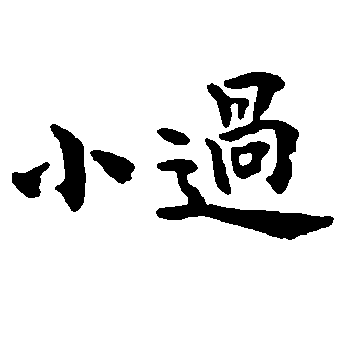 |
62. Hsiao Kuo / Preponderance of the Small
|
 |
While in the hexagram Ta Kuo, PREPONDERANCE OF THE GREAT (28), the strong lines preponderate and are within, inclosed between weak lines at the top and bottom, the present hexagram has weak lines preponderating, though here again they are on the outside, the strong lines being within.
- This indeed is the basis of the exceptional situation indicated by the hexagram.
When strong lines are outside, we have the hexagram I, PROVIDING NOURISHMENT (27), Or Chung Fu, INNER TRUTH (61); neither represents an exceptional state.
- When strong elements within preponderate, they necessarily enforce their will.
- This creates struggle and exceptional conditions in general.
If a man occupies a position of authority for which he is by nature really inadequate, extraordinary prudence is necessary.
- PREPONDERANCE OF THE SMALL. Success.
- Perseverance furthers.
- Small things may be done; great things should not be done.
- The flying bird brings the message:
- It is not well to strive upward,
- It is well to remain below.
- Great good fortune.
Exceptional modesty and conscientiousness are sure to be rewarded with success;
- However, if a man is not to throw himself away, it is important that they should not become empty form and subservience but be combined always with a correct dignity in personal behavior.
We must understand the demands of the time in order to find the necessary offset for its deficiencies and damages.
- In any event we must not count on great success, since the requisite strength is lacking.
- In this lies the importance of the message that one should not strive after lofty things but hold to lowly things.
- The structure of the hexagram gives rise to the idea that this message is brought by a bird.
In Ta Kuo, PREPONDERANCE OF THE GREAT (28), the four strong, heavy lines within, supported only by two weak lines without, give the image of a sagging ridgepole.
- Here the supporting weak lines are both outside and preponderant; this gives the image of a soaring bird.
- But a bird should not try to surpass itself and fly into the sun;
- It should descend to the earth, where its nest is.
- In this way it gives the message conveyed by the hexagram.
- Thunder on the mountain:
- The image of PREPONDERANCE OF THE SMALL.
- Thus in his conduct the superior man gives preponderance to reverence.
- In bereavement he gives preponderance to grief.
- In his expenditures he gives preponderance to thrift.
Thunder on the mountain is different from thunder on the plain.
- In the mountains, thunder seems much nearer;
- Outside the mountains, it is less audible than the thunder of an ordinary storm
Thus the superior man derives an imperative from this image:
- He must always fix his eyes more closely and more directly on duty than does the ordinary man, even though this might make his behavior seem petty to the outside world.
- He is exceptionally conscientious in his actions.
- In bereavement emotion means more to him than ceremoniousness.
- In all his personal expenditures he is extremely simple and unpretentious.
- In comparison with the man of the masses, all this makes him stand out as exceptional.
- But the essential significance of his attitude lies in the fact that in external matters he is on the side of the lowly.
Six at the beginning means:
- The bird meets with misfortune through flying.
A bird ought to remain in the nest until it is fledged.
- If it tries to fly before this, it invites misfortune.
- Extraordinary measures should be resorted to only when all else fails.
- At first we ought to put up with traditional ways as long as possible; otherwise we exhaust ourselves and our energy and still achieve nothing.
six in the second place means:
- She passes by her ancestor
- And meets her ancestress.
- He does not reach his prince
- And meets the official.
- No blame.
Two exceptional situations are instanced here.
- In the temple of ancestors, where alternation of generations prevails, the grandson stands on the same side as the grandfather.
- Hence his closest relations are with the grandfather.
The present line designates the grandson’s wife, who during the sacrifice passes by the ancestor and goes toward the ancestress.
- This unusual behavior is, however, an expression of her modesty.
- She ventures rather to approach the ancestress, for she feels related to her by their common sex.
- Hence here deviation from the rule is not a mistake.
Another image is that of the official who, in compliance with regulation, first seeks an audience with his prince.
- If he is not successful in this, he does not try to force anything but goes about conscientious fulfillment of his duty, taking his place among the other officials.
- This extraordinary restraint is likewise not a mistake in exceptional times.
- (The rule is that every official should first have an audience with the prince by whom he is appointed. Here the appointment is made by the minister.)
Nine in the third place means:
- If one is not extremely careful,
- Somebody may come up from behind and strike him.
- Misfortune.
At certain times extraordinary caution is absolutely necessary.
- But it is just in such life situations that we find upright and strong personalities who, conscious of being in the right, disdain to hold themselves on guard, because they consider it petty.
- Instead, they go their way proud and unconcerned.
- But this self-confidence deludes them.
There are dangers lurking for which they are unprepared.
- Yet such danger is not unavoidable;
- One can escape it if he understands that the time demands that he pay especial attention to small and insignificant things.
Nine in the fourth place means:
- No blame. He meets him without passing by.
- Going brings danger. One must be on guard.
- Do not act. Be constantly persevering.
1
1 See Book II, pp.360 f.
Hardness of character is tempered by yielding position,1 so that no mistakes are made.
- The situation here calls for extreme caution; one must make no attempt of one’s own initiative to reach the desired end.
- And if one were to go on, endeavoring to force his way to the goal, he would be endangered.
- Therefore one must be on guard and not act but continue inwardly to persevere.
Six in the fifth place means:
- Dense clouds,
- No rain from our western territory.
- The prince shoots and hits him who is in the cave.
As a high place is pictured here, the image of a flying bird has become that of flying clouds.
- But dense as the clouds are, they race across the sky and give no rain.
Similarly, in exceptional times there may be a born ruler who is qualified to set the world in order, but who cannot achieve anything or confer blessing on the people because he stands alone and has no helpers.
- In such times a man must seek out helpers with whose aid he can carry out the task.
- But these helpers must be modestly sought out in the retirement to which they have withdrawn.
- It is not their fame nor their great names but their genuine achievements that are important.
- Through such modesty the right man is found, and the exceptional task is carried out in spite of all difficulties.
Six at the top means:
- He passes him by, not meeting him.
- The flying bird leaves him.
- Misfortune.
- This means bad luck and injury.
If one overshoots the goal, one cannot hit it.
- If a bird will not come to its nest but flies higher and higher, it eventually falls into the hunter’s net.
- He who in times of extraordinary salience of small things does not know how to call a halt, but restlessly seeks to press on and on, draws upon himself misfortune at the hands of gods and men, because he deviates from the order of nature.
 |
63. Chi Chi / After Completion
|
 |
This hexagram is the evolution of Tai, PEACE (11).
- The transition from confusion to order is completed, and everything is in its proper place even in particulars.
- The strong lines are in the strong places, the weak lines in the weak places.
This is a very favorable outlook, yet it gives reason for thought.
- For it is just when perfect equilibrium has been reached that any movement may cause order to revert to disorder.
- The one strong line that has moved to the top, thus effecting complete order in details, is followed by the other lines, each moving according to its nature, and thus suddenly there arises again the hexagram P’i, STANDSTILL (12).
Hence the present hexagram indicates the conditions of a time of climax, which necessitate the utmost caution.
- AFTER COMPLETION. Success in small matters.
- Perseverance furthers.
- At the beginning good fortune,
- At the end disorder.
The transition from the old to the new time is already accomplished.
- In principle, everything stands systematized, and it is only in regard to details that success is still to be achieved.
In respect to this, however, we must be careful to maintain the right attitude.
- Everything proceeds as if of its own accord, and this can all too easily tempt us to relax and let things take their course without troubling over details.
- Such indifference is the root of all evil.
- Symptoms of decay are bound to be the result.
Here we have the rule indicating the usual course of history.
- But this rule is not an inescapable law.
- He who understands it is in position to avoid its effects by dint of unremitting perseverance and caution.
- Water over fire: the image of the condition
- In AFTER COMPLETION.
- Thus the superior man
- Takes thought of misfortune
- And arms himself against it in advance.
When water in a kettle hangs over fire, the two elements stand in relation and thus generate energy (cf. the production of steam).
- But the resulting tension demands caution.
- If the water boils over, the fire is extinguished and its energy is lost.
- If the heat is too great, the water evaporates into the air.
These elements here brought into relation and thus generating energy are by nature hostile to each other.
- Only the most extreme caution can prevent damage.
In life too there are junctures when all forces are in balance and work in harmony, so that everything seems to be in the best of order.
- In such times only the sage recognizes the moments that bode danger and knows how to banish it by means of timely precautions.
Nine at the beginning means:
- He brakes his wheels.
- He gets his tail in the water.
- No blame.
In times following a great transition, everything is pressing forward, striving in the direction of development and progress.
- But this pressing forward at the beginning is not good; it overshoots the mark and leads with certainty to loss and collapse.
- Therefore a man of strong character does not allow himself to be infected by the general intoxication but checks his course in time.
He may indeed not remain altogether untouched by the disastrous consequences of the general pressure, but he is hit only from behind like a fox that, having crossed the water, at the last minute gets its tail wet.
- He will not suffer any real harm, because his behavior has been correct.
Six in the second place means:
- The woman loses the curtain of her carriage.
- Do not run after it;
- On the seventh day you will get it.
When a woman drove out in her carriage, she had a curtain that hid her from the glances of the curious.
- It was regarded as a breach of propriety to drive on if this curtain was lost.
Applied to public life, this means that a man who wants to achieve something is not receiving that confidence of the authorities which he needs, so to speak, for his personal protection.
- Especially in times “after completion” it may happen that those who have come to power grow arrogant and conceited and no longer trouble themselves about fostering new talent.
This as a rule results in office seeking.
- If a man’s superiors withhold their trust from him, he will seek ways and means of getting it and of drawing attention to himself.
We are warned against such an unworthy procedure: “Do not seek it.”
- Do not throw yourself away on the world, but wait tranquilly and develop your personal worth by your own efforts.
- Times change. When the six stages of the hexagram have passed, the new era dawns.
- That which is a man’s own cannot be permanently lost.
- It comes to him of its own accord. He need only be able to wait.
Nine in the third place means:
- The Illustrious Ancestor
- Disciplines the Devil’s Country.
- After three years he conquers it.
- Inferior people must not be employed.
1
1 Wu Ting reigned from 1324 to 1266 B.C.
“Illustrious Ancestor” is the dynastic title of the Emperor Wu Ting of the Yin dynasty.1
- After putting his realm in order with a strong hand, he waged long colonial wars for the subjection of the Huns who occupied the northern borderland with constant threat of incursions.
The situation described is as follows.
- After times of completion, when a new power has arisen and everything within the country has been set in order, a period of colonial expansion almost inevitably follows.
- Then as a rule long-drawn-out struggles must be reckoned with.
For this reason, a correct colonial policy is especially important.
- The territory won at such bitter cost must not be regarded as an almshouse for people who in one way or another have made themselves impossible at home, but who are thought to be quite good enough for the colonies.
- Such a policy ruins at the outset any chance of success.
This holds true in small as well as in large matters, because it is not only rising states that carry on a colonial policy; the urge to expand, with its accompanying dangers, is part and parcel of every ambitious undertaking.
Six in the fourth place means:
- The finest clothes turn to rags.
- Be careful all day long.
In a time of flowering culture, an occasional convulsion is bound to occur, uncovering a hidden evil within society and at first causing a great sensation.
- But since the situation is favorable on the whole, such evils can easily be glossed over and concealed from the public.
- Then everything is forgotten and peace apparently reigns complacently once more.
- However, to the thoughtful man such occurrences are grave omens that he does not neglect.
- This is the only way of averting evil consequences.
Nine in the fifth place means:
- The neighbor in the east who slaughters an ox
- Does not attain as much real happiness
- As the neighbor in the west
- With his small offering.
Religious attitudes are likewise influenced by the spiritual atmosphere prevailing in times after completion.
- In divine worship the simple old forms are replaced by an ever more elaborate ritual and an ever greater outward display.
- But inner seriousness is lacking in this show of magnificence; human caprice takes the place of conscientious obedience to the divine will.
However, while man sees what is before his eyes, God looks into the heart.
- Therefore a simple sacrifice offered with real piety holds a greater blessing than an impressive service without warmth.
Six at the top means:
- He gets his head in the water. Danger.
Here in conclusion another warning is added.
- After crossing a stream, a man’s head can get into the water only if he is so imprudent as to turn back.
- As long as he goes forward and does not look back, he escapes this danger.
But there is a fascination in standing still and looking back on a peril overcome.
- However, such vain self-admiration brings misfortune.
- It leads only to danger, and unless one finally resolves to go forward without pausing, one falls a victim to this danger.
 |
64. Wei Chi / Before Completion
|
 |
1
1 See Book II, p. 362.
The change is indeed prepared for, since all the lines in the upper trigram are in relation to those in the lower.1
- However, they are not yet in their places.
- While the preceding hexagram offers an analogy to autumn, which forms the transition from summer to winter, this hexagram presents a parallel to spring, which leads out of winter’s stagnation into the fruitful time of summer.
- With this hopeful outlook the Book of Changes comes to its close.
- BEFORE COMPLETION. Success.
- But if the little fox, after nearly completing the crossing,
- Gets his tail in the water,
- There is nothing that would further.
The conditions are difficult.
- The task is great and full of responsibility.
- It is nothing less than that of leading the world out of confusion back to order.
But it is a task that promises success, because there is a goal that can unite the forces now tending in different directions.
- At first, however, one must move warily, like an old fox walking over ice.
- The caution of a fox walking over ice is proverbial in China.
- His ears are constantly alert to the cracking of the ice, as he carefully and circumspectly searches out the safest spots.
A young fox who as yet has not acquired this caution goes ahead boldly, and it may happen that he falls in and gets his tail wet when he is almost across the water.
- Then of course his effort has been all in vain.
- Accordingly, in times “before completion,” deliberation and caution are the prerequisites of success.
- Fire over water:
- The image of the condition before transition.
- Thus the superior man is careful
- In the differentiation of things,
- So that each finds its place.
When fire, which by nature flames upward, is above, and water, which flows downward, is below, their effects take opposite directions and remain unrelated.
- If we wish to achieve an effect, we must first investigate the nature of the forces in question and ascertain their proper place.
- If we can bring these forces to bear in the right place, they will have the desired effect, and completion will be achieved.
- But in order to handle external forces properly, we must above all arrive at the correct standpoint ourselves, for only from this vantage can we work correctly.
Six at the beginning means:
2
2 Note how this situation differs from that in the first line of the preceding hexagram.
- He gets his tail in the water.
- Humiliating.
In times of disorder there is a temptation to advance oneself as rapidly as possible in order to accomplish something tangible.
- But this enthusiasm leads only to failure and humiliation if the time for achievement has not yet arrived.
- In such a time it is wise to spare ourselves the opprobrium of failure by holding back.2
Nine in the second place means:
- He brakes his wheels.
- Perseverance brings good fortune.
Here again the time to act has not yet come.
- But the patience needed is not that of idle waiting without thought of the morrow.
- Kept up indefinitely, this would not lead to any success.
- Instead, an individual must develop in himself the strength that will enable him to go forward.
He must have a vehicle, as it were, to effect the crossing.
- But he must for the time being use the brakes.
- Patience in the highest sense means putting brakes on strength.
- Therefore he must not fall asleep and lose sight of the goal.
- If he remains strong and steadfast in his resolve, all goes well in the end.
Six in the third place means:
- Before completion, attack brings misfortune.
- It furthers one to cross the great water.
The time of transition has arrived, but one lacks the strength to complete the transition.
- If one should attempt to force it, disaster would result, because collapse would then be unavoidable.
- What is to be done? A new situation must be created; one must engage the energies of able helpers and in this fellowship take the decisive step — cross the great water.
- Then completion will become possible.
Nine in the fourth place means:
- Perseverance brings good fortune.
- Remorse disappears.
- Shock, thus to discipline the Devil’s Country.
- For three years, great realms are awarded.
Now it is the time of struggle.
- The transition must be completed.
- We must make ourselves strong in resolution; this brings good fortune.
- All misgivings that might arise in such grave times of struggle must be silenced.
It is a question of a fierce battle to break and to discipline the Devil’s Country, the forces of decadence.
- But the struggle also has its reward.
- Now is the time to lay the foundations of power and mastery for the future.
Six in the fifth place means:
- Perseverance brings good fortune.
- No remorse.
- The light of the superior man is true.
- Good fortune.
The victory has been won.
- The power of steadfastness has not been routed.
- Everything has gone well.
- All misgivings have been overcome.
- Success has justified the deed.
The light of a superior personality shines forth anew and makes its influence felt among men who have faith in it and rally around it.
- The new time has arrived, and with it good fortune.
- And just as the sun shines forth in redoubled beauty after rain, or as a forest grows more freshly green from charred ruins after a fire, so the new era appears all the more glorious by contrast with the misery of the old.
Nine at the top means:
- There is drinking of wine.
- In genuine confidence. No blame.
- But if one wets his head,
- He loses it, in truth.
Before completion, at the dawning of the new time, friends foregather in an atmosphere of mutual trust, and the time of waiting is passed in conviviality.
- Since the new era is hard on the threshold, there is no blame in this.
- But one must be careful in all this to keep within proper bounds.
- If in his exuberance a man gets drunk, he forfeits the favorableness of the situation through his intemperance.
NOTE. The hexagram AFTER COMPLETION represents a gradual transition from a time of ascent past a peak of culture to a time of standstill.
- The hexagram BEFORE COMPLETION represents a transition from chaos to order.
This hexagram comes at the end of the Book of Changes.
- It points to the fact that every end contains a new beginning.
- Thus it gives hope to men.
The Book of Changes is a book of the future.
Book II | Coming Soon wih version 4
Book III | Coming Soon with version 5